

Key Takeaways
Start here
Why Maintenance Is Your Responsibility Now
Core skills
The Checks Every Driver Should Do Regularly
Next step
Scheduled Maintenance: Following the Intervals
Stay alert
Warning Signs You Should Never Ignore
Long game
Building Habits That Protect Your Car Long-Term
Why Maintenance Is Your Responsibility Now
When someone else owned your car — or when you were still on a parent's policy and driving the family vehicle — maintenance decisions happened in the background. As a new driver with your own vehicle, that changes immediately. The responsibility for keeping the car safe and operational shifts entirely to you.
That doesn't mean you need to become a mechanic. It means you need a working understanding of what your car requires, how often, and what to do when something seems off. Most routine checks take five minutes and require no tools. The ones that do require a shop visit are much easier to handle when you catch problems early.
For a broader picture of what ownership involves financially and practically, see our car ownership guidance. And if you're in the first weeks of owning a vehicle, what new car owners should do in the first 90 days is a useful companion read.
The Checks Every Driver Should Do Regularly
Several checks don't follow a mileage interval — they're simply good habits to build into your routine.
PSI
Pounds per square inch — the unit used to measure tire inflation pressure. Your vehicle's recommended PSI is listed on the door jamb sticker, not the tire sidewall.
Dipstick
A long, thin metal rod in the engine bay used to measure oil level. You pull it out, wipe it, reinsert it, and check where the oil line falls relative to the marked range.
Tread depth
The depth of the grooves on a tire's surface. Worn tread reduces grip, especially in wet conditions. Most tires should be replaced when tread depth reaches 2/32 of an inch.
Coolant
A liquid that circulates through the engine to prevent overheating. It's usually stored in a translucent plastic reservoir and should be checked when the engine is cold.
Scheduled maintenance interval
A manufacturer-specified mileage or time period after which a particular service — like an oil change or tire rotation — should be performed to keep the vehicle in proper condition.
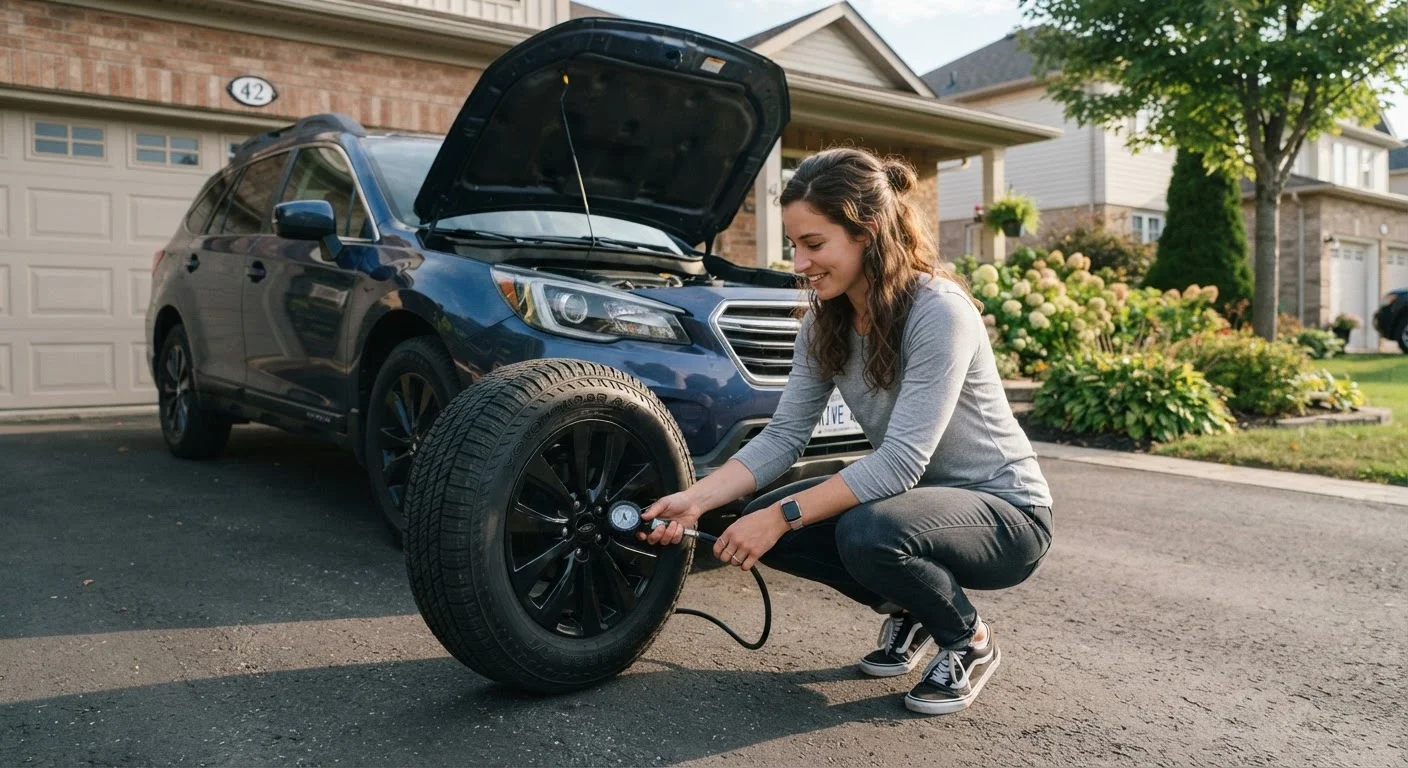
- Tire pressure: Check monthly and before long trips. The correct pressure (measured in PSI — pounds per square inch) is on a sticker inside the driver's door jamb. Underinflated tires wear unevenly, reduce fuel efficiency, and handle poorly in wet conditions. For a complete guide to tire health, see tire care from the ground up.
- Engine oil level: Pull the dipstick (usually a brightly colored loop under the hood), wipe it clean, reinsert it fully, and pull it again. The oil should fall between the two markers. Low oil is serious — don't let it run dry.
- Lights: Walk around the car periodically and confirm that headlights, taillights, brake lights, and turn signals are all working. A burned-out brake light is both a safety hazard and a ticketable offense in most states.
- Windshield and wipers: Cracked glass and degraded wiper blades impair visibility. Wiper blades typically need replacing every six to twelve months depending on use and climate.
Getting comfortable under the hood helps here. A plain-English map of what everything does can make that first look far less intimidating.
Scheduled Maintenance: Following the Intervals
Beyond weekly or monthly checks, your vehicle has a manufacturer-prescribed maintenance schedule. This covers services that need to happen at specific mileage or time intervals — whichever comes first.
Your Owner's Manual Is the Real Authority
Generic maintenance advice — including mileage rules repeated across the internet — doesn't account for your specific engine, oil type, or driving conditions. Your owner's manual is written for your exact vehicle and should be your first reference for any interval question. Most manuals are also available as free PDF downloads from the manufacturer's website if you've misplaced the physical copy.
- Oil and filter changes: Modern vehicles typically call for this every 5,000 to 10,000 miles, depending on oil type and engine. Your owner's manual has the exact figure — the old 3,000-mile rule is outdated for most cars on the road today.
- Tire rotation: Usually recommended every 5,000 to 7,500 miles. This evens out tread wear so all four tires last equally long.
- Air filter: Typically replaced every 15,000 to 30,000 miles. A clogged air filter reduces engine efficiency.
- Brake inspection: Brakes should be inspected at least annually or whenever you notice squealing, grinding, or a spongy pedal feel. Brake work should always be done by a qualified mechanic.
- Coolant flush and spark plugs: These are longer-interval services — often 30,000 miles or more — but skipping them has real consequences for reliability.
Generic timelines are a starting point, not a rulebook. Your owner's manual holds manufacturer-specific intervals that no general guide can replicate. It's worth reading — or at least bookmarking the maintenance section.
Warning Signs You Should Never Ignore
Your car communicates problems before they become critical — if you know what to look for.
- Dashboard warning lights: Red lights signal stop-and-investigate situations. Amber or yellow lights typically mean get it checked soon. Never assume a warning light will resolve itself.
- Unusual sounds: Grinding when braking, a clicking on turns, a knocking from the engine, or a rattling underneath the car are all signals that something needs attention.
- Handling changes: If the car pulls to one side, vibrates at highway speed, or the steering feels loose, tires or suspension components are likely involved.
- Fluid spots where you park: A puddle or stain under the car can indicate an oil, coolant, or brake fluid leak. Brake fluid loss in particular is a safety issue requiring immediate attention.
Brake Issues Are Always Urgent
Any symptom involving brakes — grinding noises, a soft or spongy pedal, the car pulling hard to one side when stopping, or a brake warning light — should be treated as a priority. Brakes are a primary safety system and brake repair is not a task for beginners. Get the vehicle to a qualified mechanic promptly if any of these signs appear.
If you're unsure whether a symptom is urgent, err on the side of getting it checked. A diagnostic visit costs far less than the repair that follows from ignoring an early warning. The trade-off between DIY investigation and a shop visit is worth understanding — see DIY car maintenance vs. taking it to a shop for a clear breakdown.
Building Habits That Protect Your Car Long-Term
Consistent maintenance compounds over time. A car that's been looked after from the start is more reliable, holds its value better, and avoids the expensive repairs that come from neglect.
A few practical habits make a significant difference:
- Keep a simple maintenance log — a notebook or phone note tracking what was done and when. This matters for warranty claims and if you ever sell the vehicle. Keeping a maintenance log explains why this is worth doing from day one.
- Adjust your checks seasonally. Hot summers and cold winters affect tires, batteries, and fluids differently. Seasonal car maintenance gives a practical checklist for temperature extremes.
- Don't let common myths guide your decisions. Maintenance myths that could actually hurt your car covers several widely repeated beliefs that can lead new drivers astray.
Maintenance isn't a chore reserved for experienced drivers. Building these habits early means fewer surprises, lower costs over time, and a vehicle that stays safe and roadworthy for as long as you own it.