

Key Takeaways
Why Tires Are Your Car's Most Critical Safety Component
Every safety system in your car — the brakes, the steering, the stability control — ultimately delivers its effect through four palm-sized contact patches where rubber meets road. Those patches are your tires. When they're in good shape, everything works as designed. When they're not, no amount of modern technology fully compensates.
Tire neglect is also surprisingly common. Many drivers only think about tires when one goes flat or a warning light appears. A more proactive habit pays dividends in both safety and cost. Whether you're a new driver or a seasoned one, the basics of tire care are straightforward and don't require any special tools beyond a simple gauge.
For a broader look at vehicle readiness across the seasons, see our seasonal maintenance guide — tires are a recurring item on that checklist for good reason.
Tire Pressure: The Number That Changes Everything
Tire pressure affects fuel economy, handling, braking distance, and how evenly a tire wears. An underinflated tire flexes more than it should, generating excess heat — a leading cause of tire failure on highways. An overinflated tire reduces the contact patch, making your car skittish and more vulnerable to damage from road hazards.
The correct pressure for your vehicle is printed on a sticker inside the driver's door jamb — not on the tire sidewall, which shows the maximum allowed pressure, a different number. Check pressure when tires are cold (the car has been parked for at least three hours or driven fewer than a mile). Readings taken after driving will run higher due to heat expansion and give you a misleading figure.
Always check tire pressure before a long road trip, not when you've just arrived somewhere — hot tires give inflated readings that can cause you to bleed off pressure you actually need.
Heat from driving raises tire pressure temporarily; checking cold tires gives the accurate baseline your vehicle manufacturer intended.
Keep a digital tire pressure gauge in your glove box rather than relying on gas station air pumps, which are often poorly calibrated.
An accurate personal gauge takes the guesswork out of pressure checks and costs only a few dollars — a worthwhile investment given how much tire pressure affects safety and fuel efficiency.
Pressure drops roughly 1 PSI for every 10°F drop in outside temperature, so tires that were fine in October may be underinflated by December. Make a habit of checking when seasons change.
Most late-model vehicles have a Tire Pressure Monitoring System (TPMS) that alerts you when pressure drops significantly, but it's not a substitute for manual checks — TPMS warnings typically trigger only when a tire is already 25% below its recommended pressure.
Tread Depth: How to Know When You're Running Out of Grip
Tread channels water away from the contact patch. As tread wears down, wet-weather stopping distances increase substantially. The legal minimum tread depth in most U.S. states is 2/32 of an inch, but many safety experts suggest considering replacement at 4/32 inch, particularly if you drive in rain or snow regularly.
The classic quick-check method: insert a penny into a tread groove with Lincoln's head pointing down. If you can see the top of Lincoln's head, the tread is at or below 2/32 inch — replacement is overdue. A quarter works for the 4/32 threshold: if you can see the top of Washington's head, you're getting close.
Don't Rely Solely on TPMS Alerts
The Tire Pressure Monitoring System is a helpful backup, but it only alerts you once pressure has already dropped well below the safe threshold. By the time the light comes on, the tire may have been underinflated long enough to cause wear or heat damage. Manual monthly checks remain the most reliable habit.
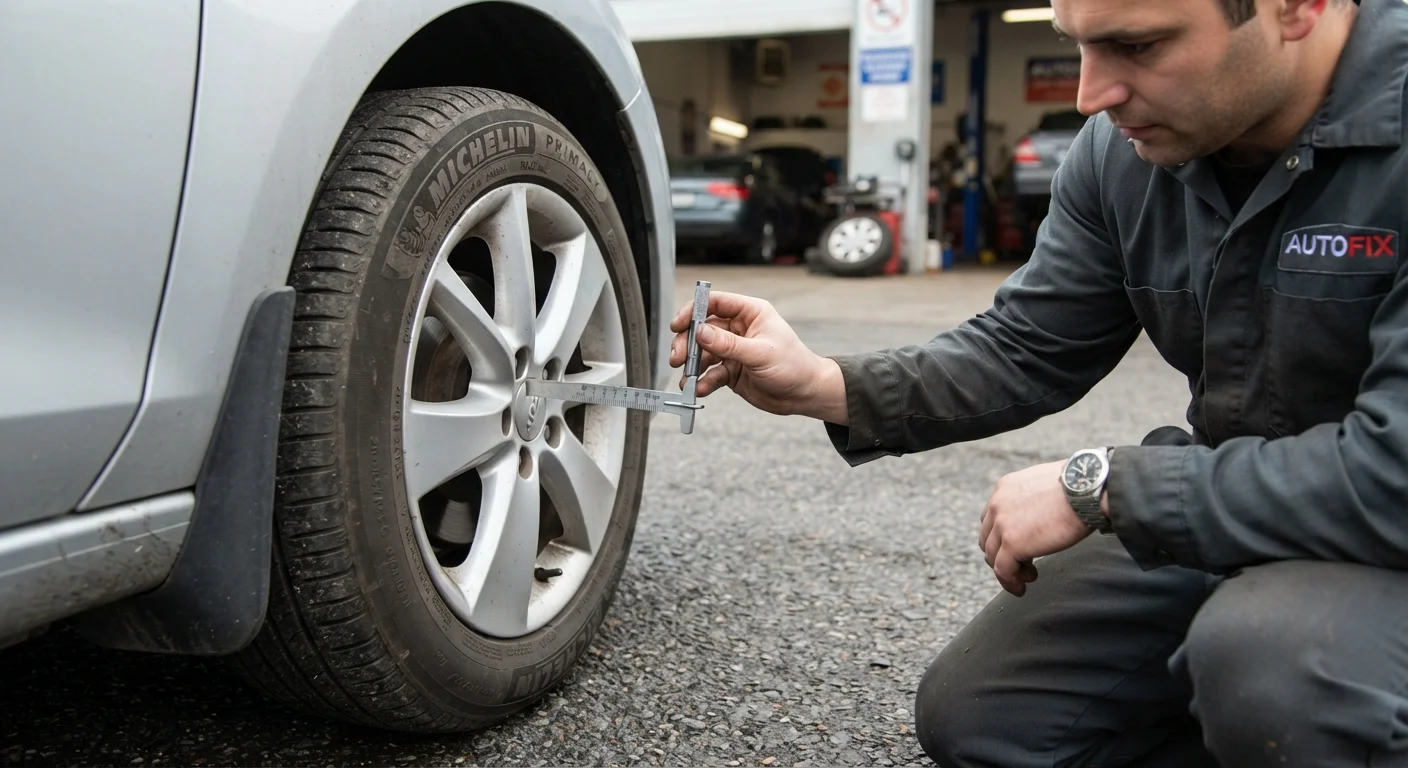
For a more accurate reading, inexpensive tread depth gauges are available at most auto parts stores and take only seconds to use. Check multiple grooves across the tire width, as wear is often uneven.
Uneven wear patterns are also informative. Wear concentrated in the center suggests the tire has been chronically overinflated. Wear on both outer edges points to chronic underinflation. Edge wear on just one side often indicates an alignment issue. If you notice these patterns, consult a mechanic — alignment and pressure problems accelerate tire wear significantly. Drivers dealing with an unexpected skid caused by poor traction can also refer to our guide on handling a vehicle skid for what to do in the moment.
Rotation Schedules: Making Your Tires Last
Front and rear tires wear at different rates. On front-wheel-drive vehicles, the front tires handle both steering and power delivery, so they wear faster. Rotating tires — moving them to different positions on the vehicle — evens out this wear and extends the usable life of the full set.
A common recommendation is to rotate every 5,000–7,500 miles, which often aligns with oil change intervals, making it easy to combine the two. Your owner's manual will specify the recommended interval and the correct rotation pattern for your drivetrain. If you haven't consulted your manual recently, our article on reading your owner's manual explains how to get the most out of it.
Note that some vehicles with different-sized front and rear tires, or directional tires, have limited rotation options — a shop can advise on what's possible for your specific setup.
When Replacement Can't Wait
Beyond tread depth, several conditions call for immediate replacement regardless of how much tread remains:
- Sidewall bulges or bubbles: These indicate internal structural damage. A bulging tire can fail without warning at highway speed.
- Deep cuts or punctures in the sidewall: Sidewalls cannot be safely patched. Tread-area punctures may be repairable, but sidewall damage means replacement.
- Persistent slow leaks: If a tire repeatedly needs air, something is wrong — a nail, a faulty valve stem, or a damaged bead seal. Don't ignore it.
- Visible cords or fabric: If you can see the internal structure through worn or damaged rubber, the tire is unsafe to drive on.
- Age: Rubber degrades over time even with low mileage. Many manufacturers recommend inspecting tires after five years and considering replacement after ten, regardless of appearance. Check the sidewall for the DOT code — the last four digits indicate the week and year of manufacture (e.g., 2319 means the 23rd week of 2019).
Skipping replacement when these signs appear is one of the maintenance decisions that can quietly turn into a major — and costly — problem. See our piece on the hidden costs of skipping routine maintenance for perspective on how deferred care adds up.
High-Mileage Vehicles Need Extra Attention
Older vehicles may have tires that are aging even if they haven't covered many miles. If you drive a high-mileage car or one that sits for extended periods, pay extra attention to the manufacture date on your tires. For broader guidance on keeping an aging vehicle reliable, see our article on keeping a high-mileage car reliable.