

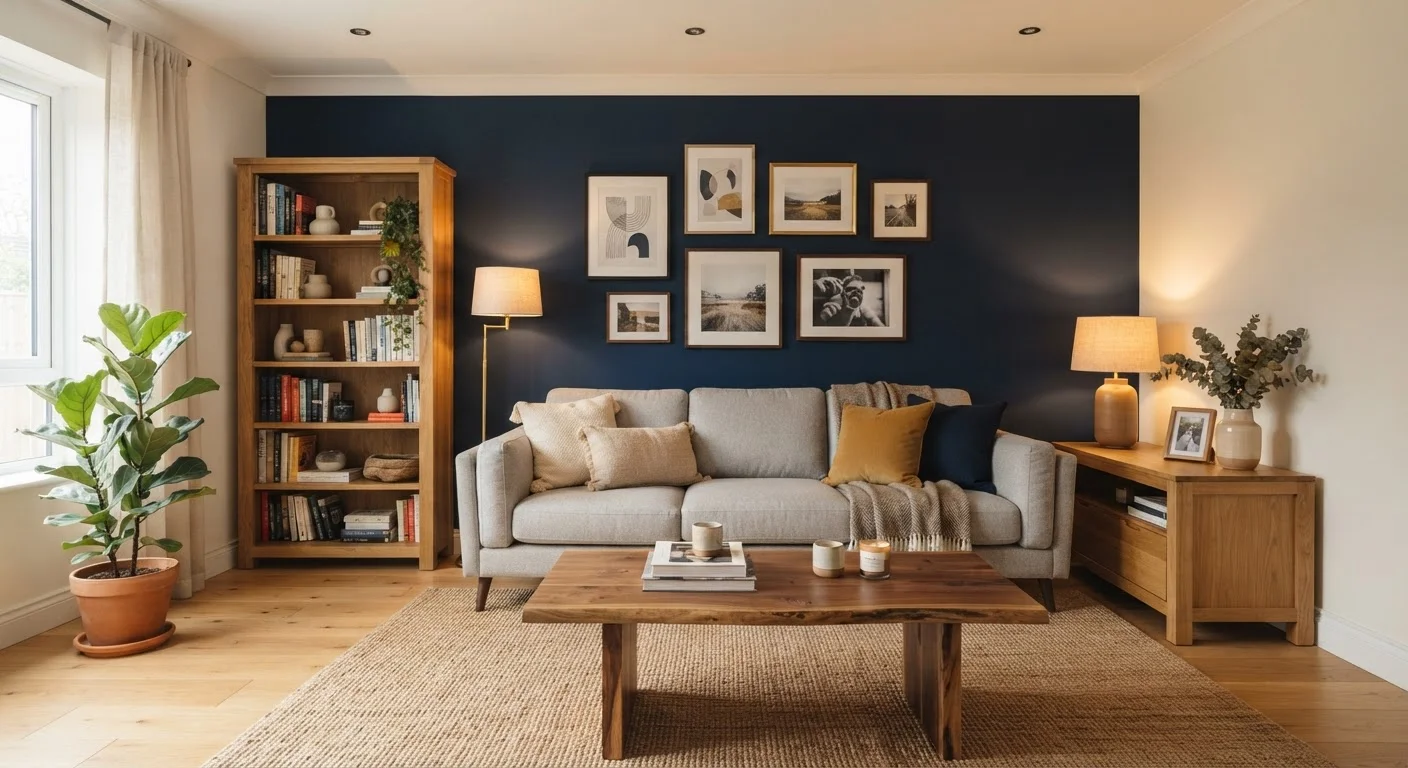
Key Takeaways
Creates a clear focal point in the room
A single treated wall directs the eye and gives a room a sense of intentional composition — particularly useful when furniture placement already defines a natural center.
Introduces bold color without full commitment
Painting one wall lets you experiment with a deeper or more saturated shade than you'd risk on all four walls, making it easier to reverse if the effect doesn't land.
Can correct awkward proportions visually
A darker or patterned wall on the short end of a long, narrow room draws the eye inward, making the space feel more balanced without any structural changes.
Adds depth through texture and material contrast
Wood paneling, limewash, or wallpaper on a single wall introduces tactile variation that a uniformly painted room can't achieve, elevating the overall sense of finish.
Cost-effective way to refresh a tired space
Treating one wall is faster and uses significantly less material than a full-room repaint, making it an accessible update for homeowners working within a modest decorating budget.
Can shrink a small room visually
Dark or heavily patterned feature walls advance toward the viewer, making an already tight space feel more enclosed. Small rooms often need the opposite effect.
Random placement looks unplanned, not stylish
An accent wall placed on a wall with no natural focal point — no fireplace, no furniture anchor, no architectural detail — reads as indecisive rather than intentional.
Clashes when disconnected from the room's palette
A feature wall color that doesn't echo anything else in the room — furniture, rugs, textiles — creates visual friction instead of cohesion.
Can date a room quickly when trend-driven
Accent walls tied to a specific trend cycle (a particular paint hue or pattern popular in a given year) can feel dated faster than neutral, considered choices.
Wallpaper removal adds future renovation effort
While peel-and-stick options have improved, traditional wallpapered accent walls can be time-consuming and costly to remove if tastes or ownership change.
Our Verdict
Accent walls are a genuine decorating tool — not a gimmick — when used with intention. They reward rooms that already have a strong focal point, a cohesive color story, and walls with clean proportions. Applied randomly or without regard for the room's existing elements, they tend to fragment rather than elevate.
Homeowners who want to add visual interest to a room with a clear focal point — such as a fireplace wall, a bedroom headboard wall, or a dining room feature — without committing to a full repaint.
What an Accent Wall Is Actually Supposed to Do
An accent wall — one surface treated differently from the rest of a room through paint, wallpaper, paneling, tile, or texture — is designed to create a focal point. The idea is directional: it guides the eye toward the most intentional part of a room, much like a frame draws attention to a painting.
The concept isn't new. Designers have long used feature walls to add depth, define zones in open-plan spaces, and introduce bold color without the commitment of painting an entire room. Done well, an accent wall makes a room feel composed and considered. Done poorly, it reads as an afterthought — a random burst of color on the first wall someone painted.
Understanding the difference comes down to placement, proportion, and how well the treatment connects to everything else in the room. See how interior designers build depth across a whole room for the broader context in which accent walls play a role.
When Accent Walls Genuinely Work
The strongest accent walls share a few consistent traits.
Creates a clear focal point in the room
A single treated wall directs the eye and gives a room a sense of intentional composition — particularly useful when furniture placement already defines a natural center.
Introduces bold color without full commitment
Painting one wall lets you experiment with a deeper or more saturated shade than you'd risk on all four walls, making it easier to reverse if the effect doesn't land.
Can correct awkward proportions visually
A darker or patterned wall on the short end of a long, narrow room draws the eye inward, making the space feel more balanced without any structural changes.
Adds depth through texture and material contrast
Wood paneling, limewash, or wallpaper on a single wall introduces tactile variation that a uniformly painted room can't achieve, elevating the overall sense of finish.
Cost-effective way to refresh a tired space
Treating one wall is faster and uses significantly less material than a full-room repaint, making it an accessible update for homeowners working within a modest decorating budget.
Walls that back a bed, frame a fireplace, or sit behind a dining table are natural candidates — the furniture arrangement already signals that this is the room's focal point. The accent wall simply reinforces it. A bold or textured treatment on any other wall in those same rooms would feel arbitrary by comparison.
Accent walls also perform well in narrow or long rooms where one wall is considerably larger than the others. Treating the short end wall with a deeper color or a pattern draws the eye inward and makes the room feel more proportional. Similarly, color and visual techniques can reshape how a room reads without any structural changes.
When Accent Walls Backfire
The execution falls apart in predictable ways — and recognizing them in advance saves a lot of repainting.
Can shrink a small room visually
Dark or heavily patterned feature walls advance toward the viewer, making an already tight space feel more enclosed. Small rooms often need the opposite effect.
Random placement looks unplanned, not stylish
An accent wall placed on a wall with no natural focal point — no fireplace, no furniture anchor, no architectural detail — reads as indecisive rather than intentional.
Clashes when disconnected from the room's palette
A feature wall color that doesn't echo anything else in the room — furniture, rugs, textiles — creates visual friction instead of cohesion.
Can date a room quickly when trend-driven
Accent walls tied to a specific trend cycle (a particular paint hue or pattern popular in a given year) can feel dated faster than neutral, considered choices.
Wallpaper removal adds future renovation effort
While peel-and-stick options have improved, traditional wallpapered accent walls can be time-consuming and costly to remove if tastes or ownership change.
One of the most common mistakes is choosing a wall based on convenience rather than logic — painting the wall you can see from the front door, for instance, when nothing in the room draws the eye there naturally. Another is selecting a color that has no relationship to the rest of the room's palette, creating a jarring contrast that reads as disconnected rather than dramatic.
It's also worth noting that not every room needs an accent wall. A space that's already rich in texture, pattern, and layered materials may not benefit from a feature wall at all — adding one risks visual noise rather than clarity.
Choosing the Right Treatment
Paint is the most accessible option, but it's far from the only one. Each material brings different strengths.
- Paint: Easiest to change, lowest cost, wide color range. Works in virtually every room but requires precise color selection.
- Wallpaper: Adds pattern and visual texture that paint can't replicate. Modern peel-and-stick versions lower the commitment level considerably.
- Wood paneling or shiplap: Introduces warmth and dimension. Suits living rooms, bedrooms, and home offices particularly well.
- Tile: Reserved mostly for kitchens and bathrooms, where it also adds a functional layer of protection alongside aesthetics.
- Limewash or plaster finishes: Create depth through texture variation rather than a flat coat, softening the boundary between accent and field walls.
How to Test Before You Commit
Before painting or applying wallpaper to an entire wall, apply a large sample swatch — at least 12 by 12 inches — directly on the wall and observe it at different times of day. Natural light in the morning and artificial light in the evening can shift a color significantly. Living with the sample for two to three days gives a more honest read than a small chip card ever will.
When selecting a paint color, pull from a tone already present in your existing furniture, rugs, or artwork. A color that appears in the room's accessories will feel anchored rather than imported. If no color in the room offers a natural lead, that's often a sign to reconsider whether an accent wall is the right move at all.
Common Misconceptions Worth Dropping
A few assumptions tend to lead homeowners astray when planning an accent wall.
"Darker always means more dramatic." Not necessarily. A wall finished in deep charcoal in a room with low ceilings and limited natural light will feel oppressive, not sophisticated. Drama comes from contrast and proportion, not shade alone.
"Any wall works as long as the color is right." Wall selection matters as much as color choice. The decorating rules that seem fixed are often more flexible than assumed — but wall placement is one area where spatial logic really does apply.
"Accent walls are outdated." Like most design elements, they cycle in and out of trend cycles. What determines longevity isn't trend status — it's whether the wall serves a genuine purpose in the room's composition. A thoughtfully placed accent wall tied to well-hung art and correct proportions looks current in any decade.