

| Fatal crash rate at night vs. day | Approximately 3× higher per mile driven (National Safety Council) |
| Low-beam headlight range | Roughly 160–200 feet (General engineering standard) |
| High-beam headlight range | Roughly 350–500 feet (General engineering standard) |
| Required high-beam switch-off distance | Within 500 feet of oncoming traffic (most states) (Varies by state law) |
| Peak fatigue window | 2–6 a.m. and mid-afternoon (National Sleep Foundation guidance) |
| Stopping distance at 60 mph (dry road) | Approximately 180–200 feet (General driver education reference) |
Why Nighttime Driving Carries Higher Risk
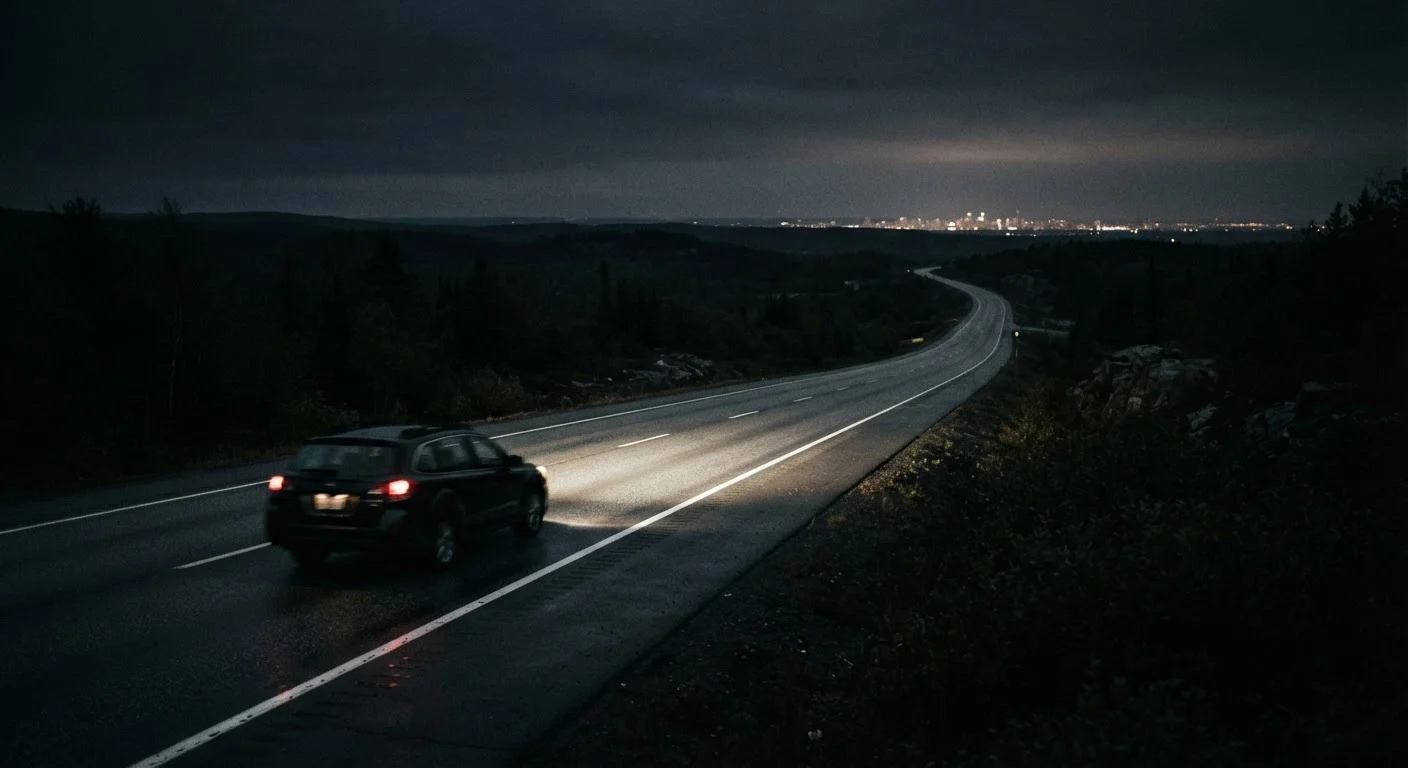
Fatal crash rates are disproportionately high after dark. According to the National Safety Council, traffic death rates per mile driven are roughly three times higher at night than during the day. The reasons are interconnected: reduced visibility limits how far ahead you can see, oncoming headlights create glare that temporarily impairs vision, and fatigue — which naturally increases in the evening — slows reaction time.
These factors compound each other. A drowsy driver dealing with glare on an unlit rural road faces a very different risk profile than the same driver on a bright, well-marked urban street at noon. Understanding each factor individually helps you manage the combination more effectively.
Routine habits that dull alertness can be harder to detect at night, when reduced sensory input already limits your situational awareness.
| Fatal crash rate at night vs. day | Approximately 3× higher per mile driven (National Safety Council) |
| Low-beam headlight range | Roughly 160–200 feet (General engineering standard) |
| High-beam headlight range | Roughly 350–500 feet (General engineering standard) |
| Required high-beam switch-off distance | Within 500 feet of oncoming traffic (most states) (Varies by state law) |
| Peak fatigue window | 2–6 a.m. and mid-afternoon (National Sleep Foundation guidance) |
| Stopping distance at 60 mph (dry road) | Approximately 180–200 feet (General driver education reference) |
Visibility: What You Can and Can't See
Standard low-beam headlights illuminate roughly 160–200 feet ahead. At 60 mph, your vehicle covers that distance in about two seconds — leaving very little margin if a hazard appears at the edge of your light range. This is sometimes called overdriving your headlights: traveling fast enough that stopping distance exceeds what your lights reveal.
High beams extend visibility to approximately 350–500 feet, but must be switched off when an oncoming vehicle is within 500 feet or when following another vehicle closely, per most state laws. Use them on dark, unlit roads when no other traffic is present.
Peripheral vision and depth perception also degrade in low light. Pedestrians and cyclists — especially those not wearing reflective gear — can be nearly invisible until they're dangerously close. Scanning intersections deliberately, rather than relying on peripheral cues, compensates partially for this limitation. See our guide to safer intersection habits for specific techniques.
Overdriving your headlights
Traveling at a speed where your stopping distance exceeds the distance your headlights illuminate. At that speed, you would not have enough room to stop if a hazard appeared at the edge of your light.
Glare recovery time
The time your eyes need to readjust to normal darkness after exposure to bright oncoming lights. This can last several seconds, during which your effective vision is reduced.
High beams
The brighter, longer-range headlight setting used on unlit roads. They must be switched to low beams when approaching or following other vehicles, as required by most state traffic laws.
Peripheral vision degradation
In low-light conditions, the eye's ability to detect objects outside the direct line of sight diminishes, making hazards at the edges of your field of view harder to notice.
Following distance
The space maintained between your vehicle and the one ahead, typically measured in seconds. At night or in poor conditions, extending beyond the standard three-second rule is generally advisable.
Glare, Fatigue, and Speed Adjustments
Glare management: When facing oncoming high beams, shift your gaze to the right edge of your lane rather than looking directly at the light source. Your lane markings remain visible, and you avoid the temporary blind spot that direct glare creates. Dirty or scratched windshields dramatically worsen glare — a clean windshield is a practical safety measure, not just cosmetic upkeep. Check your car maintenance basics to keep wipers and glass in good condition.
Fatigue awareness: Drowsiness peaks in the early-morning hours (roughly 2–6 a.m.) and again in mid-afternoon. Night driving frequently overlaps with the first window. Signs of fatigue include lane drifting, missing exits, and difficulty focusing. Common drowsy driving myths — like the idea that cracking a window or turning up music keeps you alert — are worth understanding before you find yourself in that situation.
Speed and following distance: Reducing speed at night gives you more time to react to hazards at the edge of your headlight range. Increasing following distance beyond the standard three-second rule is also advisable, since brake lights alone may not give you enough warning. The risks of following too closely apply around the clock but become more pronounced in low visibility.
Vehicle Readiness for Night Driving
Your vehicle's condition has a direct impact on nighttime safety. Headlights that are yellowed, misaligned, or simply aging produce significantly less usable light than properly maintained ones. Tail lights and brake lights that are dim or burned out make your vehicle less visible to drivers behind you. A pre-trip readiness check should always include confirming all exterior lights are functional.
Dashboard warning lights related to electrical systems can sometimes indicate issues that affect lighting. If you're unsure what a warning light means, decoding your warning lights is a useful reference before any drive, especially a long one at night.
Mirrors adjusted correctly before driving — including the rearview and both side mirrors — reduce blind spot risk that becomes harder to manage when visibility is already limited. Make adjustments before you start moving, not while underway.
New and Teen Drivers Face Added Risk at Night
Inexperienced drivers are statistically at higher risk during nighttime hours. Many graduated licensing programs restrict unsupervised night driving for this reason. If you're a parent of a new driver, reviewing what the early months of independent driving look like can help set realistic expectations and appropriate boundaries.