

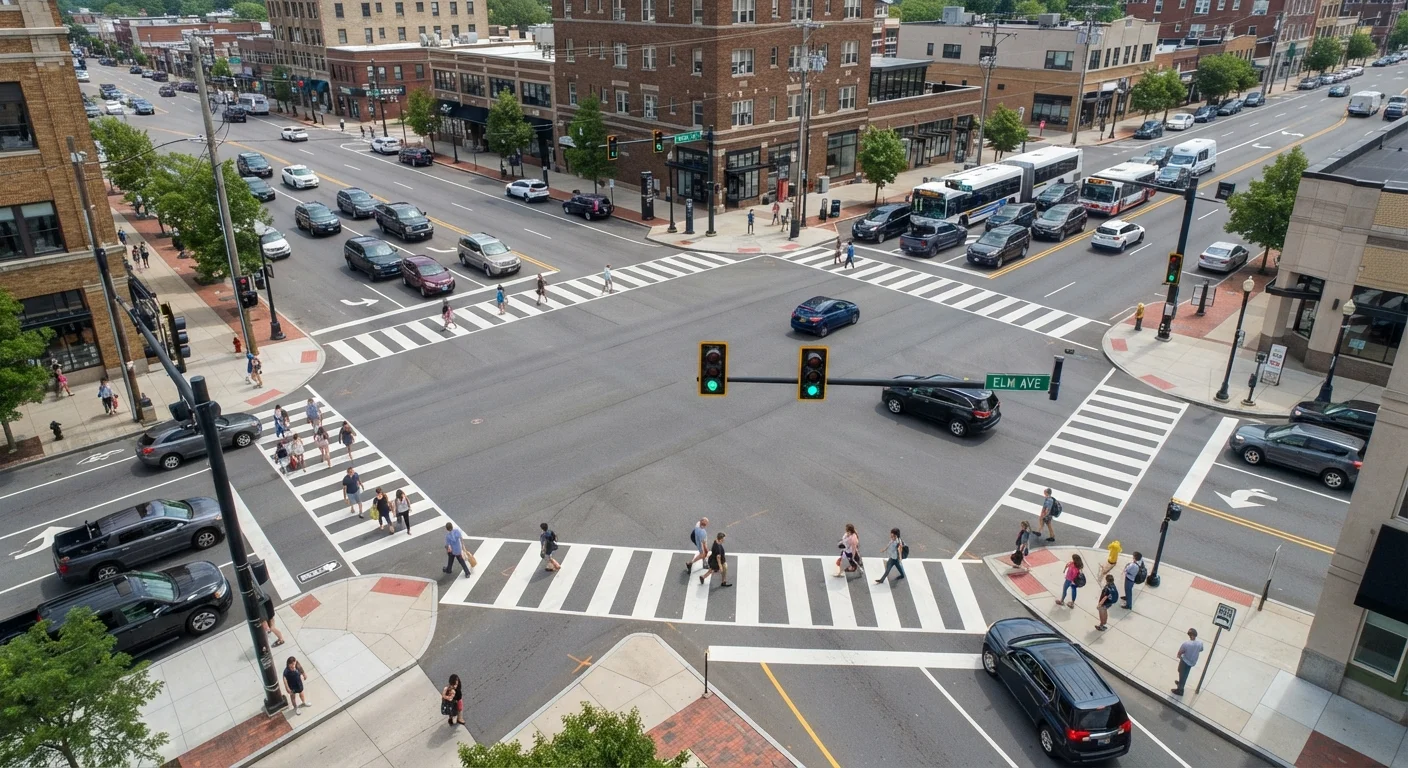
Key Takeaways
Why Intersections Demand Extra Attention
Intersections are where traffic flows from multiple directions converge, creating the highest density of conflict points on any road. According to the Federal Highway Administration, roughly 40 percent of all traffic crashes in the U.S. occur at or near intersections. The reasons are straightforward: drivers are making simultaneous decisions about speed, right-of-way, and lane position while other road users are doing the same — often with different assumptions.
What makes intersections especially tricky is the mix of variables: signal timing, turning vehicles, pedestrians stepping off curbs, cyclists crossing lanes, and drivers who may be running late or distracted. Urban intersections add congestion; rural ones often lack clear sight lines. Neither is inherently safe without deliberate attention. For a broader look at how city driving differs from highway travel, see our guide to highway vs. city driving skills.
Begin slowing well before the intersection, not just at the stop line.
Approaching more slowly gives you additional seconds to read the situation — signal phase, cross-traffic behavior, pedestrian presence — before you're committed to a decision. Drivers who brake late tend to make rushed, less accurate judgments.
Check both ways twice before proceeding, even on a green light.
A green signal gives you the legal right of way, but it doesn't guarantee the intersection is clear. Red-light runners and distracted drivers don't always stop. A second scan takes less than two seconds and can prevent a T-bone collision.
Actively scan for cyclists and pedestrians before every turn.
Right and left turns place vehicles directly across pedestrian crosswalks and bike lanes. These road users are easy to miss when attention is on oncoming traffic alone. They're also the most likely to be seriously injured in a collision.
Understand your vehicle's blind spots before navigating complex intersections.
Pillars, mirrors, and vehicle height all create areas your eyes simply can't cover from the driver's seat. At intersections, a cyclist or pedestrian in a blind spot is invisible until the last moment. Our blind spot guide explains where to look.
Never assume another driver will yield when they're supposed to.
Right-of-way rules describe what should happen, not what always does. Assuming compliance puts you at the mercy of every other driver's attention level. Building in personal confirmation — even a brief pause — protects you regardless of what the other driver does.
Eliminate in-cabin distractions before reaching the intersection.
Adjusting the radio, looking at a navigation screen, or glancing at a phone at the wrong moment can cost you the situational awareness you need most. Intersection decisions happen in under three seconds; divided attention during that window is genuinely dangerous.
Core Habits That Lower Your Risk
The practices below aren't complicated, but they do require consistent application. The goal is to replace automatic, habit-driven behavior with deliberate, situation-aware choices every time you approach a crossing.
It's also worth reading about habits that quietly erode driver awareness — many of the same patterns that dull general attentiveness are especially costly at intersections.
Conditions That Raise the Stakes
Certain situations reliably increase intersection risk, and recognizing them prompts you to apply extra caution proactively rather than reactively.
- Low-visibility conditions: Rain, fog, glare, and darkness all reduce how far you can see and how quickly others can see you. Our night driving reference guide covers the specific factors that make nighttime intersections harder to navigate safely.
- Unfamiliar intersections: When you don't know the signal timing, lane markings, or turning patterns, give yourself more buffer time and speed.
- High-pedestrian areas: School zones, downtown corridors, and areas near transit stops require you to actively scan for pedestrians — especially children, who can enter a crosswalk unpredictably.
- Distraction: Even a glance at your phone changes your perception of a situation that can shift in under a second. For practical strategies, see our phone-free driving guide.
Right-of-way confusion is also a consistent factor in intersection crashes. If you're uncertain about who goes first in a given scenario, our guide to right-of-way and traffic rules clears up the most common misunderstandings.
This article provides general driver education and is not a substitute for formal driver training or official traffic regulations in your state.