

Key Takeaways
Tailgating
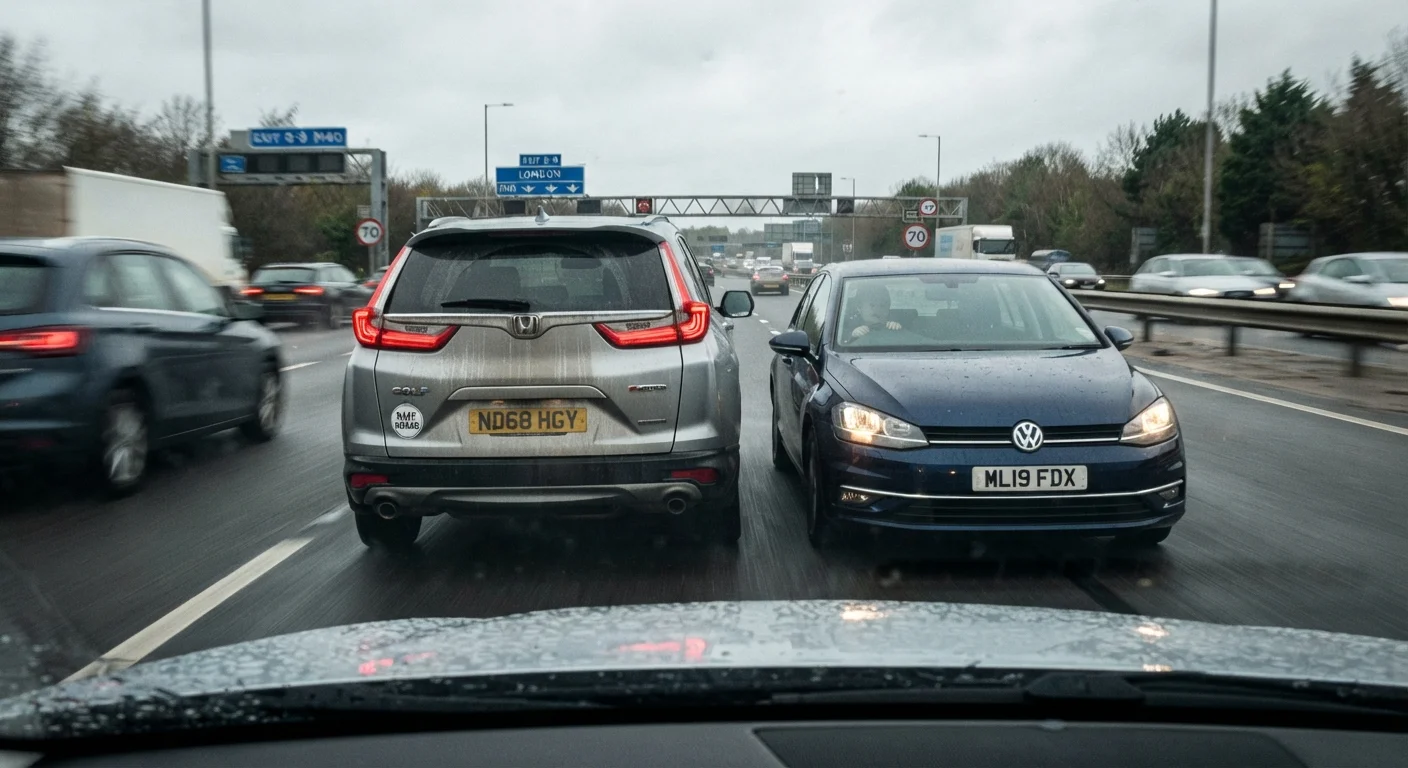
Tailgating means following another vehicle more closely than is safe given your speed, road conditions, and reaction time. It leaves you with too little distance to stop if the car ahead brakes suddenly. Most driving safety guidelines recommend maintaining at least a three-second gap between your vehicle and the one in front.
The 'three-second rule' is a minimum baseline. At higher speeds, in poor weather, or when driving larger vehicles, four or more seconds of following distance is generally advised.
The Physics That Make Tailgating So Risky
Most drivers believe they're in full control right up until the moment something goes wrong. With tailgating, the problem isn't reflexes — it's physics. At 60 mph, your vehicle covers approximately 88 feet every single second. Before your foot even reaches the brake pedal, reaction time — typically between 1.0 and 1.5 seconds for an alert driver — has already allowed your car to travel well over 100 feet.
Then comes actual braking distance, which depends on your speed, tire condition, road surface, and vehicle weight. Add both together and you get total stopping distance — a figure that shocks most people when they see it mapped out. Understanding stopping distances in concrete terms is one of the most useful things a driver can do to recalibrate their sense of safe spacing.
When you follow the car ahead by one or two car lengths at highway speed, you have essentially eliminated your stopping margin. Any gap shorter than the total stopping distance means a collision is unavoidable once braking begins.
~88 ft/sec
Distance covered per second at 60 mph
This figure illustrates how rapidly space disappears at highway speed before a driver can even initiate braking.
1.0–1.5 sec
Typical driver reaction time
Traffic safety research consistently places alert driver reaction time in this range — and fatigue or distraction pushes it higher.
~29%
Of all U.S. crashes that are rear-end collisions
According to the National Highway Traffic Safety Administration, rear-end crashes are consistently among the most frequent crash types on American roads.
Why Drivers Underestimate the Risk
Tailgating is common in part because it doesn't feel dangerous in the moment. Speed perception degrades on open roads and familiar routes, and the brain is poor at calculating relative distances at highway velocities. Drivers also tend to overestimate their own reaction speed — a well-documented bias in driving research.
Fatigue compounds the problem significantly. A tired driver can have a reaction time that's measurably slower, reducing whatever small margin they thought they had. Habits that quietly erode driver awareness — including overconfidence on familiar roads — can gradually normalize dangerously short following gaps without the driver ever noticing the drift.
External pressure plays a role too. Drivers sometimes tailgate because they feel rushed, frustrated with slower traffic ahead, or are responding to social cues from other drivers. None of these factors change the underlying physics.
“Drivers consistently overestimate their ability to react in time. The gap that feels safe is rarely as large as it appears, especially at speed.”
— National Highway Traffic Safety Administration, U.S. federal road safety agency
Conditions That Make Tailgating Even More Dangerous
Following distance that feels adequate in dry, daylight conditions becomes dangerously inadequate in rain, fog, darkness, or on gravel. Wet pavement can increase stopping distances by 50% or more depending on speed and tire tread depth. Ice can multiply that figure several times over.
Vehicle load matters as well. A fully loaded SUV or a pickup truck carrying cargo requires considerably more stopping distance than an empty compact car — a fact that many drivers don't account for when setting their following gap. Night driving factors such as reduced visibility and slower hazard recognition mean the three-second rule should be treated as a floor, not a target, after dark.
Intersections present a related challenge. Drivers who habitually follow closely often bring that same habit through intersections, where cross-traffic hazards demand even more situational awareness. Building safer habits around intersections covers this risk in more detail.
Practical Ways to Maintain a Safe Following Distance
The three-second rule is the most widely recommended starting point: pick a fixed roadside object, and count the seconds from when the vehicle ahead passes it until your front bumper reaches the same point. If you count less than three seconds, you're too close.
A few habits support consistent following distance. First, resist the urge to fill gaps when other drivers merge in front of you — simply ease off the accelerator slightly and rebuild your buffer. Second, give yourself an extra second of gap for each adverse condition present: rain, heavy traffic, fatigue, or an unfamiliar road. Third, treat the three-second rule as a minimum — not a precision target you're always trying to hit exactly.
Following distance rules are frequently misunderstood, along with speed limits and right-of-way. Reviewing what the guidelines actually say — rather than relying on habit — is a straightforward way to reduce your risk without any additional effort behind the wheel.
This article is for general informational purposes only. Always follow the traffic laws applicable in your state and consult official driving resources for jurisdiction-specific requirements.