

Key Takeaways
Why Weather Changes the Physics of Driving
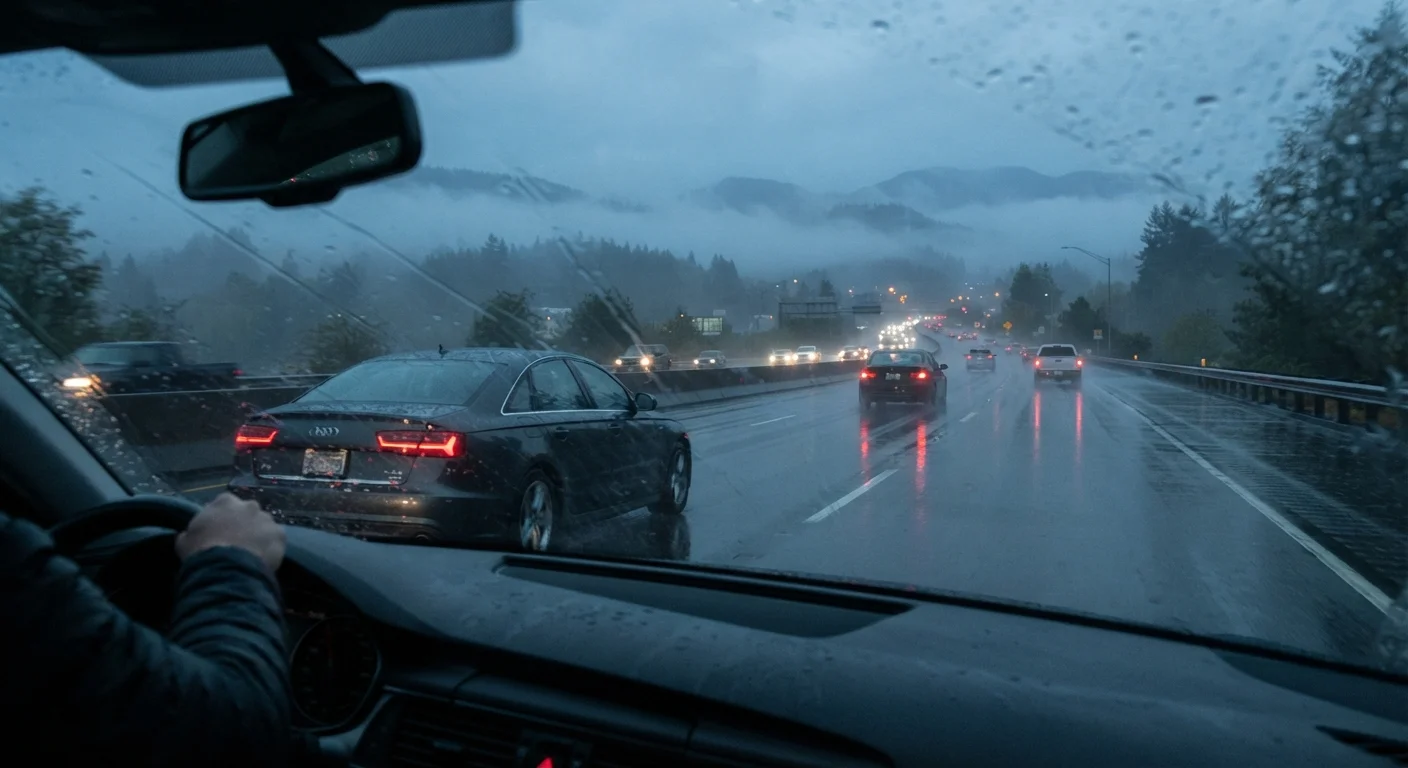
Most drivers know bad weather calls for slower speeds. What fewer appreciate is why — and that different conditions change vehicle physics in fundamentally different ways. Rain reduces friction between tire and road. Snow compresses unpredictably underfoot. Ice eliminates grip almost entirely. Fog removes the visual information drivers use to judge distance and speed. Each scenario demands a distinct set of adjustments, not just a lighter foot on the gas.
Understanding the mechanics behind traction loss, stopping distance, and visibility degradation helps you make better decisions in real time. The skills overlap with those covered in our guide on highway versus city driving, but adverse weather adds another layer of complexity that requires deliberate habit changes.
21%
U.S. crashes linked to weather conditions
According to the U.S. Department of Transportation Federal Highway Administration, roughly 21% of vehicle crashes annually are weather-related.
2x
Wet-road stopping distance vs. dry
Wet pavement can roughly double stopping distances compared to dry conditions, depending on speed and tire condition.
35 mph
Speed at which hydroplaning can begin
Hydroplaning can start at speeds as low as 35 mph when tires are worn and standing water is present on the road surface.
Driving in Rain: Hydroplaning and Wet Braking
When rain falls on a road, water fills microscopic gaps in the asphalt. If your tires can't displace that water fast enough — through their tread channels — a thin film builds between rubber and pavement. This is hydroplaning: your tires are riding on water, not road, and steering and braking inputs have little effect.
Hydroplaning risk increases with speed, standing water depth, and reduced tread depth. Tires with 2/32" of tread remaining (the legal minimum in most states) displace far less water than new tires. Even moderate rain can create pooling in road depressions.
- Reduce speed gradually before entering standing water — sudden braking on a wet surface extends your stopping distance significantly.
- Avoid cruise control in rain. If you hydroplane, the system may accelerate to maintain speed, worsening the situation.
- Follow existing tire tracks when possible — the vehicles ahead have already displaced some water from those lanes.
- Increase following distance to at least 4–5 seconds. Wet braking distances can be double those on dry pavement.
If your vehicle begins to hydroplane, ease off the accelerator smoothly and steer gently in the direction you want to go. Do not brake hard or jerk the wheel.
Before driving in heavy rain, lightly press your brakes a couple of times at low speed to clear surface water from your rotors and get a feel for your stopping response.
Wet brake rotors can temporarily reduce braking effectiveness. A brief, gentle application at low speed helps restore normal response before you need hard braking.
On icy roads, try to stay in the tracks left by larger vehicles ahead — their weight compresses ice and creates slightly more textured contact points for your tires.
Following established tracks doesn't eliminate ice risk, but it can provide marginally more grip than driving on undisturbed, glassy ice surfaces.
Driving in Snow: Traction, Momentum, and Patience
Snow driving is largely a momentum management exercise. Packed snow offers some grip, but that grip disappears the moment you ask too much of it — through hard braking, sharp turns, or aggressive acceleration. All-wheel drive (AWD) helps you move in snow but does not help you stop any faster. This is a common misconception that leads AWD drivers to follow too closely or enter curves too fast.
Key adjustments for snowy roads:
- Accelerate slowly. Spinning wheels on snow reduces traction further. Apply the gas gently to avoid wheel spin.
- Brake early and progressively. Even with antilock brakes (ABS), stopping distances increase dramatically on packed snow.
- Increase following distance to 8–10 seconds — roughly triple the dry-road standard.
- Know your hills. Momentum carries you up; gravity and ice carry you down. Approach descents in a lower gear and brake before the slope, not during.
Winter tires (sometimes called snow tires) use a different rubber compound that stays pliable in cold temperatures, providing measurably better grip than all-season tires below about 45°F. They're a meaningful safety upgrade in areas with consistent winter conditions. See our seasonal car maintenance checklist for what to inspect before winter arrives.
Driving on Ice: The Most Unforgiving Surface
Ice — especially black ice, the thin, nearly transparent glaze that forms on bridges, overpasses, and shaded road sections — can reduce tire grip to a fraction of what even wet pavement offers. It forms at or just below freezing (32°F) when moisture on the road surface refreezes, often after temperatures drop at night or in shaded areas.
Posted speed limits reflect dry-road assumptions. On ice, those speeds are often completely unsafe. If roads are icy, the only genuinely effective adjustment is a major speed reduction — often to 20–25 mph or less on affected sections.
Don't Trust AWD or 4WD to Stop You
All-wheel drive and four-wheel drive systems improve traction during acceleration, but they provide no advantage when braking on ice. Drivers of AWD vehicles frequently follow too closely in winter conditions, assuming their vehicle can stop faster — it cannot. Maintain the same or greater following distances as any other vehicle on icy roads.
- Steer and brake gently. Any abrupt input can break traction. If you have ABS, apply steady brake pressure and let the system modulate. Without ABS, use light, pumping pressure.
- Watch for surface changes. Bridges and overpasses freeze before road surfaces because cold air circulates beneath them.
- If you begin to skid, ease off the accelerator, look where you want to go, and steer that direction. For more detail, our article on handling a vehicle skid covers the correct response step by step.
Driving in Fog: Visibility and the Speed Disconnect
Fog creates a dangerous disconnect: the inside of your car feels normal, but your ability to see — and be seen — is severely degraded. Dense fog can reduce visibility to under 100 feet, meaning a vehicle traveling at 55 mph covers that distance in about 1.2 seconds. The moment you see a hazard may already be too late to avoid it at highway speed.
Key fog driving rules:
- Use low beams, not high beams. High beams reflect off fog particles and back into your eyes, reducing visibility further. Many vehicles have dedicated fog lights positioned lower on the bumper — use them if equipped.
- Slow down significantly. Your speed should allow you to stop completely within the distance you can see ahead.
- Use your defroster and wipers to prevent interior condensation from adding to the visibility problem.
- Pull off safely if visibility becomes too poor. Turn off your running lights (so following drivers don't drift toward them thinking you're moving) and activate hazard lights instead.
Fog often appears suddenly when descending into valleys or approaching bodies of water. This pairs well with the broader awareness habits discussed in our guide on night driving considerations, where reduced visibility is a shared theme.
Vehicle Preparation Before Bad Weather Arrives
No driving habit compensates for a mechanically unready vehicle. Tires are the foundation of weather safety — tread depth, inflation pressure, and rubber compound all affect how your vehicle responds in rain, snow, and ice. Check tread depth with a quarter: if you can see the top of Washington's head, you have less than 4/32" remaining and should consider replacement.
Beyond tires, a few targeted checks matter most before winter or storm season:
- Windshield wipers: Streaking or skipping blades reduce visibility in rain and snow. Replace them annually or at the first sign of degradation.
- Brake condition: Worn brake pads or low brake fluid extend stopping distances on every surface. See our guide to car fluids for what to check.
- Defrost and HVAC systems: A malfunctioning defroster is a visibility hazard in cold, wet weather.
- Battery: Cold temperatures reduce battery capacity. A battery showing signs of weakness in fall may fail entirely in a January cold snap.
For a full pre-season walkthrough, the seasonal maintenance guide covers fluids, battery, tires, and more in detail.
This article is for general informational purposes only. Driving conditions vary widely — always exercise your own judgment, observe posted signs and local advisories, and consult a qualified mechanic for vehicle-specific maintenance decisions.