

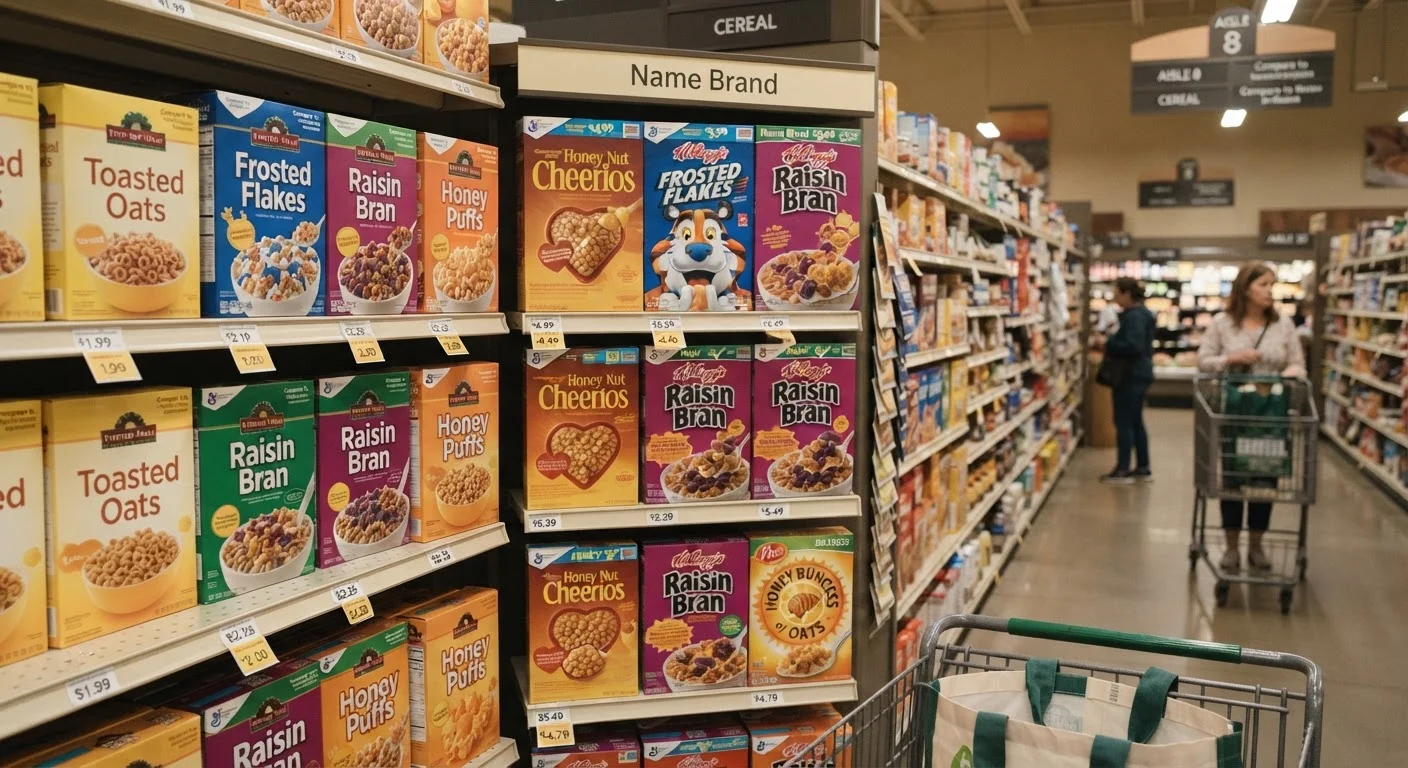
Key Takeaways
Option A
Store Brands (Private Label)
The retailer-owned, value-forward alternative.
Best for: Budget-conscious shoppers who want comparable quality without paying for national advertising.
Option B
Name Brands (National Brands)
The established, heavily marketed household names.
Best for: Shoppers who prioritize proven consistency, specific formulations, or category-specific performance.
If you're stocking everyday pantry staples like canned goods, flour, or pasta
Store Brands (Private Label)
Ingredients and nutritional profiles are typically identical to name brands, and the savings add up significantly over a monthly grocery run.
If you're purchasing over-the-counter medications or supplements
Store Brands (Private Label)
FDA regulations require generic OTC drugs to contain the same active ingredients at the same dosages as brand-name equivalents — making store brands a reliable choice.
If consistent performance matters in a specialized product, like a specific skincare formula
Name Brands (National Brands)
Proprietary formulations, clinically tested ingredients, and established track records can justify the higher price in categories where results are harder to replicate.
If you need tools, appliances, or products that rely on manufacturer warranties and support
Name Brands (National Brands)
National brands often provide more robust warranty coverage and customer service infrastructure, which adds real value for durable goods.
If you're comparison shopping across multiple factors, not just price
Store Brands (Private Label)
In most commodity categories, store brands deliver equivalent quality at a lower unit price — making them the stronger value by almost any measure.
The Manufacturing Reality Most Shoppers Don't Know
Walk down any grocery aisle and you'll see national brands and store brands sitting side by side, often with dramatically different price tags. What many shoppers don't realize is that a significant portion of store-brand products are produced by the same manufacturers that make name brand goods — sometimes on the same production line, in the same facility, with nearly identical formulations.
Retailers contract directly with major manufacturers to produce private-label versions of products. The difference isn't always in what's inside — it's often in the packaging, the marketing budget baked into the price, and the shelf placement. This is especially common in categories like canned vegetables, dairy, cereals, and household cleaners.
That said, "made in the same factory" doesn't automatically mean "identical product." Recipes, ingredients, and quality controls can vary. The smart move is to compare ingredient lists and nutrition labels directly rather than assuming equivalence — or assuming a gap. For a structured approach to evaluating products across multiple factors beyond price, see our comparison shopping guide.
| Criterion | Store Brands | Name Brands |
|---|---|---|
| Typical price difference | 20–30% lower on average | Higher — includes ad spend |
| OTC medication equivalence | FDA-mandated same active ingredients | Same active ingredients |
| Proprietary formulations | Rare — generic recipes common | Common in specialty categories |
| Warranty & support | Often limited or retailer-only | Typically more robust |
| Manufacturing source | Often same facilities as name brands | Manufacturer-controlled facilities |
| Label transparency | Ingredient lists usually clear | Ingredient lists usually clear |
| Best category fit | Staples, OTC, cleaning, paper goods | Specialty, durables, tested formulas |
Where Store Brands Win on Value
Store brands have the clearest advantage in commodity and staple categories — products where the underlying ingredients are standardized and performance variation is minimal. Canned tomatoes, dried pasta, milk, eggs, basic cleaning sprays, and paper goods are examples where national brand premiums reflect advertising spend far more than product quality.
Over-the-counter (OTC) medications are one of the strongest arguments for store brands. The U.S. Food and Drug Administration requires that generic OTC drugs contain the same active ingredients in the same concentrations as their name brand counterparts. A store-brand pain reliever containing 500mg of acetaminophen is pharmacologically equivalent to the name brand version at the same dosage.
~20–30%
Average store brand price savings
Consumer research consistently finds private-label products priced 20–30% below national brand equivalents across major grocery categories.
~1 in 5
Grocery items that are store brand
Private-label products account for roughly one in five items sold in U.S. grocery stores, reflecting growing consumer acceptance.
Identical
Active ingredients in generic OTC drugs
The FDA requires OTC generic drugs to contain the same active ingredient, strength, and dosage form as the brand-name version.
For staple grocery purchases, the savings compound quickly. Choosing store brands consistently across a typical household shopping list can meaningfully reduce monthly food costs without a noticeable change in meal quality. As explored in our article on when cheaper doesn't mean saving money, the key is distinguishing genuine value from just a lower sticker price.
Where Name Brands Justify the Premium
Not every category favors the store brand. Name brands hold a real edge when proprietary formulations, long-term reliability, or manufacturer support matter.
Specialty skincare and haircare products often rely on patented ingredient combinations developed through clinical testing. A store-brand moisturizer may use similar base ingredients but differ in concentrations, delivery mechanisms, or additional compounds — differences that may not be visible on a label but can affect results.
Durable goods — appliances, tools, electronics — present another case for name brands. National manufacturers typically back their products with more comprehensive warranty programs and established customer support channels. As our buying once vs. buying cheap analysis explains, the total cost of ownership over a product's lifetime often matters more than the purchase price alone.
Flavor and texture preferences are also legitimate factors in food categories like snack foods, condiments, or specialty cheeses, where national brands have refined their formulas over decades and consumers develop genuine brand loyalty based on consistent taste profiles.
How to Decide Category by Category
The most practical framework isn't "always buy store brand" or "always stick with the name." It's a category-by-category evaluation using a few straightforward criteria.
- Compare active ingredients or nutritional panels directly, not brand names. If they match, quality is likely comparable.
- Calculate unit price (price per ounce, per count, per sq ft) rather than total package price. Store brands sometimes package differently to obscure cost differences.
- Check return and warranty terms. For higher-stakes purchases, a name brand's service infrastructure can be worth the cost difference.
- Try before you commit to bulk. Buy a single store-brand version before purchasing in quantity, especially for food, cleaning products, or personal care items.
- Look for quality signals beyond branding. Third-party certifications, ingredient sourcing transparency, and standardized testing results are more reliable indicators than label design.
For a deeper breakdown of which specific categories tend to favor generics versus name brands, see our brand name vs. generic category guide. The goal is making informed decisions — not reflexively defaulting to either end of the shelf.
Store Brand Quality Has Improved Significantly
Major retailers have invested heavily in private-label quality programs over the past two decades. Many now offer tiered store brand lines — from value-tier basics to premium private-label products positioned to compete directly with national brands on quality. When evaluating a store brand, check which tier it belongs to, as the quality range within a single retailer's lineup can be wide. For a broader breakdown of where these differences are and aren't meaningful, see our in-depth look at when the difference is real.