

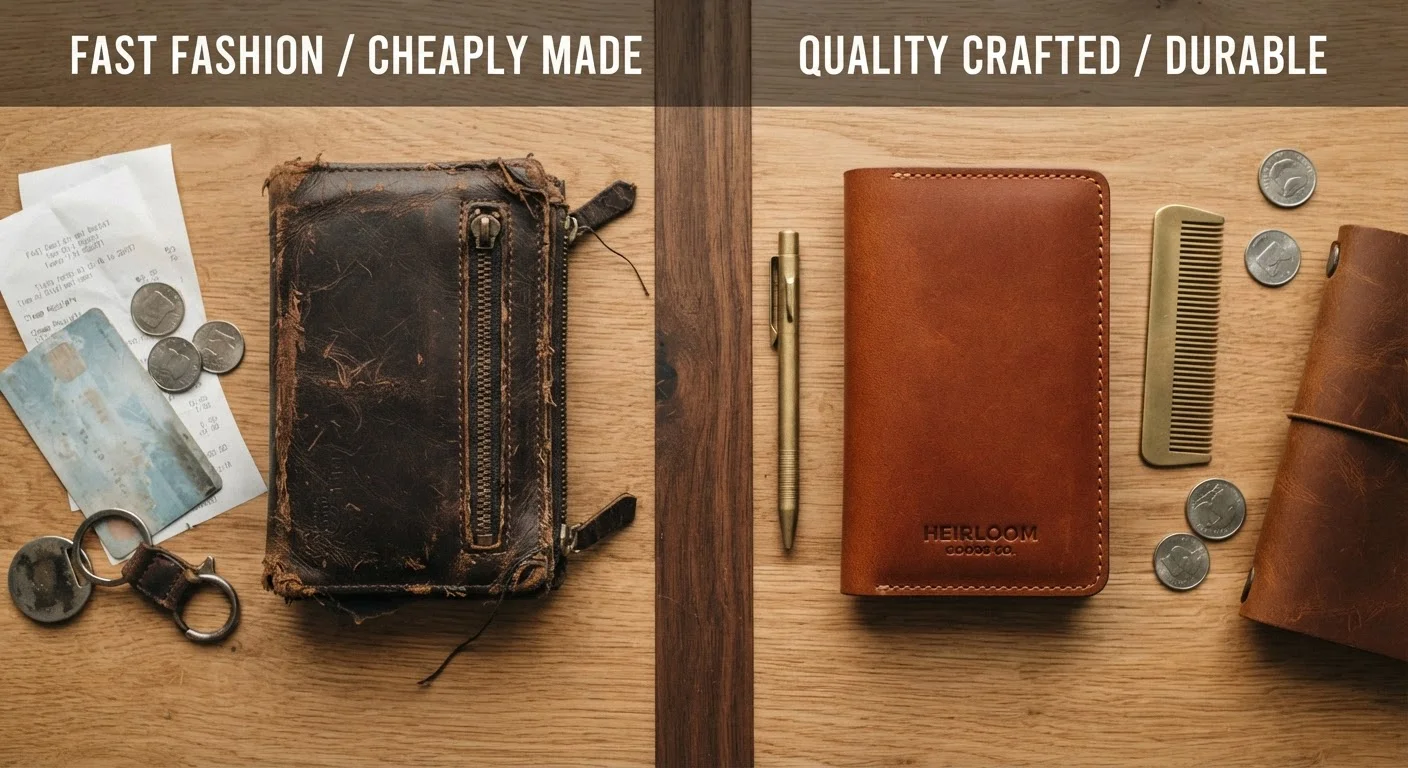
Key Takeaways
Option A
Buying Once (Quality-First)
Higher upfront cost, lower total cost over time.
Best for: Consumers who use an item frequently and want to avoid repeat purchases, repairs, or performance frustrations.
Option B
Buying Cheap (Low Price First)
Lower entry cost, but often higher cumulative spend.
Best for: Situations where the item is used rarely, is likely to become obsolete, or serves a short-term one-off need.
If you use the item daily or nearly every day
Buying Once (Quality-First)
Frequent use accelerates wear on low-quality items. A more durable purchase typically costs far less per use over its lifespan.
If the item serves a single or rare occasion
Buying Cheap (Low Price First)
When an item won't be used again, minimizing upfront spend is rational — there's no long-term cost to compound.
If the product category evolves quickly (tech, software tools)
Buying Cheap (Low Price First)
Rapid obsolescence means even a durable, expensive purchase may need replacement before it pays for itself.
If replacement or repair is inconvenient, expensive, or time-consuming
Buying Once (Quality-First)
Hidden costs — shipping, labor, time lost — can make repeated cheap purchases more disruptive than a single quality buy.
If your budget is constrained right now
Buying Cheap (Low Price First)
Cash flow matters. Buying cheap now and upgrading later is a legitimate strategy when funds are genuinely limited, provided replacement costs are factored in.
Why the Sticker Price Misleads Most Buyers
When most people compare products, they compare prices. That instinct is understandable — price is visible and immediate. But the purchase price is only the first payment. What you ultimately spend includes maintenance, replacements, repairs, accessories, and the cost of your own time.
This fuller picture is called total cost of ownership (TCO). It's the same framework businesses use when evaluating equipment, and it applies equally to your household. A $30 tool that breaks in eight months and costs $30 to replace has already matched the price of a $60 version that lasts five years — before accounting for any difference in performance along the way.
Understanding TCO doesn't require a spreadsheet. It requires asking one clarifying question before you buy: How often will I use this, and for how long? That single question shifts the conversation from sticker price to actual value. For a deeper look at structuring that evaluation, see how to compare products beyond the sticker price.
| Criterion | Buying Once (Quality-First) | Buying Cheap (Low Price First) |
|---|---|---|
| Upfront cost | Higher | Lower |
| Expected lifespan | Longer | Shorter |
| Total cost over time (frequent use) | Lower | Higher |
| Cost-per-use | Typically lower | Typically higher |
| Repair/replacement frequency | Low | High |
| Best for infrequent or one-time use | No — overpays for unused lifespan | Yes — minimizes unnecessary spend |
| Best for fast-obsolescence categories | Often no | Often yes |
| Performance consistency | Generally higher | More variable |
The Math Behind Cost-Per-Use
Cost-per-use is the simplest tool for making this concrete. Divide the purchase price by the number of times you expect to use the item. A $120 pair of boots worn 200 times over three years costs $0.60 per use. A $40 pair that wears out after 60 uses costs $0.67 — and you now need to buy again.
The calculation changes based on context. A $15 pair of sandals worn a dozen times on vacation may never need replacing in that context, making it the rational choice. But for items embedded in your daily routine — bags, footwear, tools, kitchen equipment, bedding — cost-per-use almost always favors the more durable option.
3–5×
Replacement cycles for low-quality daily-use items
Consumer research broadly shows that low-cost versions of high-frequency-use products are replaced three to five times as often as durable alternatives over a five-year period.
$0.60 vs $0.67
Cost-per-use comparison: quality vs. cheap footwear example
A $120 item used 200 times costs $0.60 per use; a $40 item used 60 times costs $0.67 — before accounting for the additional purchase needed to replace it.
One category where this becomes especially pronounced is home goods and appliances. A low-cost appliance that requires service calls or fails early can quickly exceed the price of a more reliable model. The hidden costs buyers routinely overlook — like installation, consumables, and maintenance — make this gap even wider over time.
When Buying Cheap Is the Smarter Move
The quality-first argument has a real limit: it assumes duration and frequency of use that don't always materialize. There are legitimate cases where the low-cost option is the correct one.
- One-time or rare use: If you need a specific tool for a single project and won't use it again, minimizing spend is reasonable.
- Rapidly obsolete categories: In technology, a product cycle can make even a well-made purchase outdated within two or three years. Overspending on durability in a fast-moving category often doesn't pay off.
- Children's items with short windows: Kids outgrow clothing, shoes, and gear quickly. Spending for longevity in a product that will be outgrown in months rarely makes sense.
- Genuine budget constraints: Cash flow is real. When funds are limited, a cheaper item today and an upgrade later is a practical strategy — as long as you go in with eyes open about the likely replacement cost.
The key is being honest about which category your purchase actually falls into, rather than rationalizing a low-priced option you'll be disappointed by in six months. For a candid look at when paying more does and doesn't add real value, see when higher prices actually justify themselves.
Applying This Framework Before You Buy
Before committing to any non-trivial purchase, run through three questions:
- How often will I realistically use this? Be honest. "I'll use it every week" is only useful if it's true.
- What does failure actually cost me? Factor in replacement shipping, downtime, installation, and your own time — not just the purchase price of a replacement.
- Is this category stable or fast-moving? Durable goods in stable categories reward quality investment. Technology or trend-sensitive items often don't.
These questions won't always point to the same answer, and that's the point. The goal isn't to always buy quality or always buy cheap — it's to make the choice deliberately, with an accurate picture of what each option costs over its actual lifespan.
If you're approaching a significant purchase and want a structured evaluation process, smart approaches to large one-time purchases offers a framework built for exactly that. And if you're curious whether a lower-priced alternative genuinely closes the quality gap, brand name vs. generic breakdowns by category can help you decide when the label actually matters.
A Note on "Quality" Signals
Higher price does not automatically mean higher quality. Brand markup, marketing costs, and retailer margin all factor into a product's price independently of how well it's made. When evaluating durability, look for verifiable indicators — material composition, warranty terms, and third-party testing results — rather than relying on price as a proxy for quality. For context on where generic and store-brand alternatives genuinely match or fall short of name-brand options, see store brands vs. name brands by category.