

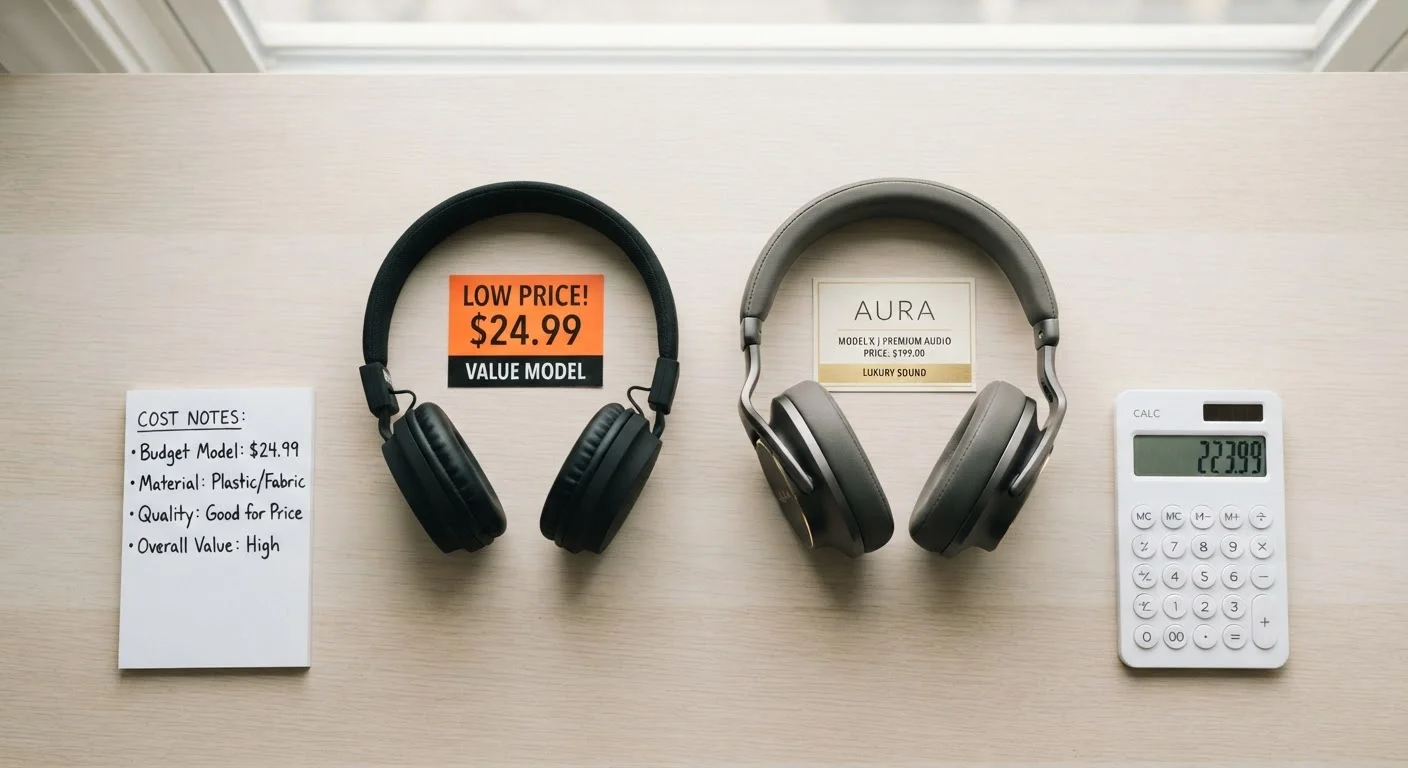
Key Takeaways
Price vs. Value
Price is what you pay at the register. Value is what you actually get in return — measured over time, across uses, and against your real needs. Buying cheaper means paying less upfront; saving money means spending less overall. These are not the same thing, and confusing them is one of the most common and costly shopping mistakes consumers make.
Economists distinguish between nominal cost (the sticker price) and total cost of ownership (TCO), which accounts for maintenance, replacement frequency, and opportunity cost over the item's useful life.
Why Cheap and Affordable Are Different Things
Most shoppers equate a lower price with a better deal. It's an instinct that retailers actively reinforce — clearance tags, bulk discounts, and sale stickers all signal savings before you've evaluated anything about the product itself. But price and value are separate variables, and treating them as the same thing leads to a predictable trap: you spend less per transaction while spending more over time.
Affordable means getting solid value at a price that fits your budget. Cheap means paying as little as possible, regardless of what you get. The distinction matters because cheap purchases often require earlier replacement, generate hidden costs, or simply fail to do the job — meaning you buy again. That cycle is the opposite of saving money.
Smart shopping, as covered in the Buying Smart hub, starts with reframing the core question. Instead of asking "what's the lowest price?", ask "what's the lowest cost over time?"
Reframe the question before you buy
Before checking out, ask: how many times will I actually use this, and how long do I expect it to last? A quick mental estimate of cost-per-use changes the perceived value of both cheap and expensive options — often in surprising ways. This single habit is one of the most effective checks against impulse and price-bias decisions.
The Cost-Per-Use Framework
Cost-per-use is the most practical tool for cutting through sticker price bias. The math is straightforward: divide what you paid by the number of times you'll realistically use the item. A $90 cast iron pan used weekly for ten years works out to pennies per use. A $15 nonstick pan that warps in six months and needs replacing costs several times more per meal prepared.
This framework applies beyond kitchenware. A durable pair of work boots, a quality mattress, a reliable tool — items you interact with frequently benefit most from this kind of analysis. In contrast, for a single-use or low-frequency purchase, the calculus shifts: a cheap folding table you'll use once doesn't need to last a decade.
2–4x
Typical replacement frequency for low-quality goods vs. mid-tier alternatives
Consumer durability research consistently finds that products at the lowest price tier in categories like footwear, appliances, and tools require replacement significantly more often than mid-tier equivalents.
$0 saved
Net savings when a cheap replacement costs as much as one quality item
Buying a $25 item three times over five years costs the same as one $75 item — with more time, effort, and inconvenience spent on replacements.
Up to 40%
Share of total product cost that can come from consumables and accessories
Industry analyses of printers, razors, and coffee machines show that post-purchase costs — ink, blades, pods — can account for the majority of lifetime spending on a product.
The real trade-off between buying cheap and buying once is often invisible at the register but becomes obvious after the second or third replacement. Running that simple division before you buy makes the trade-off visible upfront.
Quality Trade-Offs That Quietly Add Up
Not every quality difference is obvious on the shelf. Low-cost products sometimes cut corners on components that degrade quickly — motor windings in appliances, stitching in apparel, or materials in tools. These don't fail immediately; they underperform gradually until replacement becomes unavoidable.
There's also the category of hidden costs buyers routinely overlook: proprietary accessories, replacement filters, higher energy draw, or consumables that only work with one product line. A printer priced attractively can cost multiples of its sticker price in ink cartridges within a year. A "free" or deeply discounted piece of equipment that requires paid software adds a recurring cost the initial price concealed.
This doesn't mean expensive is always better — it means the full cost picture needs to be understood before the transaction. Paying more isn't always paying better either; premium pricing sometimes reflects brand margin rather than product quality. The goal is to find the price point where actual performance and durability meet your real needs — not to maximize or minimize spend for its own sake.
When the Lower Price Really Is the Right Call
None of this means defaulting to the pricier option. There are clear situations where a lower-priced item is the smarter purchase — and recognizing them is just as important as knowing when to invest more.
Generic and store-brand products in categories like pantry staples, basic cleaning supplies, and many over-the-counter medications are often manufactured to the same or similar standards as name brands, as explored in the Brand Name vs. Generic breakdown. Fashion items tied to short-lived trends, items needed for a single specific occasion, and products where every version on the market degrades at roughly the same rate are all candidates for the lower-cost choice.
The key is applying the same cost-per-use logic in both directions. A cheap option that performs comparably and lasts a similar lifespan to a pricier one is genuinely the better deal — not a compromise. Common myths about saving money often involve reflexively spending more as a proxy for quality rather than evaluating what the extra cost is actually buying you.
True savings come from matching the right price tier to the specific product, use case, and lifespan — not from always choosing the lowest or the highest number on the tag.