

Key Takeaways
Start here
What Defensive Driving Actually Is
Build your foundation
The Core Habits That Make It Work
Apply to real situations
How Conditions Change the Equation
Know what to avoid
Common Mistakes That Undercut Defensive Driving
Stay sharp long-term
Keeping the Habits Sharp Over Time
What Defensive Driving Actually Is
Most drivers think of defensive driving as something taught in a weekend course — a box to check for an insurance discount. In practice, it's a continuous mindset: the habit of anticipating what other drivers, pedestrians, and road conditions might do before anything goes wrong.
The core idea is simple. You cannot control other drivers. You can control your position, speed, attention, and reaction time. Defensive driving is the deliberate management of those factors to reduce your exposure to risk — regardless of what anyone else on the road does.
That distinction matters on modern roads. Traffic has grown more complex, with more distracted drivers, new road users like e-bikes and scooters, and navigation apps that sometimes encourage abrupt maneuvers. Passive rule-following — staying in your lane and obeying signals — is necessary but not sufficient.
Following distance
The space you maintain between your vehicle and the one ahead. More space means more time to brake safely if traffic stops suddenly.
Hazard anticipation
The practice of identifying potential dangers before they become emergencies — such as noticing a car about to pull out of a parking lot before it actually does.
Blind spot
An area around your vehicle that mirrors don't fully show. Most commonly refers to the rear-side zones where another car can travel without appearing in your mirror.
Scanning
Actively moving your eyes across the road ahead, mirrors, and surroundings in a regular pattern rather than staring at a fixed point.
Driver-assistance systems
Electronic features built into modern vehicles — such as automatic braking or lane alerts — designed to help drivers avoid certain hazards, but not to replace driver attention.
The Core Habits That Make It Work
Defensive driving breaks down into a handful of concrete habits, each of which directly reduces reaction time or exposure to hazards:
- Scan ahead, not just in front. Experienced drivers look 10–15 seconds ahead — roughly a city block or a quarter-mile at highway speed. This gives you time to identify developing situations rather than reacting to them at close range.
- Maintain following distance. The three-second rule (at minimum) gives you stopping room if traffic ahead halts suddenly. See our guide on following distance and right-of-way for a fuller breakdown of how to apply it correctly.
- Control your speed for conditions. Posted limits reflect ideal conditions. Rain, heavy traffic, construction zones, and night driving all call for lower speeds.
- Manage your blind spots actively. Mirrors have limits. Before lane changes, a physical head-check toward the blind spot is still the most reliable method.
- Expect the unexpected from others. Assume the driver ahead may brake suddenly or the pedestrian at the curb may step out. This isn't pessimism — it's margin.
Use the Three-Second Rule Consistently
To check your following distance, pick a stationary object like a sign or overpass. Count how many seconds pass between the car ahead clearing it and your car reaching it. If it's less than three seconds, you're too close. In rain, night, or heavy traffic, aim for four to five seconds.
How Conditions Change the Equation
Defensive driving isn't a fixed formula — it scales with conditions. Rain reduces tire grip and increases stopping distances significantly. Fog narrows your usable sight line to a fraction of its normal length. Ice can cut traction so drastically that normal driving inputs become dangerous. For a detailed look at adjustments for specific weather, see driving in rain, snow, ice, and fog.
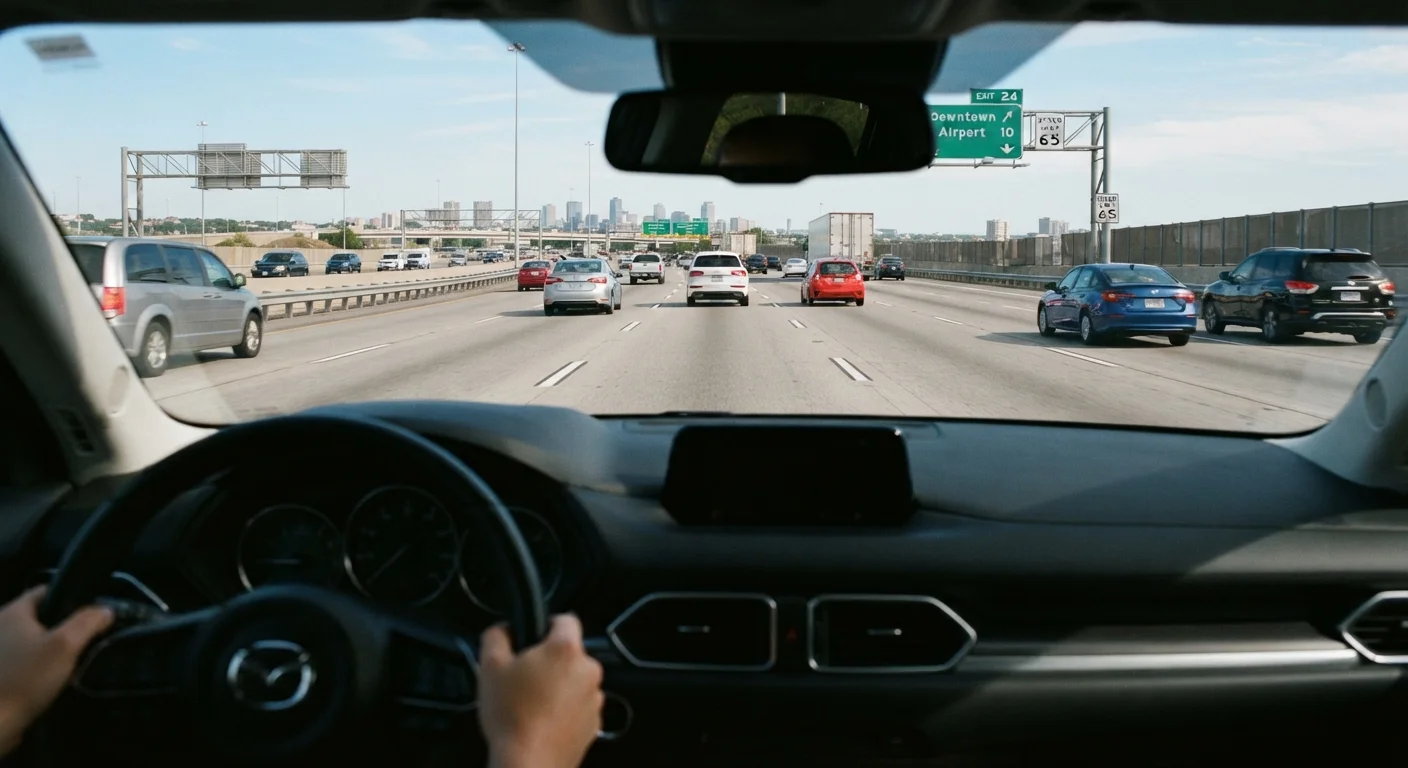
Environment matters too. Highway and city driving demand different skill sets. Urban streets require close attention to cyclists, pedestrians, and sudden stops at intersections. High-speed highway driving demands smooth, deliberate inputs and early awareness of merging traffic.
Time of day also plays a role. Dusk is particularly hazardous because headlights aren't yet fully effective but ambient light is fading — a combination that makes pedestrians and cyclists harder to spot.
Common Mistakes That Undercut Defensive Driving
The habits that erode defensive driving are usually gradual and invisible until something goes wrong. Familiarity is a major culprit: drivers who commute the same route daily often report running on autopilot, which means reduced scanning and slower hazard recognition.
Distraction — particularly from smartphones — remains a leading factor in preventable crashes. Even glancing at a screen for two seconds at 55 mph means covering roughly 160 feet without eyes on the road. Hands-free calling reduces some risk but doesn't eliminate the cognitive load of a phone conversation.
Overconfidence in the vehicle is another common issue. Modern driver-assistance features like automatic emergency braking and lane-keep assist are genuinely useful, but they're designed as backups, not substitutes for attention. Relying on them as primary safety mechanisms creates a false sense of security. For more on the habits that gradually dull awareness, see the habits that quietly erode driver awareness over time.
Don't Outsource Attention to Technology
Driver-assistance features such as adaptive cruise control and lane-keep assist are designed as supplemental tools, not replacements for active driving. Most manufacturers explicitly state that the driver must remain alert and in control at all times. Treating these systems as autopilot is both unsafe and inconsistent with how they're engineered to work.
Keeping the Habits Sharp Over Time
Defensive driving is a skill that needs maintenance. One practical approach: periodically audit your own habits. Are you consistently keeping adequate following distance, or do you close the gap when traffic is light? Are you checking mirrors every five to eight seconds, or only when something catches your attention?
Vehicle condition is part of this too. Tires, brakes, and lights are the physical foundation of your ability to respond to hazards. Routine maintenance checks aren't separate from safe driving — they're inseparable from it. And if a dashboard warning light appears, knowing what it means and whether to pull over is essential; decoding your car's warning lights is a useful starting point.
The goal isn't perfection on every drive. It's building a consistent baseline of awareness that holds up under normal fatigue, distraction, and the unpredictability of real traffic — and that keeps improving slightly over time rather than drifting downward.