

Key Takeaways
Stopping Distance
Stopping distance is the total distance a vehicle travels from the moment a driver perceives a hazard to the moment the vehicle comes to a complete stop. It is made up of two parts: the reaction distance (how far the car moves while the driver recognizes the danger and applies the brakes) and the braking distance (how far the car travels once the brakes are engaged). Both parts are influenced by speed, road conditions, and the vehicle's mechanical state.
Braking distance increases with the square of vehicle speed — doubling your speed roughly quadruples the braking distance, not merely doubles it, due to the physics of kinetic energy.
Two Phases, One Number
Every stopping distance measurement combines two distinct phases. The first is reaction distance — the ground covered between your eyes registering a hazard and your foot pressing the brake. The second is braking distance — the ground covered while the brakes convert kinetic energy into heat and friction.
At 60 mph, an alert driver with a typical reaction time of about 1.5 seconds travels roughly 132 feet before the brakes even engage. After braking begins on dry pavement, an additional 180 feet or more may pass before the car stops. That total — over 300 feet — is about the length of a football field. Most drivers significantly underestimate this figure.
Understanding that stopping distance is a two-part equation is important because each component responds to different variables. Improving reaction time addresses the first; tire condition, road surface, and brake performance shape the second.
Why Speed Has a Multiplying Effect
Speed's impact on stopping distance is not linear — it is exponential. This comes down to basic physics: kinetic energy equals one-half of mass times velocity squared. When velocity doubles, the energy that brakes must dissipate quadruples.
Practically, this means a driver going 40 mph and one going 80 mph are not in twice the danger — they are in roughly four times the danger when it comes to stopping. That extra distance at higher speeds often means the difference between a near-miss and a collision.
~4×
Braking distance increase when speed doubles
A consequence of the kinetic energy equation: energy scales with the square of velocity, not linearly with speed.
~132 ft
Distance traveled during reaction time at 60 mph
Based on a typical alert-driver reaction time of approximately 1.5 seconds at 60 mph, before brakes are applied.
2×
Stopping distance increase on wet vs. dry pavement
Wet road surfaces significantly reduce tire-to-road friction, a well-established principle in road safety research.
This is one reason why speed management is considered foundational to safe driving, not just a legal formality. Highway driving introduces the added complexity of sustained high speeds, where small increases in velocity carry outsized consequences for stopping ability.
Road Surface and Environmental Conditions
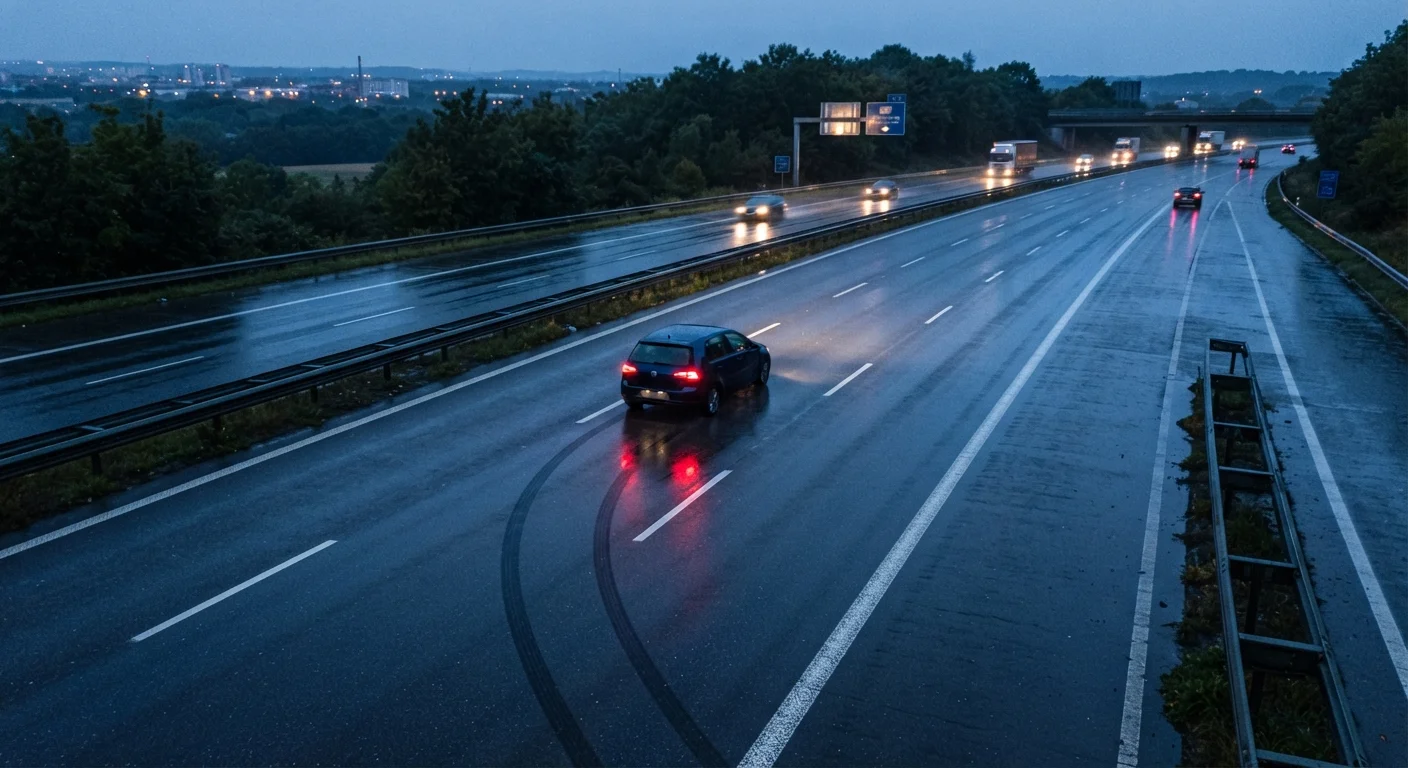
Even with identical speed and reaction time, stopping distance changes dramatically based on what is beneath your tires. Dry asphalt provides relatively high friction. Wet asphalt can roughly double stopping distances. Snow and ice can extend them by a factor of three to ten depending on conditions.
The mechanism is tire-to-road friction, measured as the coefficient of friction. Every surface has a different value; a tire gripping dry pavement may have a coefficient around 0.7–0.8, while black ice can drop that figure to 0.1 or lower. When friction drops, braking force drops with it.
Road debris, gravel, and deteriorated pavement also reduce friction unpredictably. Understanding how weather conditions alter vehicle handling is essential context for interpreting why stopping distances vary so widely between a clear summer day and a freezing winter commute.
Adjust Your Gap in Bad Weather
In rain, snow, or fog, the standard 3-second following distance is often insufficient. Safety organizations generally recommend at least doubling this gap in wet conditions and extending it even further on snow or ice. The extra space directly compensates for increased braking distance and potentially slower hazard perception in low visibility.
Reaction Time: The Human Factor
Reaction time is often treated as a fixed individual trait, but it fluctuates based on several controllable and uncontrollable factors. An alert, well-rested driver might react in 1.0–1.5 seconds. A tired, distracted, or impaired driver can take 2–3 seconds or more — a gap that adds dozens of additional feet to stopping distance before brakes are applied.
Common reaction time extenders include: driver distraction (phone use, in-car conversations, eating), fatigue, alcohol and medications, age-related changes in processing speed, and low-visibility conditions where the hazard is detected later.
This is also why tailgating is so dangerous. At highway speeds, the space between bumpers can vanish before a sluggish reaction has even completed. The real risk of following too closely is closely tied to stopping distance physics — there is simply no room for reaction time to do its job.
Mechanical Factors and Following Distance
Tire tread depth, tire pressure, and brake condition all influence the braking distance portion of stopping distance. Worn tires displace water less effectively, increasing wet-road stopping distances substantially. Overinflated or underinflated tires change the contact patch with the road, affecting grip. Degraded brake pads or low brake fluid can reduce braking force.
Regular vehicle maintenance — particularly tire inspection and brake system checks — is the driver's most direct mechanical lever over stopping distance. These are not cosmetic concerns; they have measurable safety consequences.
The simplest behavioral adjustment any driver can make is managing following distance. The 3-second rule (at minimum) builds a buffer large enough to absorb normal reaction times and average braking distances on dry roads. In wet or icy conditions, following distance guidelines point to extending that gap significantly. If traction disappears entirely and a skid begins, knowing the correct skid response becomes the next critical skill.
This article is for general informational purposes only. Always follow local traffic laws and consult qualified professionals regarding vehicle maintenance and safety systems.