

Key Takeaways
Sale Urgency Tactics
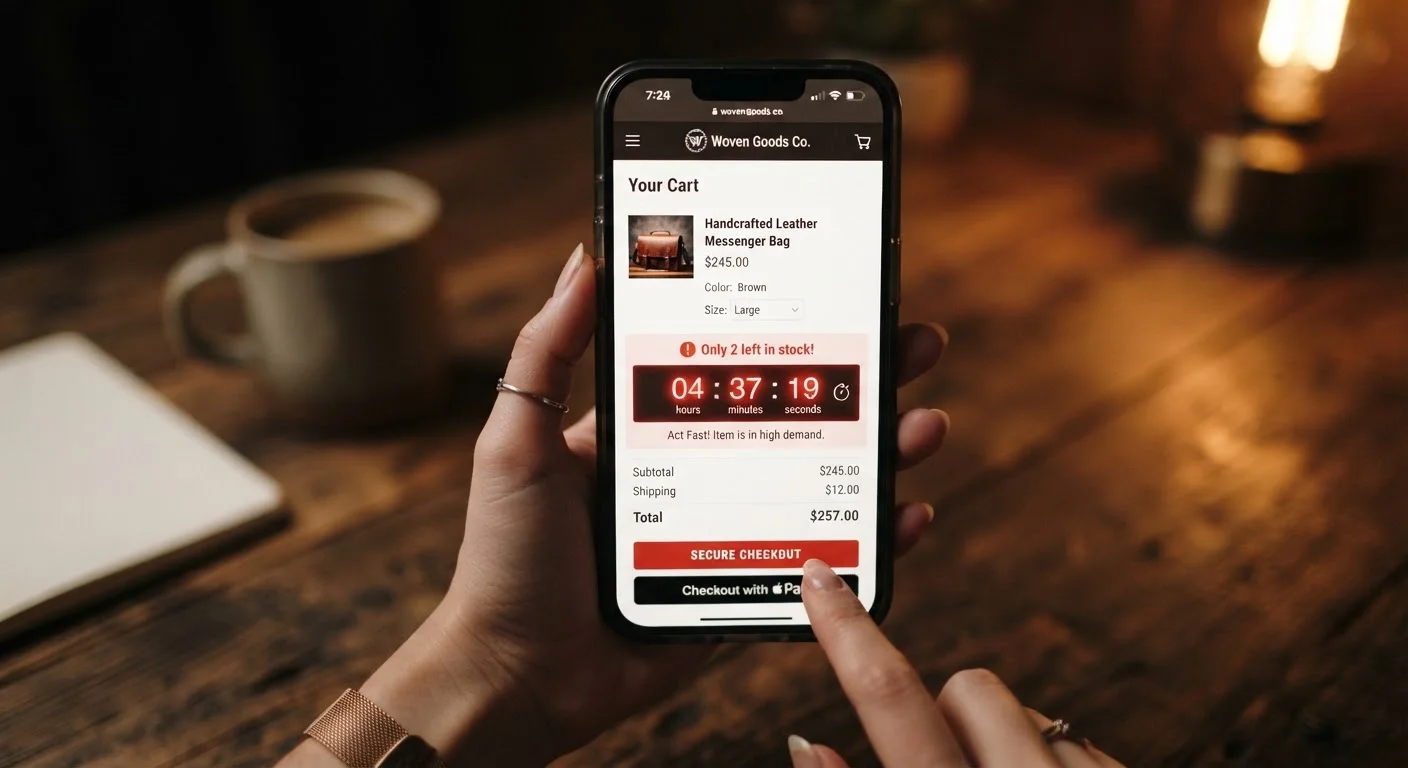
Sale urgency tactics are retailer techniques designed to make shoppers feel they must act immediately or risk losing out. They include countdown timers, low-stock warnings, flash sale banners, and real-time 'X people are viewing this' alerts. The goal is to compress the time you have to think critically before making a purchase decision.
Behavioral economists refer to the underlying mechanism as 'loss aversion' — the tendency for people to weigh potential losses more heavily than equivalent gains, a concept established in prospect theory by Kahneman and Tversky.
How Urgency Gets Engineered Into the Shopping Experience
Modern retail — online especially — is built around reducing hesitation. Every element of the purchase flow, from the color of the 'Buy Now' button to the flashing stock counter, is tested and optimized to shorten the gap between 'I'm interested' and 'I clicked purchase.' Urgency tactics are a core tool in that process.
The most common forms include:
- Countdown timers — displaying hours or minutes until a sale supposedly ends
- Low-stock indicators — 'Only 4 left!' labels regardless of actual inventory thresholds
- Social proof overlays — '37 people are viewing this right now'
- Flash sale banners — short-window discounts that appear without prior notice
These aren't neutral information. They're persuasion tools, and understanding them is the first step to using your own judgment rather than reacting to theirs. For a broader look at similar tactics, shopping traps that catch even careful consumers covers how anchor pricing and false scarcity operate across retail channels.
Urgency Tactics Are Legal — But Not Always Accurate
In the United States, the FTC has guidelines governing deceptive pricing and false advertising, but enforcement varies and many urgency displays exist in a gray area. A countdown timer that resets is not automatically illegal, though it may be misleading. The practical implication: don't assume a scarcity or deadline claim is verified just because it appears on a legitimate retail site.
The Psychology That Makes Urgency Work
Urgency tactics exploit a well-documented cognitive pattern: loss aversion. Research in behavioral economics — most notably from the work of Daniel Kahneman and Amos Tversky — established that people feel the pain of a loss roughly twice as strongly as the pleasure of an equivalent gain. Retailers reframe a missed sale as a loss ('You'll pay more tomorrow') rather than a neutral non-event.
Layered on top of this is scarcity bias — the tendency to assign higher value to things perceived as rare or about to disappear. A product you'd scroll past at regular price becomes more attractive once you believe it's nearly gone.
Time pressure compounds both effects. When a clock is ticking, your brain deprioritizes analytical thinking and leans on fast, emotional processing. The result: you're less likely to compare prices, question whether you need the item, or recall that you saw it cheaper elsewhere last week.
“The illusion of scarcity is one of the most reliable drivers of perceived value. When people believe something is disappearing, they want it more — regardless of whether they wanted it before.”
— Robert Cialdini, Author of 'Influence: The Psychology of Persuasion' and Professor Emeritus of Psychology, Arizona State University
This is why the psychology behind urgency and how it clouds judgment matters beyond just avoiding buyer's remorse — it directly affects your ability to evaluate value objectively.
What 'Scarcity' Signals Actually Mean
Low-stock messages deserve particular scrutiny. Retailers can configure the inventory threshold that triggers a 'low stock' alert. A warehouse with 500 units can still display 'Only 3 left!' if their system is set to flag anything below, say, 10 units — or if the alert is triggered per-variant (size, color) rather than per-product total.
2x
How much more losses hurt than equivalent gains
Kahneman and Tversky's foundational prospect theory research found that loss aversion causes people to weight losses approximately twice as heavily as equivalent gains.
~60%
Online shoppers influenced by scarcity messaging
Industry surveys on e-commerce conversion optimization consistently find that low-stock and countdown messages meaningfully increase add-to-cart rates, though the exact figure varies by product category and platform.
24 hrs
Wait time that reduces impulse purchase follow-through
Consumer behavior research and financial planning guidance commonly cite a 24-hour pause as an effective buffer against urgency-driven purchases, with many unplanned items not repurchased after the delay.
Countdown timers can be similarly misleading. Some reset on page reload, or extend automatically when the deadline passes. Neither behavior would meet a plain-language definition of 'limited time.'
None of this is necessarily illegal — but it is designed to make you feel urgency you wouldn't otherwise feel. Recognizing the gap between the signal and the reality it claims to represent is a practical consumer skill.
Practical Ways to Stay in Control
Awareness alone doesn't fully neutralize these tactics — the emotional response can still occur even when you know what's happening. Building deliberate habits around buying decisions adds a structural buffer.
- Use a waiting period. Add the item to a wish list rather than your cart. Revisit in 24 hours. Items that feel urgent rarely disappear overnight, and your assessment of whether you need them often changes.
- Check price history. Free browser extensions and price-tracking tools let you see whether a 'sale' price is genuinely lower than the item's typical cost. A 30% discount off an inflated 'original' price may be no discount at all.
- Apply a needs framework. Before checking out, ask whether the item solves a specific, current problem or is being justified by the discount itself. The needs vs. wants framework for cutting through purchase pressure gives a structured way to make that call.
- Separate the offer from the item. Would you still want this at full price? If the answer is no, the sale hasn't created value — it's created a rationalization.
Understanding what impulse buying quietly costs your budget over time can also reinforce why these habits are worth building. The Buying Smart hub has additional practical guidance for evaluating purchases before committing.