

Key Takeaways
Impulse Buying
Impulse buying is an unplanned purchase made in the moment, driven more by emotion than deliberate decision-making. You didn't walk in planning to buy it — something in the environment, the offer, or your mood tipped you over the edge. It's not a character flaw; it's a predictable human response that retailers actively engineer.
Behavioral economists describe impulse purchases as arising from a conflict between the brain's reward-seeking limbic system and the deliberative prefrontal cortex — with retailers designing environments that favor the former.
Why Impulse Buying Is Built Into the Shopping Experience
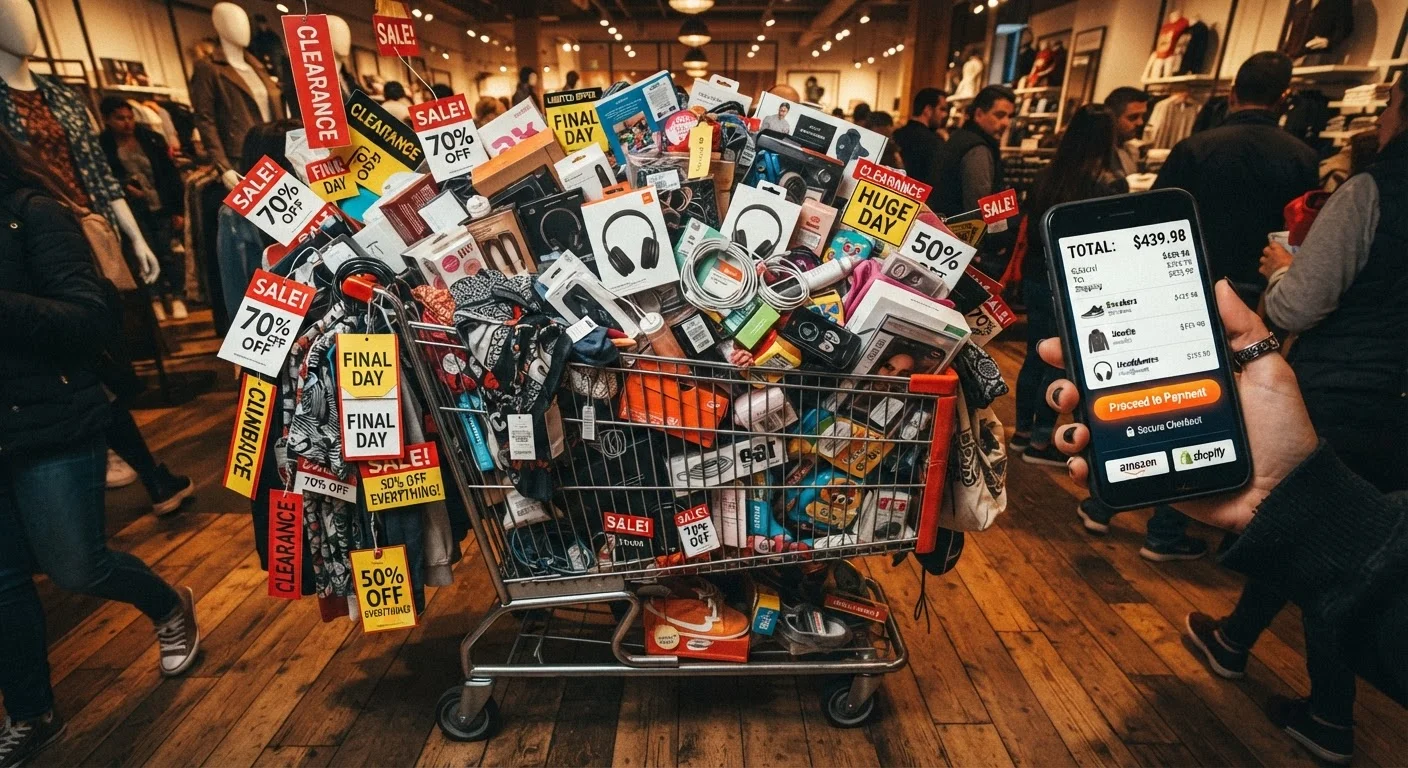
Impulse buying isn't something retailers hope happens — it's something they plan for. Store layouts, product placement at eye level, checkout-lane displays, and limited-time banners are all engineered outputs of decades of consumer behavior research. The goal is to move you from browsing to buying before your rational mind has time to weigh in.
Online retail has extended these tactics into your home. Countdown timers, low-stock warnings, and one-click checkout all serve the same function: compress the time between impulse and purchase so hesitation can't set in. Our guide on how urgency tactics work breaks down the most common digital pressure tools in more detail.
The result is a retail environment where spending without planning is the path of least resistance — and resisting it takes active effort most shoppers aren't primed to apply in the moment.
$314/mo
Average American impulse spending estimate
A widely cited Slickdeals consumer survey found Americans reported spending an average of roughly $314 per month on impulse purchases, though self-reported figures vary across surveys.
~40%
Share of all retail sales attributed to impulse purchases
Retail industry research has consistently estimated that unplanned purchases account for a substantial share of in-store and online sales, highlighting how central the tactic is to retail revenue strategy.
The Psychological Triggers Retailers Rely On
Several well-documented cognitive patterns make impulse purchases feel reasonable in the moment:
- Scarcity perception: When something appears rare or limited, its perceived value rises. "Only 2 left" creates urgency that bypasses deliberate thinking.
- Emotional state: Stress, boredom, or even excitement lower the threshold for unplanned spending. Retail therapy is a documented phenomenon, not a cliché.
- Anchoring: A price shown as marked down from a higher number makes the current price feel like a bargain, regardless of whether that original price was realistic. See how common shopping traps exploit anchoring in everyday retail.
- Reward anticipation: The act of buying — not owning — triggers a dopamine response. The excitement peaks at purchase, which is why buyer's remorse often follows.
These aren't obscure marketing tricks. They're grounded in behavioral science, and understanding them makes them easier to catch before they cost you money.
“Retailers don't just sell products — they sell decisions. The most powerful retail environments are those that make an unplanned purchase feel like a natural conclusion to the shopping experience.”
— Dan Ariely, Behavioral economist and author of 'Predictably Irrational'
What Impulse Buying Quietly Costs Over Time
A $12 item at checkout doesn't feel like a budget problem. But unplanned purchases stack. If you make three small impulse buys a week averaging $15 each, that's roughly $2,300 a year — money that could have gone toward an emergency fund, debt payoff, or a savings goal.
The damage compounds when impulse spending creates credit card balances that carry interest. A $50 spontaneous purchase put on a card and paid off over several months costs more than $50 by the time interest is added. This dynamic is part of a broader pattern of everyday spending habits that quietly erode financial progress.
There's also an opportunity cost dimension. Money spent impulsively isn't invested, saved, or used to pay down high-interest debt — all of which have measurable long-term value. The headline price of an impulse purchase is always lower than its true cost.
Practical Ways to Interrupt the Impulse Cycle
The goal isn't to eliminate spontaneous spending entirely — it's to make it a choice rather than a reflex. A few approaches that financial counselors commonly recommend:
- The 24/48-hour rule: For any unplanned purchase above a threshold you set (say, $25), wait a day before buying. Most impulse urges fade without the retailer's artificial urgency present.
- Use a wish list, not a cart: Online carts with saved payment info make buying frictionless. Moving items to a wish list restores a decision point before checkout.
- Shop with a list and a budget: Going into a store — or a website — with defined intent reduces susceptibility to environmental triggers.
- Check total cost of ownership: A cheap, impulsive buy that breaks quickly costs more than a planned, quality purchase. Our piece on buying once vs. buying cheap covers this trade-off in depth.
None of these require extreme discipline. They simply insert a small gap between the impulse and the action — and that gap is where your actual judgment lives.
This article is for general informational and educational purposes only and does not constitute personalized financial advice. For guidance specific to your financial situation, consider consulting a qualified financial professional.