

Key Takeaways
Urgency Bias in Consumer Decisions
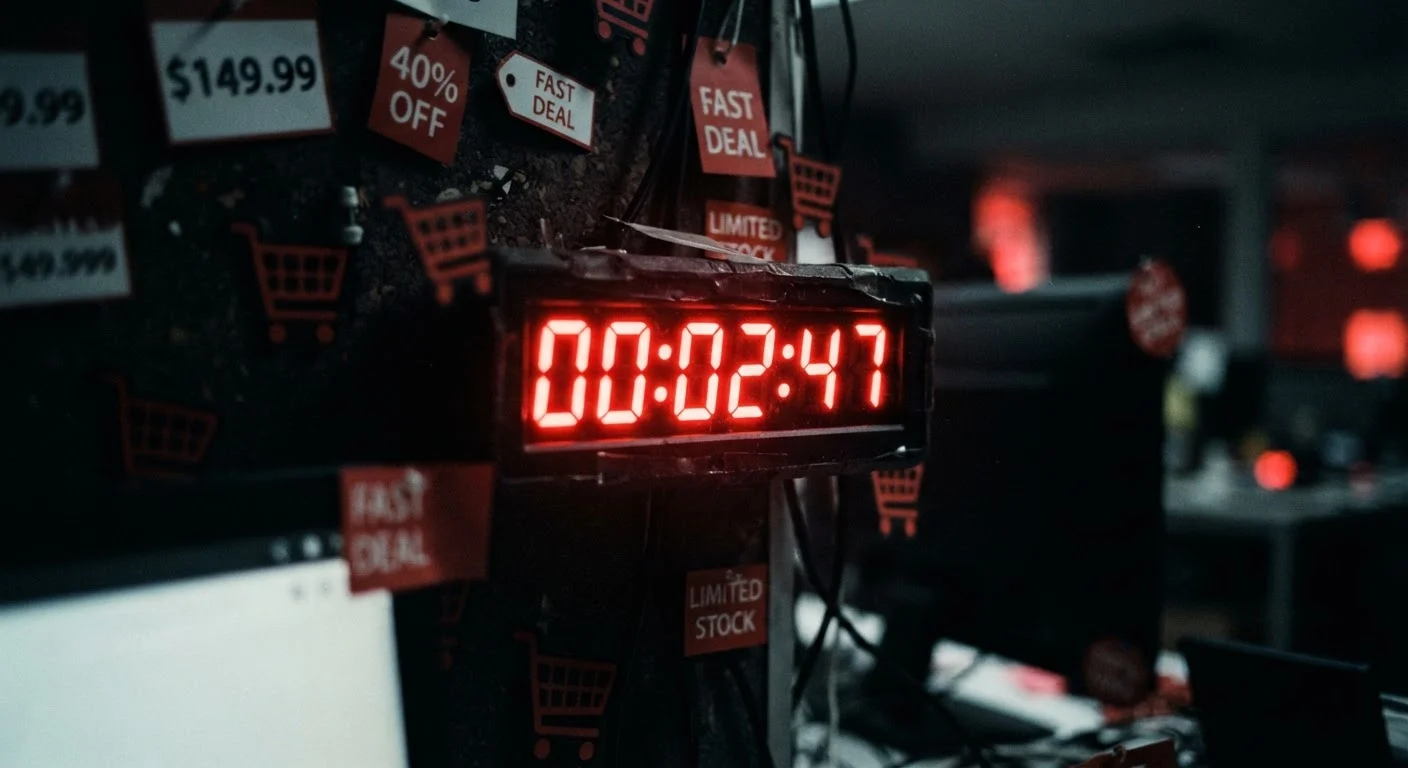
Urgency bias is the tendency to make faster, less critical decisions when we feel time is running out. In retail and marketing contexts, it describes how artificially imposed deadlines — countdown timers, 'only 2 left' alerts, flash sale windows — trigger an emotional response that overrides deliberate thinking. The result is that shoppers often prioritize speed over sound judgment.
Psychologists link this to a conflict between the brain's prefrontal cortex (deliberate reasoning) and the limbic system (fast, emotion-driven responses). Perceived scarcity activates the latter, making rational cost-benefit analysis harder to perform in the moment.
How Urgency Hijacks the Decision-Making Process
When a website displays a ticking clock or flashes "Only 3 left in stock," something measurable happens in the brain. Perceived time pressure activates threat-response pathways that prioritize speed over accuracy. Psychologists call this a shift from System 2 thinking (slow, deliberate, analytical) to System 1 thinking (fast, automatic, emotionally driven). The practical result: you weigh fewer variables, skip comparison steps, and anchor heavily on the urgency itself rather than the product's actual value to you.
This isn't a character flaw — it's a predictable feature of human cognition that marketers have researched and engineered around. The design of urgency cues is iterative and data-tested. Retailers know exactly which phrasing, color choices, and timer formats produce the highest conversion rates at the lowest deliberation time.
“The best way to resist the pull of immediate gratification is to pause and ask yourself whether you'd make the same decision if the deadline weren't there. If the answer is no, the deadline is doing the work, not the product.”
— Dan Ariely, Behavioral economist and author of 'Predictably Irrational'
The Mechanics of Manufactured Scarcity
Not all urgency signals reflect real-world constraints. Manufactured scarcity refers to the practice of presenting artificial limits — on time, quantity, or access — to simulate the pressure of genuine shortage. Common forms include:
- Countdown timers that reset when you return to the page
- Low-stock alerts that persist at "2 remaining" across days
- "Today only" pricing that appears every weekend
- Flash sale windows that recur on a predictable schedule
Understanding that scarcity can be manufactured doesn't mean every deadline is fake. Real supply constraints and genuinely expiring offers do exist. The consumer's challenge is developing habits that distinguish one from the other — and that begins with slowing down enough to ask the question at all. See how to identify whether a deadline is genuine for concrete indicators to look for.
2x
Weight people place on losses vs. equivalent gains
Behavioral economists including Daniel Kahneman and Amos Tversky documented in foundational research that losses loom roughly twice as large psychologically as equivalent gains — a principle directly exploited by urgency marketing.
59%
Shoppers who regret impulse purchases
According to a survey conducted by CreditCards.com, the majority of Americans who made impulse purchases reported at least some level of regret afterward, underscoring the gap between in-the-moment and post-purchase judgment.
Why 'Fear of Missing Out' Is the Engine
At the core of urgency-based marketing is a well-documented psychological driver: loss aversion. Research in behavioral economics has consistently shown that people feel the pain of a potential loss more acutely than the pleasure of an equivalent gain. A "limited time" frame repackages a neutral purchase opportunity as a loss-threat — you're not just buying something, you're racing to avoid losing access to it.
This framing is especially powerful because it operates largely below conscious awareness. Shoppers experiencing urgency pressure often report feeling certain about their decision in the moment, then uncertain about why they bought within hours. This pattern is closely related to the psychology of impulse buying, where the emotional spike of a transaction fades quickly and leaves the underlying cost behind.
Practical Countermeasures That Actually Work
The most reliable defense against urgency pressure is a habit, not a rule: always introduce a deliberate gap between impulse and action. This doesn't require rigid discipline — a few minutes of friction is often sufficient to allow System 2 thinking to re-engage.
The 24-Hour Wish List Rule
Instead of adding an urgency-priced item directly to your cart, add it to a wish list or save the link in a note. Revisit it the next day with fresh eyes. If the desire and the value case are still clear, the purchase is likely sound. If the interest has faded, the urgency was doing most of the motivational work.
Before acting on any time-sensitive offer, it helps to run through a short internal check:
- Was I looking for this item before I saw the sale, or did the sale create the desire?
- Does the deadline reflect a real constraint, or could I verify it independently?
- Would this purchase fit my needs, wants, or nice-to-haves framework under normal conditions?
If the answer to any of these reveals that urgency is the primary motivation, that's a reliable signal to pause. And if a deal is genuinely good, waiting a day rarely costs you as much as you fear — and often costs nothing at all.