

Key Takeaways
Price Anchoring
Price anchoring is a sales technique where retailers display a higher price first — or alongside a lower one — to make the second price feel like a bargain. Your brain uses that first number as a reference point, or "anchor," even when it has no real connection to the item's actual value. The result is that you feel like you're getting a deal based on a comparison, not on whether the price is objectively fair.
Anchoring is a well-documented cognitive bias described in behavioral economics research, including foundational work by psychologists Amos Tversky and Daniel Kahneman, showing that people rely heavily on the first number they encounter when making numerical judgments.
Why That "Original" Price Changes Everything
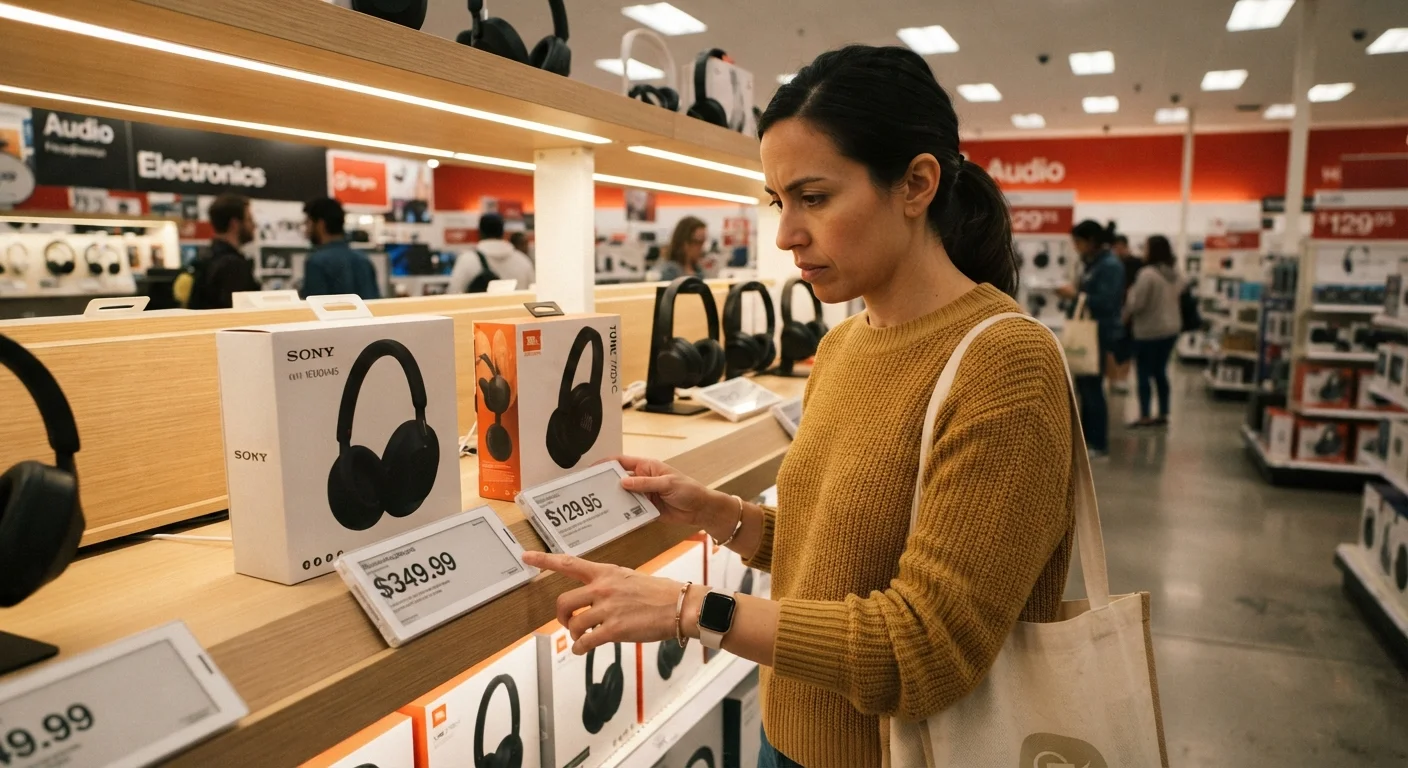
Walk through any retail store and you'll see them constantly: price tags with a number crossed out above a lower one. The crossed-out figure isn't just information — it's a psychological anchor. Your brain latches onto it as a reference point and judges everything else against it.
This happens because human judgment is comparative rather than absolute. We're not wired to know whether $49 is a fair price for a blender in isolation. But when a tag reads Was $99, Now $49, the brain processes it as "50% savings" almost automatically — even if the item was never consistently sold at $99.
The anchor doesn't have to be a crossed-out price. It can be the most expensive item in a product lineup, a "premium" version placed at the top of a web page, or a large package positioned next to a smaller one. Wherever a high number appears first, it shapes the numbers that follow.
“The basic principle is that people don't evaluate things in absolute terms — they evaluate them relative to some reference point. That reference point has an enormous effect on how things get judged.”
— Richard Thaler, Nobel laureate in economics and co-author of 'Nudge'
Common Anchoring Tactics to Recognize
Understanding how anchoring is deployed in real retail environments makes it easier to spot in the moment.
- Crossed-out prices: The most visible form. A higher "original" or "regular" price appears alongside the current price to frame it as a discount.
- Decoy pricing: A high-priced option is added to a lineup not to sell, but to make the mid-range choice feel reasonable. Subscription plans with three tiers often follow this pattern.
- Bundle anchoring: A bundle is priced against the sum of its individual parts, making the package feel like savings — even if the individual items were overpriced to begin with.
- In-store placement: Premium products displayed at eye level or at the start of an aisle set a mental price ceiling. Everything else in that category then feels comparatively affordable.
These tactics aren't limited to physical stores. E-commerce product pages, app checkout flows, and subscription sign-up screens all use anchoring in similar ways. See how to decode retail price tags for more on what those numbers and labels actually signal.
~60%
Shoppers influenced by initial price displayed
Behavioral economics research consistently shows the majority of consumers adjust their value judgments based on the first price they encounter, even when that price is arbitrary.
3-tier
Most common decoy pricing structure
Pricing researchers have documented that three-option lineups — low, mid, premium — are among the most widely used formats for anchoring consumers toward the middle choice.
2x
Typical anchor-to-sale price ratio in retail
A common anchoring pattern presents a "was" price roughly double the sale price, a ratio found frequently across apparel, home goods, and electronics retail environments.
How to Ground Your Judgment in Something Real
Because anchoring works even when you're aware of it, the most effective response is to replace the retailer's anchor with an independent benchmark before making a decision.
Use unit pricing. Many grocery and household goods shelves display a price-per-unit (per ounce, per count, per sheet). This strips away the packaging and lets you compare actual value — not the anchor. Unit pricing is one of the most underused tools available to everyday shoppers.
Check price history. For larger purchases — electronics, appliances, furniture — free browser tools let you see what a product actually sold for over time. If the "original" price barely existed, the anchor was artificial. Our guide on identifying a real deal walks through this process.
Compare across retailers independently. Don't just compare items within the same store's lineup — that lineup was designed with anchors built in. Effective comparison shopping means looking at the same or equivalent product across multiple sources before forming a price opinion.
Ask whether you need the item at all. Anchoring can make an unnecessary purchase feel rational. A discounted price on something you didn't plan to buy is still money spent, not money saved.
Set Your Own Anchor Before You Shop
Before entering a store or browsing online, research a realistic price range for what you're looking for. When you arrive with your own benchmark, the retailer's anchor has less influence over your judgment. Even a rough number — found through a quick search or a unit-price comparison — gives your brain a reference point that isn't controlled by the seller.
Anchoring and the Bigger Picture of Smart Spending
Price anchoring is one piece of a broader retail environment designed to influence spending. Seasonal markdowns, store brand placement, and loyalty pricing all interact with the same underlying psychology. Understanding that your sense of "a good deal" is partly constructed — not just discovered — puts you in a stronger position to evaluate purchases on your own terms.
This doesn't mean every discount is fake or every retailer is acting in bad faith. Genuine sales exist. But a lower price relative to an anchor only matters if the anchor was honest. When you separate what a price feels like from what it actually represents, you make decisions based on value rather than comparison — and that's where real savings come from.
For a broader look at smart purchasing habits, the Buying Smart hub and Deals & Savings hub offer practical frameworks for evaluating products and identifying genuine discounts.
This article is for general informational and educational purposes only and does not constitute personalized financial advice. Consult a qualified financial professional for guidance specific to your situation.