

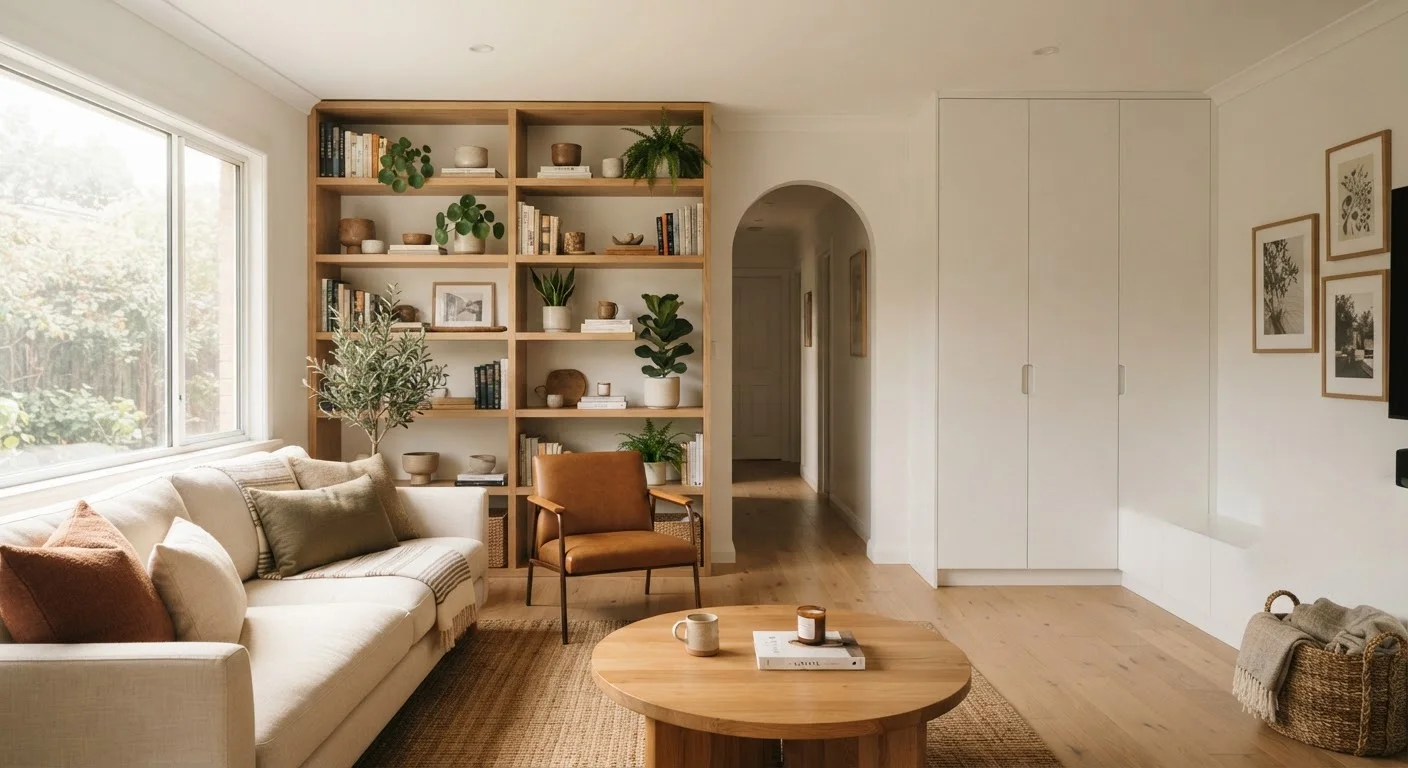
Key Takeaways
Option A
Open Shelving
The airy, display-forward choice.
Best for: Homeowners who keep tidy collections and want their storage to double as décor.
Option B
Closed Cabinets
The organized, hide-it-all classic.
Best for: Anyone who prioritizes clutter control, dust reduction, and a streamlined visual environment.
If you love displaying books, plants, and curated objects
Open Shelving
Open shelves let your collections become part of the room's design. They reward intentional curation and add personality without additional décor spending.
If clutter accumulates quickly in your home
Closed Cabinets
Closed doors make it effortless to tuck away everyday mess. Your space looks put-together even when life gets busy.
If you have a small living room and want it to feel larger
Open Shelving
Visible wall depth and lighter visual weight can help a compact room breathe. Pair with a consistent color palette on the shelves for best results.
If you live in a dusty environment or have allergy concerns
Closed Cabinets
Cabinet doors significantly reduce dust accumulation on stored items, cutting down on cleaning time and airborne irritants.
If you want flexibility without a full renovation
Open Shelving
Floating shelves are typically less invasive to install and easier to rearrange than built-in cabinetry, making them a lower-commitment starting point.
What Each Option Actually Offers
Open shelving and closed cabinets solve the same basic problem — where to put your things — but they create very different living environments. Understanding what each genuinely delivers (and demands) is more useful than chasing a trend.
Open shelves expose everything stored on them, which means they function simultaneously as storage and as visual design. A well-styled shelf can anchor a room. A neglected one becomes a source of ambient stress. The trade-off is real: open shelving rewards those who enjoy the process of curation and don't mind a light weekly dusting.
Closed cabinets operate on the opposite principle. Doors create a visual boundary — what's inside is out of sight, and the room reads as calmer and more uniform. The drawback is physical: cabinets carry more visual weight, and in a smaller room, a full wall of closed storage can feel oppressive. For more on managing scale and sight lines in compact rooms, see how to make a small room feel larger without structural changes.
| Criterion | Open Shelving | Closed Cabinets |
|---|---|---|
| Visual weight | Light and airy | Heavier, more structured |
| Dust accumulation | Higher — all surfaces exposed | Lower — contents protected |
| Clutter visibility | Everything on display | Hidden behind doors |
| Styling effort required | Ongoing curation needed | Minimal — close the door |
| Installation flexibility | Easier to adjust or relocate | More permanent, especially built-ins |
| Best room size | Works well in smaller rooms | Better suited to larger rooms |
| Child safety | Items accessible at any height | Lockable for hazardous items |
Practical Realities: Maintenance, Dust, and Daily Life
One factor that decorating inspiration photos rarely show: open shelves collect dust at a noticeably faster rate than closed storage. Every surface is exposed to airborne particles, and in homes with pets, fireplaces, or high foot traffic, that buildup can be significant. Plan for a light weekly wipe-down if you go the open route.
Closed cabinets largely eliminate this issue, but they introduce a different one — what interior designers sometimes call invisible clutter. When storage is hidden, it's easy to keep adding items until the cabinet no longer closes properly. A regular declutter session becomes essential. This connects to a broader principle: whichever system you choose, the storage only works as well as the habits behind it. The same logic applies to clothing storage — our room-by-room approach to clearing clutter walks through how to assess what deserves space in any storage system.
~1×/week
Recommended dusting frequency for open shelves
Home organization specialists generally suggest a light weekly wipe-down to keep open shelving looking its best in average households.
50%+
Of homeowners prefer hybrid storage solutions
Surveys of interior design preferences consistently show that most homeowners favor combining open and closed storage rather than committing to one approach exclusively.
For households with young children, closed lower cabinets — particularly those with childproof latches — offer a practical safety advantage by keeping breakables and hazardous items out of reach.
Aesthetic Impact and Room Feel
Open shelves visually extend a wall rather than block it. When shelves are styled with breathing room between objects — a mix of books, a plant, a small piece of art, some negative space — they can make a room feel curated and lived-in in the best sense. If you're new to shelf styling, styling a bookshelf that looks intentional is a practical place to start.
Closed cabinets create visual uniformity, which works especially well in rooms with a lot of competing elements — busy wallpaper, eclectic furniture, or large windows with strong outdoor views. A flush cabinet front quiets the room and lets other design choices take center stage.
A note worth keeping in mind: open shelving in a living space operates on many of the same psychological principles as open-plan floor plans — both maximize perceived spaciousness but reduce visual containment. If you're weighing larger layout decisions too, open-plan living trade-offs covers what changes beyond just the look.
Choosing a Hybrid Approach
For most living spaces, neither extreme is the right answer. A hybrid configuration — open shelves on upper portions of the wall paired with closed storage below — captures the strengths of both. The upper section becomes display space, while the lower cabinets handle everyday clutter: remote controls, cords, games, and anything you want out of sight but within reach.
This arrangement also keeps the visually open portion at eye level, where it has the most design impact, while grounding the room with the contained solidity of cabinet fronts. When planning any significant built-in shelving or cabinetry installation, verify whether your local building codes or rental agreements have any requirements, and consult a qualified contractor for wall-anchoring or structural work.
Whether you choose open, closed, or a blend, the underlying goal is a storage system that fits how you actually live — not just how a room looks the day after it's styled. That means being honest about your tidiness habits, how often your collections change, and how much maintenance you're willing to do consistently. The best storage solution is the one you'll actually maintain. For a broader framework on evaluating home purchases and upgrades before committing, practical buying guidance offers a useful starting point.