

Key Takeaways
Why Most Bookshelves Look Cluttered
A bookshelf filled wall-to-wall with objects doesn't automatically feel rich or layered — it usually just feels dense. The difference between a shelf that reads as curated and one that reads as chaotic comes down to three things: editing, variety, and breathing room. Most shelves struggle because they try to hold everything, rather than showcasing a considered selection.
This is less about buying new décor and more about making deliberate choices with what you already own. As the principles of layered rooms show, objects work together best when there's a clear sense of hierarchy and contrast — and that logic applies directly to individual shelves.
Less Really Is More Here
The most common styling mistake is treating the shelf as storage that happens to be visible. Aim for a shelf that holds fewer things, each chosen on purpose. A shelf with 60% of its capacity filled and thoughtful groupings will almost always look better than one packed to the edges. Let the objects breathe.
What You'll Need Before You Start
Gather everything currently on your shelves and set it on a nearby surface. This full edit pass lets you see the complete inventory and make decisions without working around items already in place.
What you will need
Soft dusting cloth
Wipe shelves clean before placing items so you're starting with a fresh surface.
Small plants or cuttings
Introduce organic texture and varying heights to break up rows of books.
Bookends
Support upright book groupings and act as anchoring decorative elements on a shelf.
Decorative objects (bowls, sculptures, framed photos)
Provide varied silhouettes and textures to create visual interest between book clusters.
Step-by-Step: Arranging Your Shelves
Follow these steps in order. Resist the urge to jump ahead — each stage builds on the last, and skipping the editing phase is the single most common reason shelves still look cluttered after rearranging.
Edit before you arrange
With everything off the shelf, sort items into three groups: keep, relocate, and remove. Be honest. Objects that have no visual or personal value just add noise. Aim to keep roughly 70–80% of each shelf's capacity filled — this leaves room for negative space, which is doing active design work, not waiting to be filled.
Establish a loose color and texture palette
Before placing anything, look at the keepers and identify two or three repeating colors and at least two distinct textures — for example, matte ceramic, natural wood, and woven fabric. This doesn't mean everything must match; it means the shelf should have a thread of continuity that makes variety feel intentional rather than random.
Vary height, depth, and orientation on each shelf
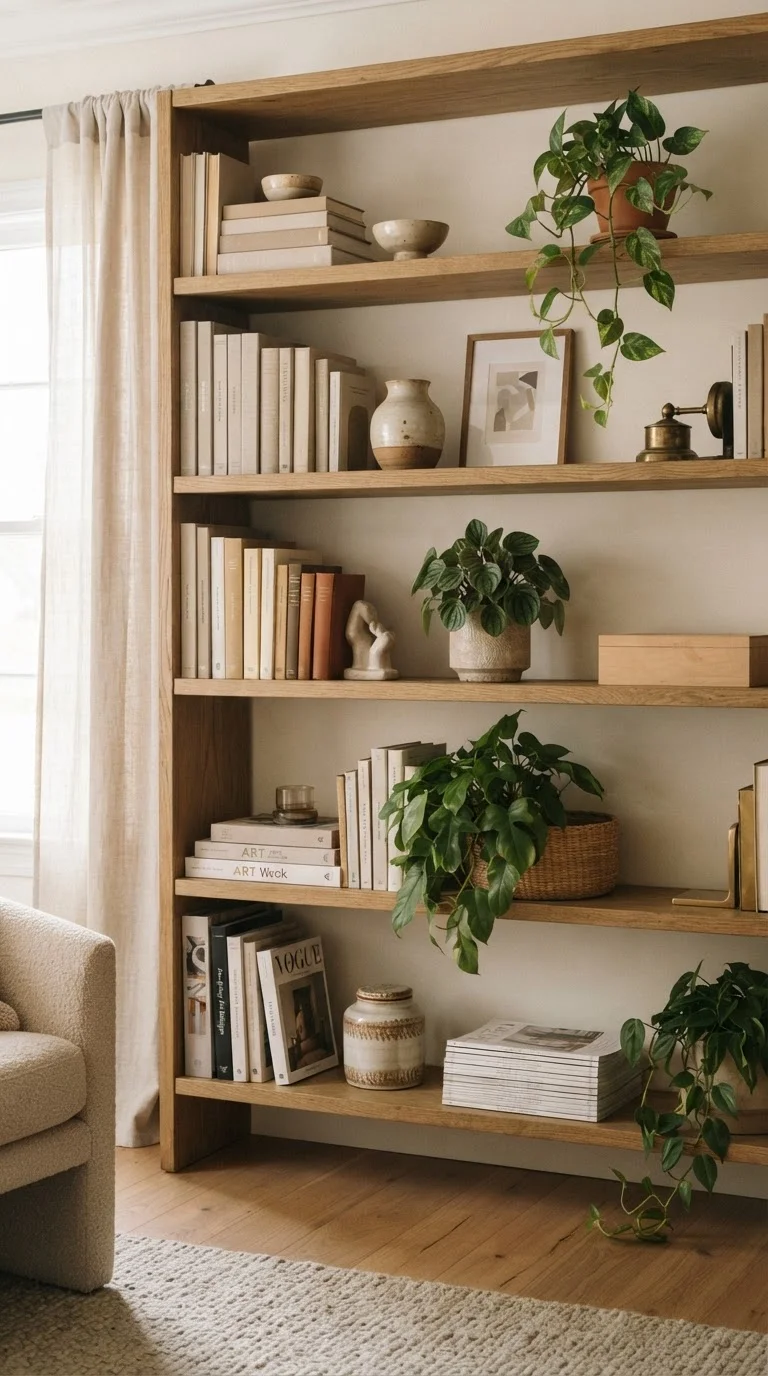
Place taller objects on one end of a shelf, stepping down to shorter items. Mix vertically stacked books with one or two horizontal stacks — the horizontal stacks also create platforms for small objects placed on top. Pull some items toward the shelf's front edge and push others back; that variation in depth creates shadow and dimension that a flat lineup never achieves.
Group objects in odd numbers
Groupings of three or five tend to feel more dynamic than pairs or even-numbered clusters, which can read as stiff or symmetrical. Within each grouping, aim for one tall element, one medium, and one low or flat — this triangle structure is easy to execute and consistently reads as intentional to the eye.
Protect negative space deliberately
Once items are placed, identify one spot on each shelf where you leave a visible gap — a section with nothing at all, or just a single understated object with clear space around it. This is the element most people resist, but it's what signals that the shelf was styled rather than packed. Negative space gives the eye a place to rest and makes the objects nearby feel more considered.
Step back and adjust with fresh eyes
Move to the other side of the room and look at the full shelf unit. Check whether the visual weight is balanced across the whole piece — not identical left-to-right, but roughly settled, without one corner feeling dramatically heavier. Make small adjustments: slide an object left, swap a book cluster to a different shelf, or move a plant one tier up. Repeat until the arrangement feels calm when you glance at it.
Don't Style While the Shelf Is Still Full
Trying to rearrange items without first clearing the shelf entirely tends to produce the same result with slightly different placement. The editing step — removing everything and being selective about what returns — is where the real improvement happens. Skipping it is the most reliable way to end up frustrated with the outcome.
Maintaining the Look Over Time
A styled shelf isn't static — it drifts as books get pulled, mail accumulates, and objects migrate in. A quick reset every few weeks takes less than five minutes: remove anything that doesn't belong, check that groupings still have breathing room, and rotate one or two objects seasonally to keep the arrangement feeling fresh. This is part of the same habit loop covered in the room-by-room seasonal refresh checklist.
If your shelf starts feeling flat or predictable, the fix is usually contrast — introduce a different texture, swap a horizontal stack for a vertical one, or move a plant to a different tier. You don't need new objects; you need a new conversation between the ones you have. For a broader look at which common decorating assumptions are worth questioning, see decorating myths that keep rooms looking flat.