

Key Takeaways
Option A
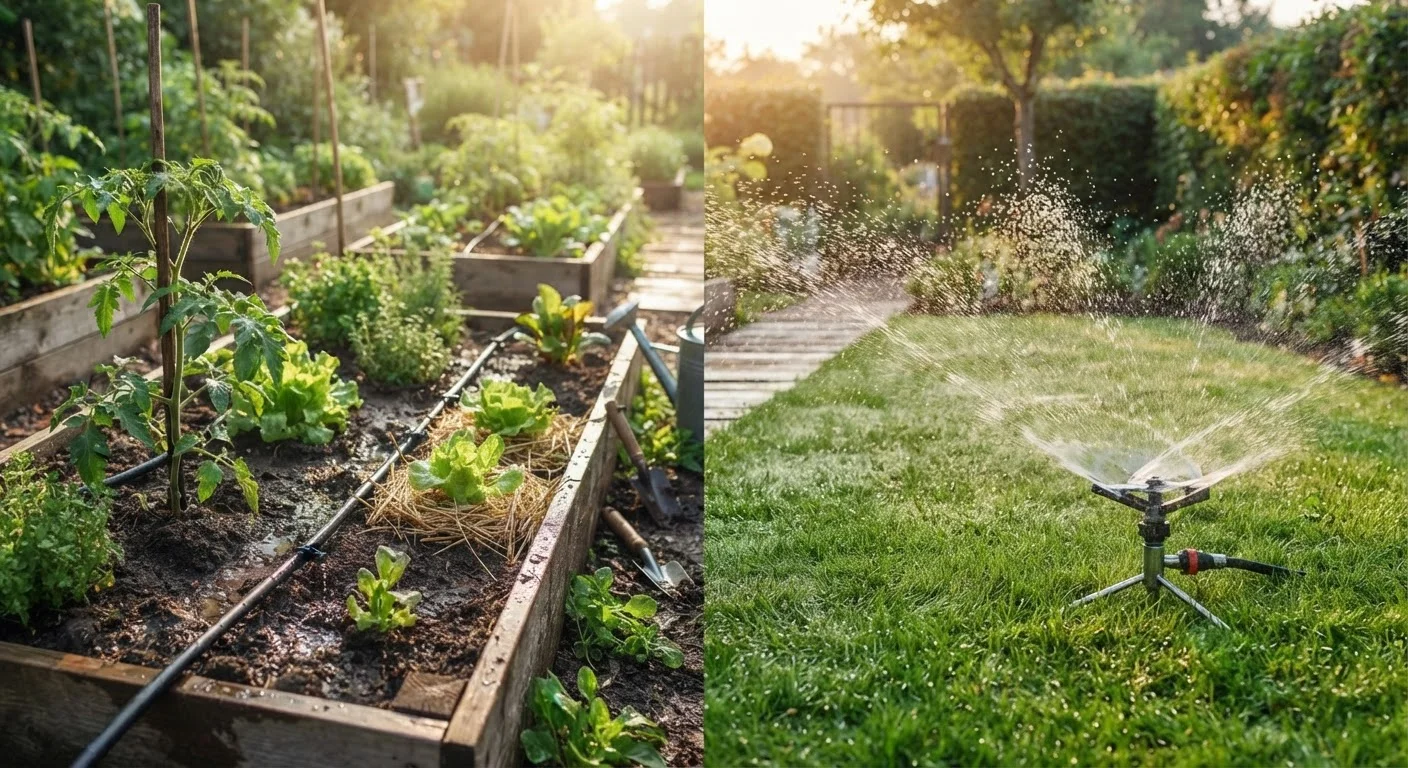
Drip Irrigation
The precision, low-volume watering method.
Best for: Vegetable gardens, raised beds, shrubs, and any planting where targeted root-zone watering and water conservation are priorities.
Option B
Sprinkler Systems
The broad-coverage, high-volume watering solution.
Best for: Lawns, large ground-cover areas, and open landscapes where even overhead coverage across wide zones is needed.
If you grow vegetables, herbs, or flowers in defined beds
Drip Irrigation
Drip emitters deliver water precisely at root level, reducing disease risk from wet foliage and cutting water waste — ideal for food gardens and ornamental beds.
If you need to water a large lawn or open turf area
Sprinkler Systems
Rotary or pop-up sprinkler heads can cover thousands of square feet efficiently, making them the practical choice for established grass lawns.
If water conservation and lower utility bills are a top priority
Drip Irrigation
Drip systems typically use 30–50% less water than overhead sprinklers by minimizing evaporation and runoff, according to general irrigation efficiency research.
If you want a DIY-friendly system for a mixed yard on a budget
Sprinkler Systems
Basic above-ground or oscillating sprinkler setups require minimal tools and no trenching, making them accessible for renters and beginner gardeners.
If you garden in a hot, arid, or drought-prone climate
Drip Irrigation
Drip lines minimize surface evaporation and can be paired with mulch to retain soil moisture — a meaningful advantage in water-restricted regions.
How Each System Works
Understanding the mechanics of each system helps clarify where each excels.
Drip irrigation uses a network of tubes, emitters, and micro-sprayers laid along or just below the soil surface. Water seeps slowly and directly into the root zone at a low flow rate — typically measured in gallons per hour. Because water never leaves the ground surface as a mist, evaporation losses are minimal. Drip systems are pressure-regulated and can be connected to a timer for automated schedules.
Sprinkler systems distribute water from above, mimicking rainfall. In-ground systems use buried supply lines connected to pop-up rotary or fixed spray heads. Above-ground versions range from simple hose-end oscillators to portable impulse sprinklers. Both types broadcast water across an area, which is efficient for turf but less precise for individual plants. For tips on how watering frequency affects plant health, see our guide on deep vs. frequent watering.
Efficiency and Water Use
Water efficiency is often the deciding factor for conservation-minded homeowners.
30–50%
Water savings with drip vs. sprinkler
Irrigation research broadly indicates drip systems use significantly less water than overhead alternatives due to reduced evaporation and targeted delivery.
50%
Water lost to evaporation from sprinklers
The U.S. Environmental Protection Agency (EPA) has noted that conventional sprinkler systems can lose up to half their water output to evaporation and runoff under certain conditions.
~9 billion gallons
Daily outdoor water use by U.S. households
According to the EPA's WaterSense program, American households collectively use roughly this amount on outdoor watering each day, much of it inefficiently applied.
Drip irrigation delivers water slowly and directly, which means very little is lost to wind drift, runoff, or surface evaporation. Mulching over drip lines further reduces moisture loss. Because foliage stays dry, fungal diseases that thrive in wet conditions are less likely to take hold — a meaningful advantage for vegetable gardens.
Sprinklers distribute water as droplets through the air, making them more susceptible to evaporation loss — especially in hot, windy conditions and during peak afternoon hours. Watering at dawn reduces this loss, but sprinklers inherently cannot match the efficiency of drip systems in arid or semi-arid climates. They also tend to water pathways, fences, and bare soil alongside plants, which adds up over a season.
That said, for lawns — where full, even coverage is the goal — sprinklers are the more practical choice. No drip system can efficiently hydrate densely planted grass blades across a wide area.
Installation, Cost, and Maintenance
Both systems vary considerably in what they cost to set up and maintain over time.
| Criterion | Drip Irrigation | Sprinkler Systems |
|---|---|---|
| Water efficiency | High — minimal evaporation | Moderate — subject to drift and evaporation |
| Best suited for | Beds, vegetables, shrubs | Lawns, large open areas |
| Installation complexity | Moderate — DIY-friendly | Low (above-ground) to High (in-ground) |
| Upfront cost | Moderate to high per zone | Low (above-ground) to high (in-ground) |
| Ongoing maintenance | Emitter checks; seasonal flushing | Head adjustments; winterization needed |
| Foliage contact | None — soil-level delivery | Yes — wets leaves and stems |
| Weed promotion | Low — targeted watering only | Higher — waters bare soil between plants |
| Automation compatibility | Yes — timer and sensor ready | Yes — zone controllers available |
Drip systems require more upfront planning: you need to map emitter placements to match each plant's needs, and lines must be adjusted as the garden changes. Emitters can clog with mineral deposits or debris and should be inspected seasonally. However, because the system operates at low pressure, pump and line stress is minimal.
In-ground sprinkler systems require professional installation in most cases — trenching, backflow prevention devices, and local code compliance all add to the complexity. Above-ground sprinklers are much simpler to set up but need to be moved or stored seasonally in frost-prone regions. Sprinkler heads can break if struck by mowers or foot traffic, and pressure imbalances across zones can create dry patches.
If you're deciding on your garden structure at the same time, it's worth reading our comparison of raised beds vs. in-ground planting, since drip systems pair especially well with contained raised beds.
Choosing the Right System for Your Yard
Most American homeowners will find that neither system is universally superior — the right answer depends on what you're growing and where.
If your yard includes both a lawn and garden beds, a hybrid approach is often the most practical: in-ground or above-ground sprinklers for turf zones, and drip lines for planting beds. Many irrigation controllers allow you to run multiple zones on independent schedules, so each area gets exactly what it needs.
Climate matters, too. In the Southwest and other drought-prone states, drip irrigation is often encouraged — and in some areas, incentivized — by local water utilities due to its conservation potential. In cooler, wetter regions, overhead sprinklers may be entirely adequate for keeping lawns healthy without waste.
Consider your plant mix as well. If you grow a variety of annuals and perennials in defined beds, drip irrigation keeps them healthier with less effort. Our article on perennials vs. annuals can help you plan a planting layout that makes the most of a drip system. For broader lawn health guidance, the seasonal lawn care checklist covers watering alongside mowing, aeration, and fertilizing in one practical reference.
When in doubt, start with what your most water-demanding area needs, then layer in the second system as your budget allows.