
Phone-Free Driving: Distraction Patterns and Practical Strategies to Break Them

Key Takeaways
Why Phones Are So Hard to Ignore Behind the Wheel
Phone use while driving isn't a simple failure of willpower. It's a habit loop reinforced by variable rewards — the same psychological mechanism that makes social media feeds compelling. A notification arrives, uncertainty about its content creates tension, and checking it delivers brief relief. That cycle runs whether you're at a desk or doing 65 mph on the freeway.
Research from the National Highway Traffic Safety Administration (NHTSA) has consistently identified distracted driving as a significant contributing factor in crashes and fatalities each year. Sending or reading a text takes your eyes off the road for roughly five seconds — at highway speeds, that's the length of a football field traveled without looking up.
What makes phones uniquely risky compared to other in-car distractions — adjusting the radio, eating, talking to a passenger — is that they pull all three types of attention simultaneously: visual (eyes off road), manual (hand off wheel), and cognitive (mind off driving). See our guide to habits that erode driver awareness for a broader look at how attention degrades behind the wheel.
The Myth of Hands-Free Safety
Many drivers believe switching to Bluetooth or speakerphone resolves the problem. It reduces one category of risk — manual distraction — but doesn't eliminate the cognitive load. Studies from the AAA Foundation for Traffic Safety have found that voice-based interactions, including hands-free calls and voice-activated infotainment commands, can leave drivers in a state of reduced situational awareness for several seconds after the interaction ends.
This matters most in complex traffic environments. Highway and city driving demand very different attention profiles — and in stop-and-go urban traffic, even a brief cognitive gap can mean a missed red light or a late reaction to a pedestrian stepping off the curb.
“Hands-free is not risk-free. Cognitive distraction can last well beyond the moment a driver finishes interacting with a device.”
— AAA Foundation for Traffic Safety, Road safety research organization
The takeaway isn't that hands-free technology is useless — it's that it's not a full solution, and treating it as one creates a false sense of security.
Practical Strategies That Actually Work
Effective phone-free driving comes from building friction into your phone habits before the trip starts, not from relying on willpower while you're already moving.
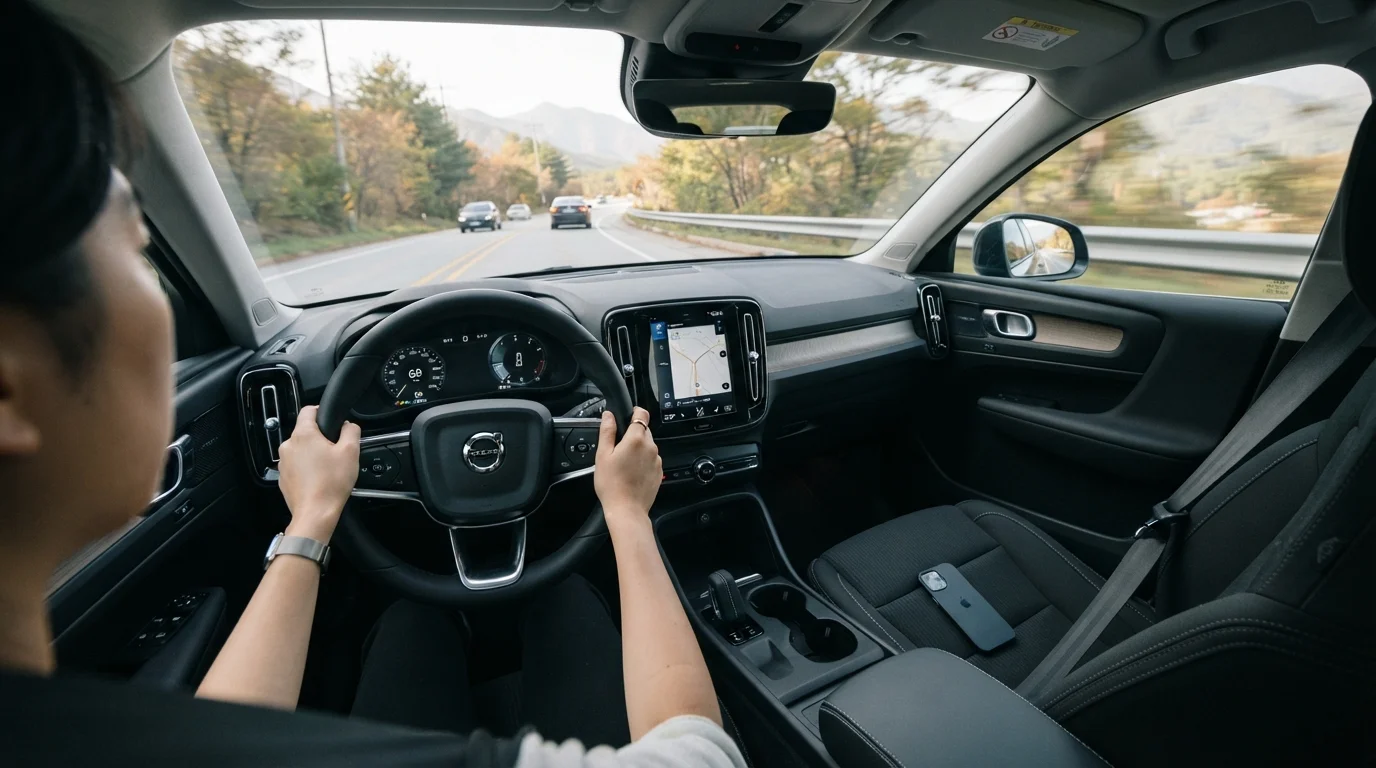
Place your phone in the glove box, back seat, or bag before starting the engine.
Out of sight genuinely means out of mind. When a phone is on the seat or mounted within your field of view, it functions as a constant visual prompt to check it. Removing it from easy reach interrupts the habit loop at its trigger stage.
Enable Do Not Disturb While Driving on your phone before every trip.
Both iOS and Android include automatic driving modes that suppress notifications and, in some configurations, send auto-replies to incoming messages. Removing the auditory and visual triggers eliminates much of the temptation entirely.
Pull over and park completely before making or returning any call.
Urgency bias makes us overestimate how time-sensitive messages are. In practice, most calls and texts can wait five to ten minutes. Building the habit of stopping first makes the boundary feel normal rather than extreme.
Set up navigation and podcasts or music before shifting into drive.
Mid-trip fiddling with maps or audio is a common gateway to phone handling. Running a short pre-drive checklist — destination entered, audio playing, volume set — removes the in-trip need to interact with the phone.
Tell passengers you won't be checking your phone and ask them to help manage it.
Social accountability is a proven behavior-change mechanism. Stating your intention out loud creates a mild commitment effect, and passengers can field calls or respond to texts on your behalf if needed.
Quick Actions You Can Take Right Now
You don't have to overhaul your routine all at once. A few targeted changes can significantly reduce temptation on your very next drive.
Intersections are a particularly high-risk moment for phone checks — the brief pause at a red light feels like downtime, but it isn't. See habits that reduce intersection risk for context on why stopping doesn't mean the danger stops.
Understanding State Laws and Real Consequences
Every U.S. state has some form of distracted driving law, and the majority ban handheld phone use for all drivers. Penalties vary by state but commonly include fines, points on your license, and — in some states — mandatory court appearances for repeat offenses. A distracted driving citation can also affect your auto insurance premiums.
~3,300
U.S. distracted driving fatalities per year
The NHTSA reports thousands of deaths attributed to distracted driving annually in the United States, with phone use a leading factor.
5 sec
Average eyes-off-road time for a text
According to NHTSA data, reading or sending a text while driving at 55 mph is equivalent to traveling the length of a football field without looking at the road.
Beyond legal consequences, the personal stakes are straightforward: reaction time degrades, the risk of collision rises, and outcomes for everyone involved — including pedestrians and cyclists — can be severe. This isn't about shaming drivers; it's about being honest that the habit carries real-world costs. If you're curious how in-car social dynamics influence distraction more broadly, research on passenger influence and crash risk offers useful perspective.