

Key Takeaways
Option A
Name Brands
The recognizable, heavily marketed national choice.
Best for: Shoppers where formulation precision, proprietary technology, or brand trust genuinely affects the product's performance.
Option B
Store Brands
The streamlined, budget-friendly private-label alternative.
Best for: Budget-conscious shoppers purchasing commodity goods where ingredients or specs are virtually identical to the national brand.
If you want to reduce your grocery bill without sacrificing quality
Store Brands
For staples like flour, sugar, canned vegetables, and dairy, store brands typically match name brand quality at a fraction of the price.
If you rely on a specific, clinically tested formulation
Name Brands
For products where the active ingredients or proprietary technology have a documented performance record, the name brand may be the more reliable option.
If you're buying over-the-counter medications
Store Brands
Generic OTC drugs must meet FDA standards for the same active ingredients and dosage — they work the same way at a lower cost.
If taste or texture matters a lot to you personally
Name Brands
For some processed foods, small recipe differences exist. Running a side-by-side taste test at home is the only reliable way to know.
If you're stocking up on household cleaning supplies
Store Brands
Cleaning products like bleach, dish soap, and all-purpose sprays follow standard chemical formulations — store brands routinely perform on par with name brands.
The Same Factory, Two Different Labels
Here's something the packaging rarely tells you: a significant share of store brand products are made by the same manufacturers that produce national brands. Retailers contract with those manufacturers to produce private-label versions — sometimes with identical formulas, sometimes with minor adjustments. The difference you pay for is often the marketing budget, not the product itself.
This is especially common with grocery staples. Canned tomatoes, frozen vegetables, olive oil, oats, and similar commodity goods tend to follow straightforward production standards. When you compare the ingredient list on a store-brand can of diced tomatoes to a name-brand version, you'll frequently find they're indistinguishable. Store brand and name brand comparisons consistently show this pattern across product categories.
Over-the-counter medications are another clear case. The FDA requires that generic drugs — including store-brand versions of pain relievers, antacids, and antihistamines — contain the same active ingredients in the same amounts as their name-brand counterparts. You are legally getting the same medicine for less money.
| Criterion | Name Brands | Store Brands |
|---|---|---|
| Average price premium | 20–30% higher on average | Lower shelf price |
| OTC medications | Same active ingredients | FDA-required equivalent formula |
| Grocery staples | Often identical ingredients | Often identical ingredients |
| Marketing & packaging spend | High — baked into price | Minimal — savings passed on |
| Specialized formulations | May have proprietary edge | May not replicate exactly |
| Warranty & support (electronics/tools) | Typically more robust | Often limited |
| Satisfaction guarantees | Varies by brand | Many retailers offer guarantees |
Where Name Brands Actually Earn Their Price
Not every premium price is unjustified. There are categories where formulation genuinely matters and where name brands have invested in proprietary research, stricter quality controls, or distinct ingredient combinations that store brands don't replicate precisely.
Specialized skincare is one example. A moisturizer built around a patented peptide complex or a dermatologist-developed formula is not directly comparable to a store-brand lookalike. The same logic applies to certain baby products, where parents reasonably want the formulation that has the longest safety track record.
Complex power tools or electronics are another area worth scrutiny. Brand-name products in these categories are often backed by dedicated customer support, replacement parts ecosystems, and warranties that store equivalents don't offer. Buying cheaper isn't always saving money when a cheaper item fails quickly and lacks support.
The practical test: ask whether the specific difference in formulation, materials, or support structure is something that will actually affect your experience. If it will, the name brand may be worth it. If it won't, you're likely paying for the logo.
~25%
Average store brand price savings vs. name brands
Consumer Reports and industry research have generally found store brands priced roughly 20–30% less than comparable name-brand products across grocery categories.
~40%
Share of U.S. grocery units sold that are private label
Private Label Manufacturers Association (PLMA) data has indicated that store brands account for a substantial and growing share of total U.S. grocery unit sales.
Same actives
FDA standard for generic OTC drugs vs. name brands
The U.S. Food and Drug Administration requires generic over-the-counter drugs to contain identical active ingredients, strength, dosage form, and route of administration as their name-brand equivalents.
How to Compare Them Without Guessing
Making smart choices between store brands and name brands comes down to a few straightforward habits rather than brand loyalty or assumptions.
- Read the ingredient list side by side. If the ingredients are the same in the same order (ingredients are listed by weight), the products are functionally equivalent.
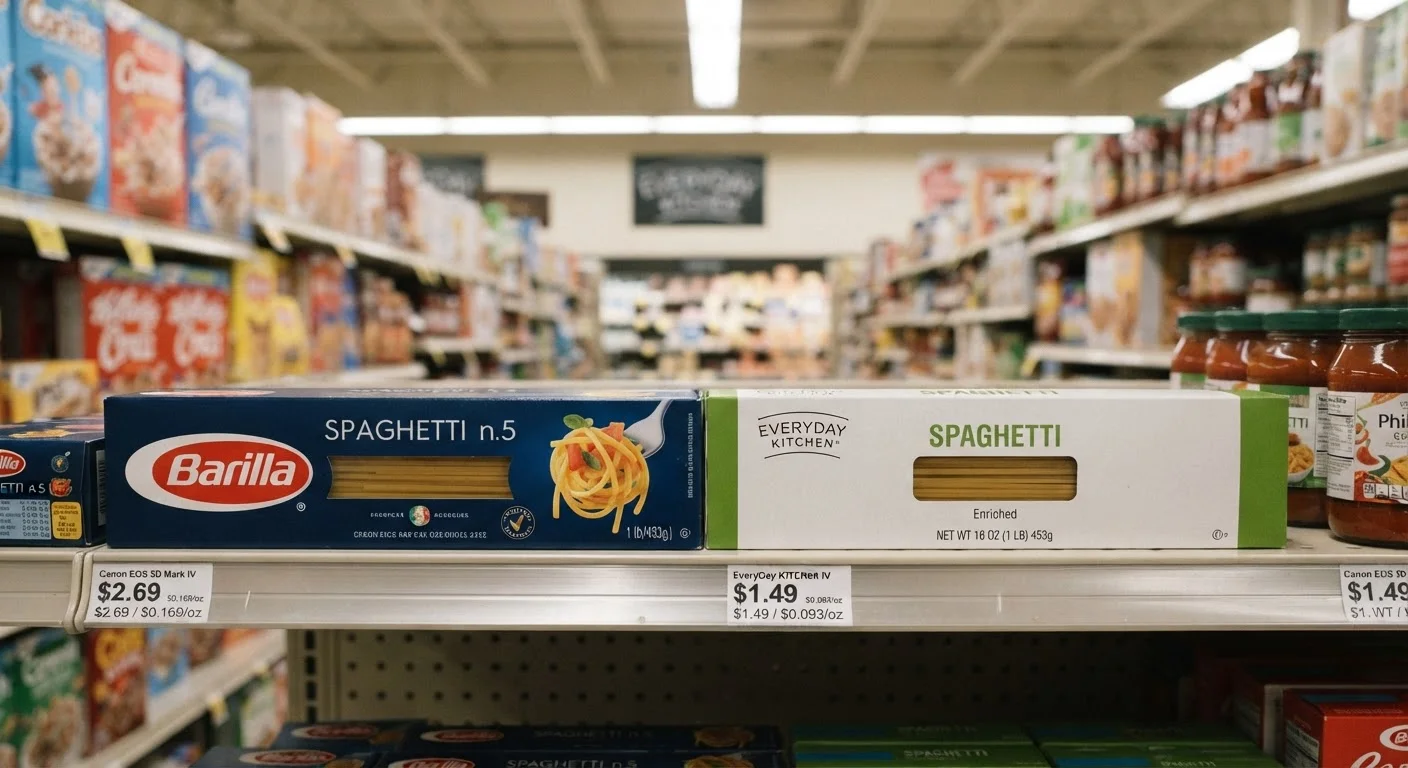
- Calculate the unit price. Shelf tags often include a per-ounce or per-unit price. This strips away package-size differences and shows the real cost comparison.
- Check the return policy. Some retailers stand behind their store brands with satisfaction guarantees, making a trial purchase low-risk.
- Start with low-stakes categories. Switch one or two staples — pasta, rice, canned goods — and see if you notice any difference before committing to broader changes.
Premium pricing signals quality — but not always. The same principle applies here: the higher price on a name brand is a signal worth questioning, not automatically trusting. And retailers know how to use pricing psychology to make you feel like you're getting a deal either way — see how price anchoring shapes what feels like a bargain.
This article provides general consumer information and education. It is not personalized financial or purchasing advice. Consult relevant professionals for decisions specific to your circumstances.