

Key Takeaways
Why Native Plants Belong in Your Garden
Gardening with native plants isn't just an environmental statement — it's one of the most practical decisions a homeowner can make. Species that evolved in your region already know how to handle local rainfall patterns, soil composition, and temperature swings. That means less supplemental watering, fewer soil amendments, and dramatically less intervention once plants are established.
Beyond the maintenance benefits, natives form the foundation of local food webs. They provide nectar, seeds, and habitat that non-native ornamentals often can't replicate. A garden designed around regionally appropriate species can support dozens of native bee species, migrating monarch butterflies, and songbirds — all without extra effort on your part.
Whether you're planning a full landscape overhaul or simply adding a pollinator border, the eight plants below represent strong, well-documented choices organized by the region where they naturally thrive. Pair this guide with a seasonal planting calendar to time your purchases and installations correctly.
What "Native" Actually Means
A plant labeled "native" can mean it's native to North America broadly, to a particular region, or even to a specific state or watershed. For the best ecological results and garden performance, aim for plants native to your specific ecoregion rather than the continent as a whole. Your local Cooperative Extension Service is a reliable, free resource for region-specific native plant lists and planting guidance.
Standout Native Plants by Region
Purple Coneflower (Echinacea purpurea) — Midwest & Eastern U.S.
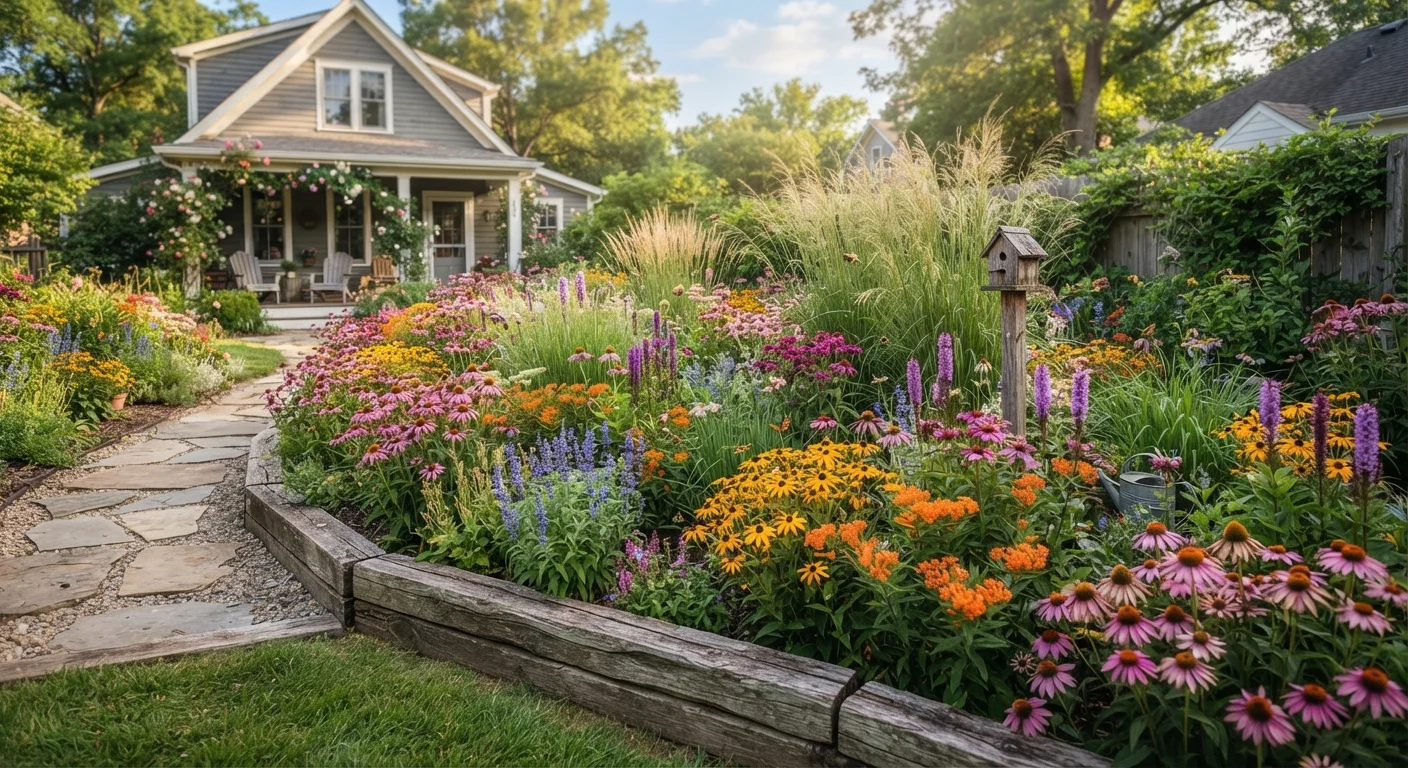
Few native perennials are as widely adaptable or as visually rewarding as purple coneflower. Native to prairies and open woodlands from the Midwest through the Eastern Seaboard, it produces bold magenta-pink daisy-like blooms from early summer into fall. The prominent seed heads that follow attract goldfinches and other seed-eating birds through winter, extending its ecological value well past peak bloom.
Coneflower tolerates clay soil, summer drought, and full sun conditions that would stress many garden perennials. It spreads gradually by self-seeding, forming natural colonies over time with minimal intervention.
Purple coneflower feeds pollinators in summer and seed-eating birds through winter — a two-season performer.
Black-Eyed Susan (Rudbeckia hirta) — Widespread Across the U.S.
One of the most geographically versatile native wildflowers, black-eyed Susan grows naturally across nearly every U.S. region. Its golden-yellow petals surrounding a dark central cone bloom prolifically from late spring through early fall, making it a workhorse in pollinator gardens. It's a short-lived perennial in many zones, often behaving as a biennial, but it self-seeds reliably enough to maintain a permanent presence.
It performs well in average to poor soils, making it an excellent low-input choice for slopes, roadside strips, or naturalized lawn areas where fertility is limited.
Black-eyed Susan thrives in poor soils and self-seeds reliably, making it nearly effortless to maintain.
Wild Columbine (Aquilegia canadensis) — Eastern Woodlands
Wild columbine is a delicate but resilient native suited to shaded and partially shaded sites in the eastern half of the country. Its distinctive red-and-yellow nodding flowers appear in early spring, making it one of the season's first nectar sources for returning ruby-throated hummingbirds. It naturalizes beautifully under deciduous trees and along shaded garden borders.
Unlike many shade-tolerant plants, columbine also tolerates dry conditions once established, making it well-suited to the dry shade beneath tree canopies — a notoriously difficult planting environment.
Wild columbine is one of the earliest spring nectar sources for ruby-throated hummingbirds in eastern gardens.
Desert Marigold (Baileya multiradiata) — Southwest & Arid West
Desert marigold is built for the harsh conditions of the Southwest, thriving in rocky, alkaline soils with minimal rainfall. Its cheerful bright-yellow blooms appear repeatedly from spring through fall after each rain cycle, offering extended seasonal color in climates where many ornamentals struggle to survive. The silvery-gray foliage provides visual interest even when the plant isn't in flower.
This species is an outstanding choice for xeriscaping — a water-conserving landscape approach especially relevant in drought-prone regions of Arizona, New Mexico, Texas, and southern California.
Desert marigold blooms repeatedly across the growing season, thriving where most ornamental plants cannot survive.
Oregon Grape (Mahonia aquifolium) — Pacific Northwest
Oregon grape is a low-maintenance evergreen shrub native to the Pacific Northwest that offers four-season interest: clusters of bright yellow flowers in late winter and early spring, blue-black berry clusters in summer that attract birds, and holly-like evergreen foliage that holds color through the wet Pacific winter. It grows naturally in a range of light conditions, from full sun to deep shade beneath Douglas fir.
Its tolerance for the Northwest's heavy clay soils and reliable rainfall makes it an extremely low-effort landscape plant once established — well-suited to foundation plantings, slopes, and woodland garden edges.
Oregon grape provides flowers, fruit, and evergreen foliage across all four seasons with minimal care.
Swamp Milkweed (Asclepias incarnata) — Wet Sites Nationwide
Where soil stays consistently moist — rain gardens, pond edges, low spots in the yard — swamp milkweed is one of the most ecologically impactful native plants available. It's a critical larval host plant for monarch butterflies, and its pink flower clusters are also highly attractive to native bees and swallowtail butterflies. It grows vigorously in full sun with adequate moisture.
Gardeners looking to support monarch populations should consider growing several plants together, as monarch caterpillars consume milkweed foliage quickly. Unlike common milkweed, swamp milkweed spreads more modestly, making it easier to manage in a formal garden setting.
Swamp milkweed is a monarch butterfly host plant that thrives in wet, sunny spots most species avoid.
Little Bluestem (Schizachyrium scoparium) — Great Plains & Southeast
Little bluestem is a native warm-season ornamental grass with exceptional four-season appeal. Green and upright through summer, it turns rich shades of copper, bronze, and burgundy in fall — colors that persist well into winter, providing structure and visual interest when most perennials have died back. It's native to prairies from the Great Plains through much of the Southeast and tolerates poor, dry soils exceptionally well.
As a clump-forming grass, it doesn't spread aggressively, making it manageable in mixed borders alongside flowering natives. Its seed heads provide winter forage for sparrows and other ground-feeding birds.
Little bluestem turns a striking copper-bronze in fall, offering some of the best off-season color of any native grass.
Cardinal Flower (Lobelia cardinalis) — Moist Sites, Eastern & Central U.S.
Cardinal flower produces some of the most saturated red flowers of any native perennial — a color that hummingbirds find irresistible. Native to streambanks and moist meadows across the eastern and central U.S., it thrives in consistently moist, organically rich soil in partial to full sun. It's a short-lived perennial that self-seeds reliably under the right conditions, maintaining its presence in the garden year after year.
Its bold vertical flower spikes, which can reach three to four feet, add strong structural contrast in rain gardens, boggy borders, or alongside water features — environments where a thoughtfully designed outdoor space can make dramatic seasonal impact.
Cardinal flower's intense red blooms are among the most reliable hummingbird attractors in eastern American gardens.
Start Small, Then Expand
If you're new to native gardening, begin with two or three species well-suited to your specific region rather than attempting a full native landscape at once. Observing how each plant establishes and spreads in your soil and microclimate will help you make smarter choices as you expand. Most native perennials look modest in their first year as they concentrate energy on root development — resist the urge to replace them before they've had a full growing season to settle in.
Getting Started With Native Gardening
When sourcing native plants, look for nurseries that specialize in locally grown, regionally appropriate stock rather than plants simply labeled "native" that may have been sourced from distant parts of the country. Plants propagated from local seed stock are often better adapted to your specific microclimate.
Native plants tend to establish best when given time to root deeply before being taxed by drought or heat. Planting in fall — when soil temperatures are still warm but air stress is low — gives roots months to spread before demanding summer conditions arrive. If you're deciding between planting in traditional garden beds or raised structures, our comparison of raised beds vs. in-ground planting can help you choose the right format for your yard. And for building a complete landscape that balances natives with other plant types, mixing perennials and annuals gives you a framework for year-round color without constant replanting.