

Key Takeaways
Our Verdict
Both bodyweight and free weight training are legitimate, evidence-supported paths to building strength and improving fitness. Free weights offer a clearer progression system and are especially useful for those targeting specific strength or muscle-building goals. Bodyweight training lowers the barrier to entry and travels anywhere you do. For most everyday Americans, a flexible mix of both — or simply whichever one you'll actually stick with — will deliver the best long-term results.
| Best for | Recommended |
|---|---|
| Those with no equipment, limited budget, or frequent travel | Bodyweight Training |
| Those focused on measurable strength or muscle-building progression | Free Weights |
| Beginners building baseline fitness and movement confidence | Bodyweight Training |
| Intermediate to advanced lifters seeking structured overload | Free Weights |
What Each Approach Actually Involves
Resistance training — any exercise that makes your muscles work against a force — is one of the most consistently supported tools in general health science, linked to benefits including improved muscle mass, bone density, metabolic health, and functional movement. The debate isn't whether to do it, but how.
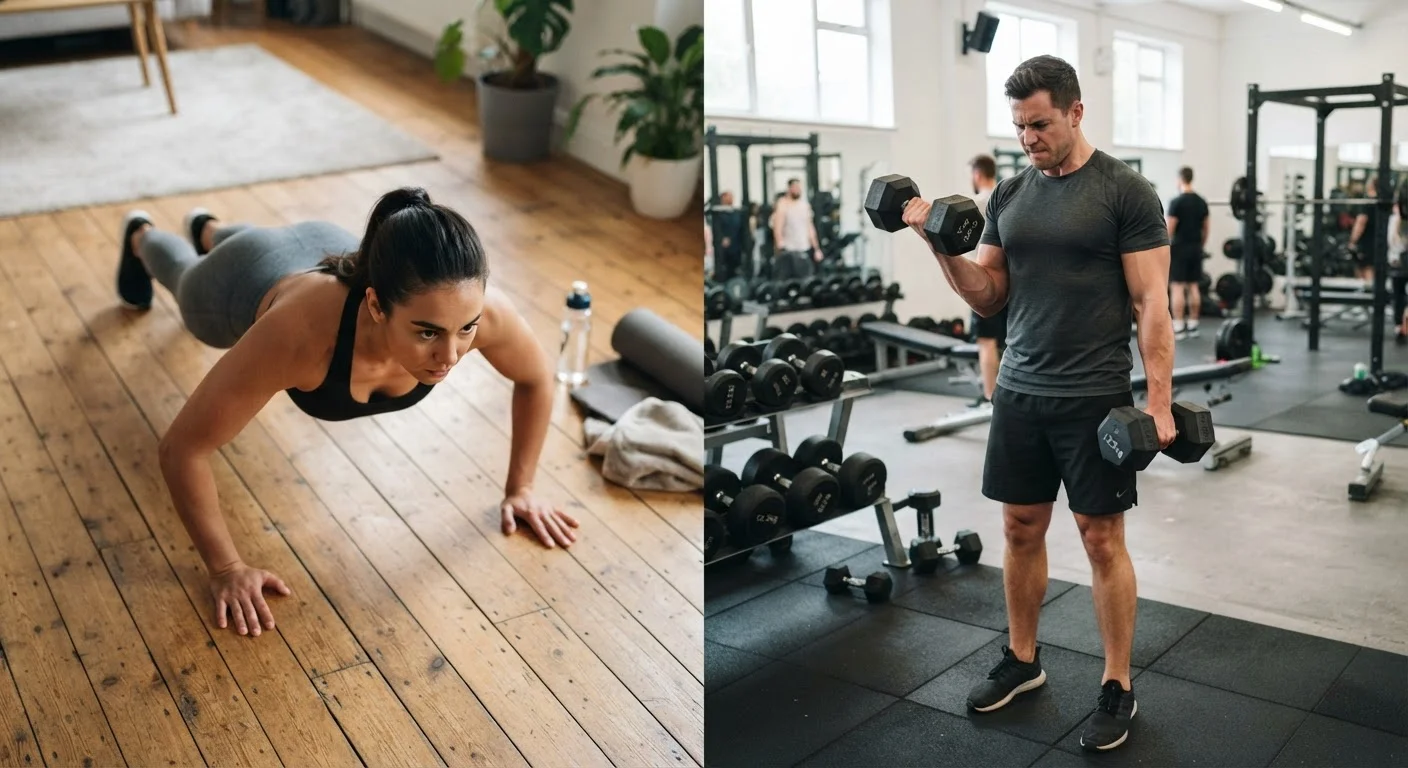
Bodyweight training uses your own body as the resistance: push-ups, squats, lunges, pull-ups, dips, and planks are common examples. Free weights include dumbbells, barbells, and kettlebells — handheld equipment that adds external load to movements. Both challenge the same fundamental principle: progressive overload, meaning you gradually increase the demand on your muscles over time.
Understanding that both methods operate on the same underlying physiology helps cut through a lot of marketing noise. As our fitness myths overview notes, many popular beliefs about exercise mislead beginners — and the idea that one training tool is inherently superior is one of them.
Where Bodyweight Training Has a Real Edge
The most obvious advantage of bodyweight exercise is accessibility. No gym membership, no equipment purchase, no commute. That removes several of the most common barriers people cite for skipping workouts. Research on exercise adherence consistently finds that convenience is one of the strongest predictors of consistency.
Bodyweight movements also tend to be compound — they engage multiple muscle groups and joints simultaneously, which builds functional, real-world strength. A well-executed push-up trains the chest, shoulders, triceps, and core at once.
For beginners, bodyweight training offers a relatively lower injury risk when learning movement patterns, since there is no external load to mismanage. It also scales meaningfully: a push-up can be modified to a wall push-up for beginners or progressed to archer push-ups or single-arm variations for advanced practitioners.
Try Tempo to Extend Bodyweight Progression
When a bodyweight movement starts to feel too easy, slowing down the lowering phase (the eccentric) to three to five seconds significantly increases muscular demand without adding any load. Pausing at the hardest point of the movement — the bottom of a push-up or squat — is another effective technique. These adjustments can meaningfully extend how long bodyweight training remains challenging before you need to seek a more difficult variation.
The main limitation is progression. Once your body adapts to a movement, adding more challenge requires creativity — changing leverage, tempo, or variation — rather than simply adding a plate to a bar. This can become a constraint for those with specific strength or hypertrophy (muscle-building) goals.
Where Free Weights Offer Distinct Advantages
Free weights make progressive overload straightforward. You can add 2.5 or 5 pounds in a controlled, measurable way each week, which is a well-established driver of strength adaptation. This precision is difficult to replicate with bodyweight alone, especially for lower-body movements like squats and deadlifts where body weight alone may not provide sufficient resistance for stronger individuals.
Free weights also expand the range of movements available. Exercises like Romanian deadlifts, bent-over rows, and overhead presses are hard to replicate without external load, and these movements address muscle groups and movement patterns that bodyweight exercises may underserve.
| Bodyweight Training | Free Weights | |
|---|---|---|
| Cost | Free — no equipment needed | Moderate to high upfront investment |
| Location flexibility | Anywhere — home, travel, outdoors | Requires gym or home equipment setup |
| Progression ease | Requires creative variation | Simple load increments |
| Lower body loading | Limited for stronger individuals | Strong — squats, deadlifts, lunges |
| Injury risk for beginners | Generally lower without external load | Higher if form is not established first |
| Muscle-building potential | Moderate, especially upper body | High across all major muscle groups |
| Beginner accessibility | High — easy to modify movements | Moderate — technique learning curve |
For those interested in building muscle mass specifically, research supports that free weights — particularly barbells — allow the volume and load needed to drive meaningful hypertrophy across a range of muscle groups. That said, this doesn't make them a requirement for general fitness. As explored in our strength vs. cardio comparison, what matters most is that you are doing some form of resistance work consistently.
Choosing What Works for Your Life
The right choice depends less on which is objectively better and more on what you will actually do reliably. If a gym feels intimidating, the commute eats into your schedule, or cost is a real barrier, bodyweight training done consistently will outperform a free weight program you abandon in three weeks. The principles of sustainable fitness make clear that adherence over time is the central variable in any exercise outcome.
Many practitioners blend both: using bodyweight movements for warm-ups, travel, or low-equipment days, while incorporating free weights for primary strength work when available. This hybrid approach is practical and well-suited to busy, unpredictable schedules.
If you train primarily at home, our home vs. gym workout comparison covers the full trade-off in detail. And if you want to build movement habits that extend beyond formal sessions, see our guide on movement habits outside the gym.
This article is for general informational and educational purposes only and is not a substitute for professional medical or fitness advice. Consult a qualified healthcare provider or certified fitness professional before beginning any new exercise program, especially if you have existing health conditions or injuries.