

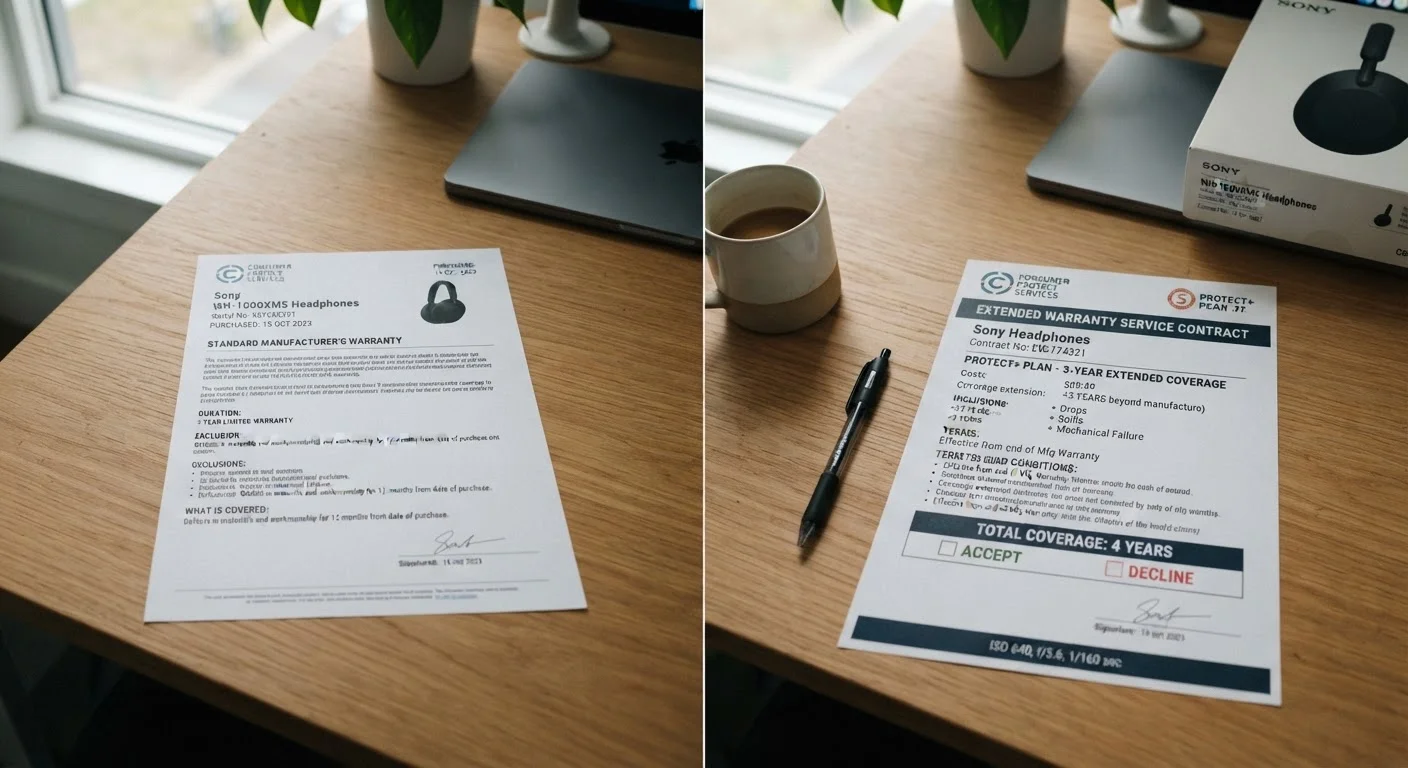
Key Takeaways
Option A
Manufacturer's Warranty
The baseline legal promise that comes with your purchase.
Best for: Consumers who want automatic, included coverage against defects in materials and workmanship during the initial ownership period.
Option B
Extended Warranty
An optional, purchased service contract that picks up where manufacturer coverage ends.
Best for: Consumers who want coverage beyond the manufacturer's terms, particularly for expensive or complex products with high repair costs.
If you want no-cost baseline protection against manufacturing defects
Manufacturer's Warranty
It's included automatically, legally regulated, and covers the period when factory defects are most likely to appear.
If you're purchasing a high-cost appliance or electronic with expensive repair parts
Extended Warranty
Repair costs on complex products can exceed the contract price, making extended coverage financially sensible — but only after carefully reviewing what's excluded.
If the extended warranty term overlaps mostly with the manufacturer's coverage
Manufacturer's Warranty
Paying for duplicate coverage rarely makes financial sense; evaluate the gap period before purchasing any extension.
If you want clear legal recourse and predictable terms
Manufacturer's Warranty
Manufacturer warranties are subject to federal and state regulation, giving consumers stronger, more consistent protections.
If the manufacturer's warranty is unusually short for a product you intend to keep long-term
Extended Warranty
When a manufacturer covers only 90 days on a product you plan to use for five or more years, a well-structured extension may provide real value — provided you understand its exclusions.
What Each Warranty Actually Is
A manufacturer's warranty is a written promise made directly by the company that made the product. It's automatically included in the purchase price and commits the manufacturer to repair, replace, or refund a product that fails due to defects in materials or workmanship within a defined period. This type of warranty is a legally enforceable contract governed at the federal level by the Magnuson-Moss Warranty Act. Learn more in our article on how the Magnuson-Moss Warranty Act protects American consumers.
An extended warranty — more accurately called a service contract — is a separate agreement you purchase, usually from a retailer, a third-party administrator, or sometimes the manufacturer itself. Unlike a manufacturer's warranty, it is not automatically included with the product and is not guaranteed to follow the same federal standards. The terms, administrators, coverage limits, and claim processes can vary dramatically from one contract to another.
The single most important distinction: one is a product feature you already own; the other is an additional financial product you choose to buy. Treating them as equivalent can lead to costly misunderstandings.
| Criterion | Manufacturer's Warranty | Extended Warranty |
|---|---|---|
| Cost to consumer | Included in product price | Additional purchase required |
| Who administers it | The manufacturer | Retailer, third party, or manufacturer |
| Federal regulation | Yes — Magnuson-Moss Act | Varies; often state-regulated only |
| When coverage starts | Date of purchase | Often date of purchase (may overlap) |
| Typical length | 90 days to several years | 1 to 5+ years from contract start |
| Accidental damage | Usually excluded | Sometimes included — check contract |
| Transferability | Varies by manufacturer | Varies by contract |
| Cancellation/refund | N/A | Often allowed within a time window |
Coverage, Exclusions, and Overlap
Manufacturer's warranties typically cover defects that arise under normal use — things like a circuit board that fails prematurely or a seam that separates due to faulty stitching. They generally do not cover accidental damage, misuse, or normal wear and tear. Warranty length varies by product category: many consumer electronics carry a one-year warranty, while major appliances may carry longer coverage on specific components.
Extended warranties often promise broader coverage — sometimes including accidental damage or power surges — but this depends entirely on the specific contract. Common exclusions include cosmetic damage, consumable parts, damage from improper installation, and failures caused by third-party modifications. For vehicles specifically, the exclusions tend to be particularly detailed; our article on extended warranties on vehicles and what the fine print usually says covers this in depth.
A critical overlap problem: many extended warranties sold at the point of purchase begin on the same day as the manufacturer's warranty, not after it expires. If a manufacturer covers a product for two years and you buy a three-year extended warranty starting on day one, you effectively have only one year of additional coverage — not three. Always check the start date in the contract.
Check Who Backs the Contract
With a manufacturer's warranty, the company that made the product is financially responsible for honoring it. With an extended warranty, a third-party administrator may be backing the contract — and if that company goes out of business, your coverage can disappear. Before purchasing an extended warranty, confirm the financial backing and check whether the administrator is licensed in your state. Some states require service contract providers to maintain reserve funds or insurance to protect consumers.
Consumer Rights That Exist Regardless of Either Warranty
Even without a written warranty, consumers often have protections they don't know about. Implied warranties — established under state law, not federal — generally mean that a product must do what it's reasonably expected to do. A washing machine that fails to wash clothes within weeks of purchase may be covered by an implied warranty even if no written warranty exists. Our article on implied warranty vs. express warranty explains when these rights apply.
Additionally, many states have lemon laws that apply to new vehicles and, in some states, other consumer products. These laws provide remedies — such as replacement or refund — when a product has a recurring defect that cannot be repaired after a reasonable number of attempts.
Understanding these background protections helps you evaluate what you're actually gaining when you consider purchasing an extended warranty. You may already have more coverage than you realize. The common warranty myths that cost shoppers money are a good starting point for clearing up what's real and what's marketing.
This article provides general consumer information and education only, not legal advice. If you have a specific warranty dispute, consider consulting a consumer protection attorney or your state attorney general's office.