
Household Debt Payoff: A Comprehensive Guide from First Payment to Final Balance

Key Takeaways
Start With a Full Picture of What You Owe
Most households carry several types of debt at once — credit cards, auto loans, student loans, medical bills, and sometimes a personal loan or two. Before you can pay any of it down effectively, you need to know exactly what you're dealing with.
Pull together every debt you carry and record four things for each one: the current balance, the interest rate (APR), the minimum monthly payment, and the due date. A simple spreadsheet or even a notebook page works fine. The goal is to see the full picture in one place rather than managing each debt in isolation.
Once you have the list, calculate your total minimum payments and compare that number to your monthly take-home income. This single exercise — often called a debt inventory — gives you the foundation for every decision that follows. The Consumer Financial Protection Bureau (CFPB) recommends this kind of structured review as a starting point for anyone trying to get control of their debt.
Record the interest rate alongside every balance — not just the balance. Two debts with similar balances can have wildly different costs depending on their APR, and that difference should drive your payoff order.
Many households focus only on balance size, missing the fact that a lower balance at 24% APR costs more over time than a larger balance at 6% APR.
Set your extra payoff payment as a fixed automatic transfer on payday, not a discretionary manual payment at the end of the month. Whatever is left at month's end tends to get spent.
Automating savings and extra debt payments is a core principle in behavioral finance — removing the decision point eliminates the opportunity to skip it.
If you're not sure where all your debts are, pulling a free credit report from AnnualCreditReport.com will show accounts you may have forgotten or accounts that have gone to collections. Review it carefully for accuracy.
Choose a Payoff Strategy That Fits Your Life
Two well-established methods dominate personal finance guidance, and both work — the difference is in what motivates you.
The Debt Avalanche
With the avalanche method, you put any extra money toward the debt with the highest interest rate first, while paying minimums on everything else. Once that balance is gone, you move to the next highest rate. This approach minimizes the total interest you pay over time, which means you get out of debt faster in most cases.
The Debt Snowball
The snowball method targets your smallest balance first regardless of interest rate. Paying off a small debt quickly delivers a psychological win that many people find keeps them going. Research published through behavioral economics suggests that visible progress — even on a smaller account — reinforces the habit of making extra payments.
Neither method is universally superior. If high-interest debt is costing you hundreds of dollars a month, the avalanche tends to be the smarter financial move. If motivation is your biggest challenge, the snowball may help you build the discipline to stay consistent. See our guide for households starting on a limited income for a practical look at applying these methods when cash is tight.
A third option worth mentioning is debt consolidation — rolling multiple balances into a single loan at a lower interest rate. This can simplify payments and reduce interest costs, but it carries real trade-offs. Review this readiness checklist before taking on a personal loan to consolidate debt to think through whether it makes sense for your situation.
Build a Budget That Makes Room for Debt Payments
A strategy without money behind it stays theoretical. The practical step is carving out room in your monthly budget to make extra payments.
A widely used starting framework is the 50/30/20 rule: roughly 50% of take-home pay toward needs, 30% toward wants, and 20% toward savings and debt repayment. That 20% bucket is where your payoff momentum comes from. Adjust the percentages based on your actual situation — high debt loads may require temporarily shrinking the "wants" category further.
Look for specific spending categories where cuts are realistic: subscription services you rarely use, dining out frequency, or discretionary shopping. Even freeing up $75 to $150 a month beyond your minimums can meaningfully shorten a payoff timeline and reduce total interest paid.
Automate minimum payments on all accounts so you never miss one. A single missed payment can trigger a late fee and a penalty interest rate — both of which work against your progress. Our long-term household budgeting guide covers how to set up and adjust a budget as your financial picture changes. For foundational budgeting strategies, the Budgeting Basics hub is a good place to start.
Don't Skip Minimums on Other Accounts
When you focus extra payments on one debt, it's easy to lose track of minimum payments on the rest. A missed minimum triggers a late fee, possible penalty APR, and a negative mark on your credit report — all of which undermine your overall progress. Automate every minimum payment before directing extra money anywhere.
Saving and Paying Down Debt at the Same Time
It can feel counterintuitive to save money while carrying debt that's accruing interest. But going into debt payoff with zero savings creates a trap: one unexpected expense — a car repair, a medical bill, a lost shift — and you're back to borrowing on a credit card.
Most financial guidance recommends building a starter emergency fund of $500 to $1,000 before aggressively paying down debt. This cushion absorbs small shocks so your payoff plan doesn't unravel. Over time, the goal is three to six months of essential expenses, though building that takes years for most households — and that's normal.
Think of saving and debt payoff as two parallel tracks rather than a competition. Even a small automatic transfer to a separate savings account each payday — $25, $50 — builds the habit and the buffer simultaneously. This article on balancing savings and debt payoff walks through the trade-offs in more detail.
$103,358
Average U.S. household debt
According to Federal Reserve data, average household debt including mortgages, auto, and credit card balances has consistently exceeded six figures for most American families.
20%
Recommended share of income for debt and savings
The 50/30/20 budgeting framework, widely cited by personal finance educators and the CFPB, allocates 20% of take-home pay to savings and debt repayment combined.
$500–$1,000
Starter emergency fund target
Many personal finance frameworks recommend this range as a first savings milestone to protect a debt payoff plan from common unexpected expenses.
Staying on Track Through the Long Middle
The beginning of a debt payoff plan often carries energy and resolve. The end carries the satisfaction of a zero balance. The difficult part is the long stretch in between, where progress can feel invisible.
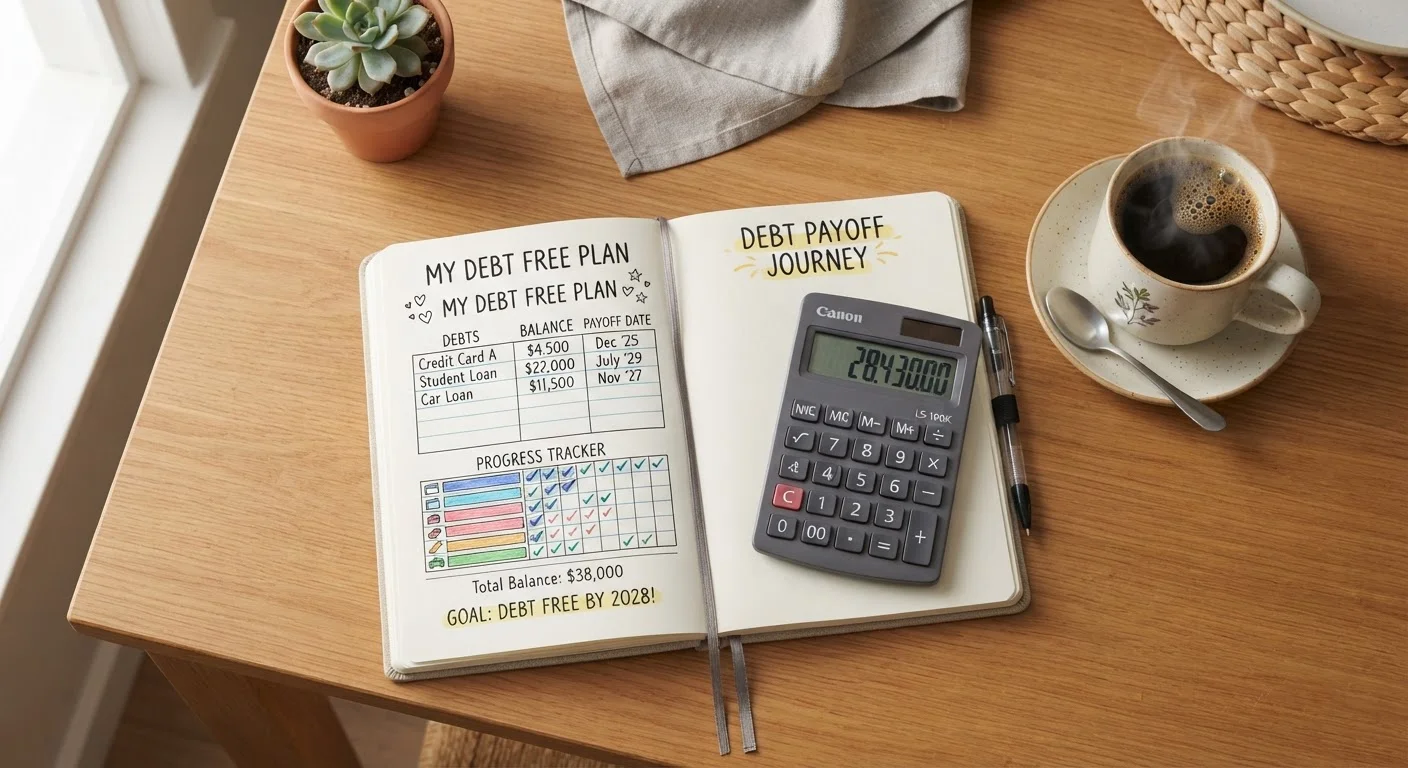
Break your payoff into visible milestones: paying off the first account, reaching the halfway point on a large balance, or hitting a cumulative payoff total. Mark each one. Some people use a simple paper chart where they color in progress; others use a spreadsheet. The medium doesn't matter — what matters is making progress visible.
Review your debt inventory monthly, even briefly. Watching balances actually fall — even slowly — reinforces that the effort is working. If you receive a tax refund, a bonus, or any unexpected income, consider directing a meaningful portion toward your target debt. A single lump-sum payment can shorten a payoff timeline considerably.
Also revisit your budget periodically. Life changes — income shifts, expenses rise, priorities evolve. A budget that worked six months ago may need adjustment. See Smart Spending guidance for ideas on keeping everyday expenses in check as you work toward payoff.
What to Do When You Hit a Setback
A setback is not a failure — it's a predictable part of a multi-month or multi-year financial process. Job changes, medical costs, car problems, and family emergencies happen. The plan needs to account for that.
If you miss a payment or have to pause extra payments for a month, contact your lender or credit card issuer. Many have hardship programs or can adjust due dates. The CFPB offers free resources on dealing with debt collectors and negotiating with creditors. Acting early — before an account goes delinquent — gives you significantly more options.
Revisit your debt list and reprioritize if needed. If your emergency fund took a hit, consider temporarily redirecting extra debt payments toward rebuilding it before resuming your payoff strategy. A depleted safety net leaves you vulnerable to the next surprise.
The most important thing after a setback is to resume the plan rather than abandon it. Imperfect progress is still progress.
Know Your Rights With Debt Collectors
If any of your debts have gone to collections, the Fair Debt Collection Practices Act (FDCPA) gives you specific legal rights — including the right to request written verification of the debt. The CFPB provides free guidance on these protections at consumerfinance.gov. You do not have to accept harassment or misrepresentation from any collector.
Life After the Final Payment
When the last balance hits zero, the habit of making those monthly payments doesn't have to disappear — it can be redirected. The amount you were putting toward debt is now available for savings, retirement contributions, or other financial goals.
Consider redirecting former debt payments toward an employer-sponsored retirement account if you haven't been contributing fully, or toward building your emergency fund to a comfortable three-to-six-month level. This redirection — sometimes called a "debt payoff dividend" — is one of the real long-term payoffs of getting through the process.
Review your credit report after payoff to confirm that accounts show a zero balance and are reported as paid in full. Errors on credit reports are more common than many people realize and can be disputed through the credit bureaus at no cost.
Finally, think about what practices kept you on track and make them part of your ongoing financial routine: monthly budget reviews, automatic savings transfers, and periodic check-ins on your overall financial picture. The discipline built during debt payoff is genuinely transferable to every other financial goal you'll pursue.
This article is for general informational and educational purposes only and does not constitute personalized financial, legal, or tax advice. Please consult a qualified financial professional for guidance specific to your situation.