

Key Takeaways
Option A
Zero-Based Budgeting
The meticulous, dollar-by-dollar approach to total spending control.
Best for: People who want to account for every dollar of income and minimize spending leakage.
Option B
The 50/30/20 Method
The streamlined, percentage-based framework for balanced financial priorities.
Best for: People who want a simple structure that covers needs, wants, and savings without micromanaging.
If you want maximum control over every spending category
Zero-Based Budgeting
Assigning every dollar a purpose makes it nearly impossible for money to disappear into vague categories. It's the most granular level of oversight available.
If you want a simple system you can maintain without much effort
The 50/30/20 Method
Three broad categories require far less tracking and decision-making, making this method much easier to sustain long-term for most people.
If you're paying down high-interest debt aggressively
Zero-Based Budgeting
You can deliberately carve out extra dollars for debt repayment each month rather than relying on a fixed percentage that may not match your payoff timeline.
If your income is stable and your finances are generally on track
The 50/30/20 Method
When your core expenses are predictable, a percentage-based split is usually enough structure to keep savings growing and spending balanced.
If your income varies month to month
Zero-Based Budgeting
Rebuilding your budget from scratch each month naturally accommodates income fluctuations, letting you reprioritize spending when earnings shift.
How Each Method Works
Understanding the mechanics of each approach makes it much easier to judge which one fits your life.
Zero-Based Budgeting
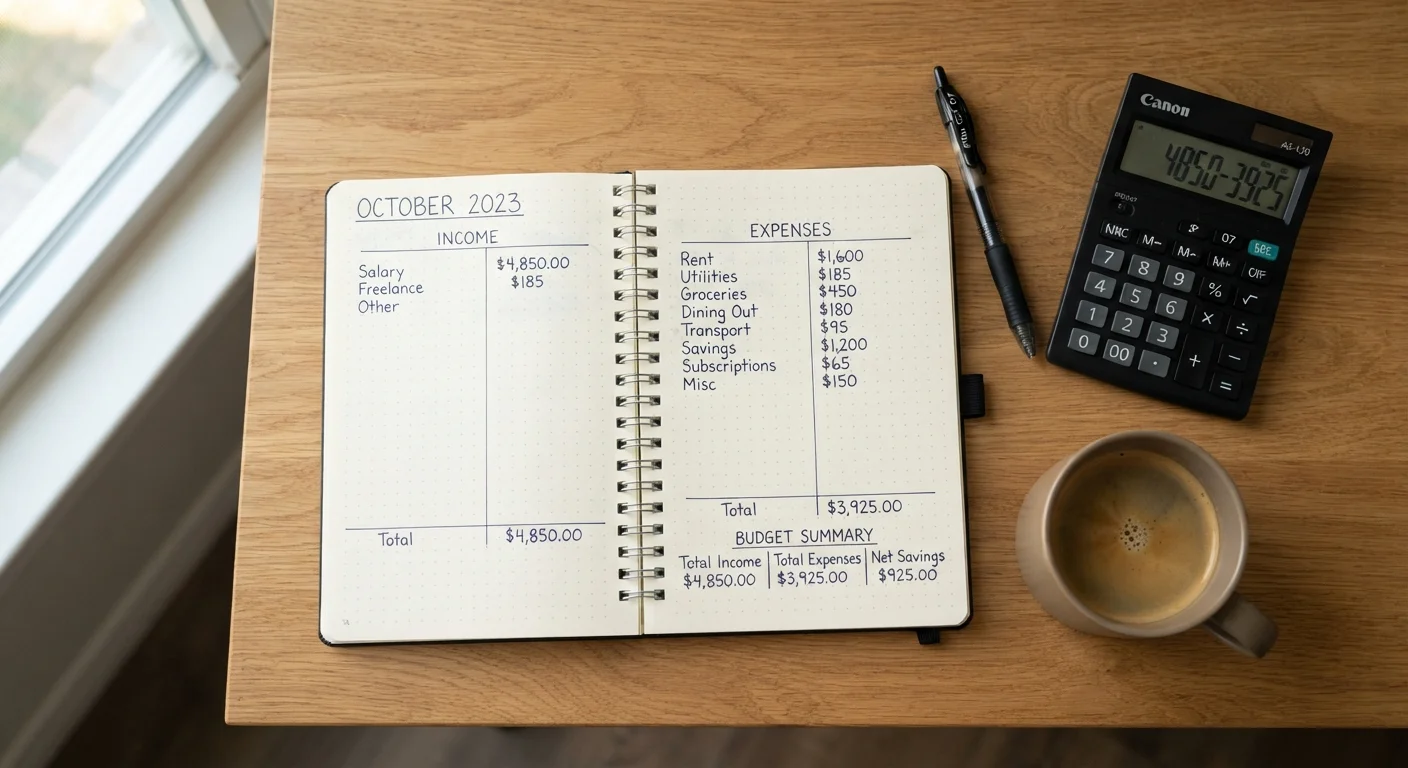
With zero-based budgeting (ZBB), you start with your monthly take-home income and assign every single dollar to a category — housing, groceries, transportation, savings, entertainment, and so on — until you reach zero dollars unallocated. That doesn't mean you spend everything; savings and debt payments are categories too. The point is that every dollar has a deliberate destination before the month begins. If your income changes next month, you rebuild the budget from scratch. For a deeper look at foundational concepts, see our guide to household budgeting from the ground up.
The 50/30/20 Method
The 50/30/20 rule — popularized in personal finance circles and rooted in work by Senator Elizabeth Warren and her daughter Amelia Warren Tyagi — divides your after-tax income into three broad percentages: 50% toward needs (rent, utilities, groceries, insurance), 30% toward wants (dining out, subscriptions, hobbies), and 20% toward savings and debt repayment. You don't track individual line items within each bucket; you simply keep spending within each category's ceiling. Our article The 50/30/20 Rule Explained walks through this framework in full detail.
| Criterion | Zero-Based Budgeting | 50/30/20 Method |
|---|---|---|
| Core concept | Every dollar assigned a job | Income split by percentage |
| Monthly setup time | High — rebuilt each month | Low — percentages stay fixed |
| Tracking detail | Line-item categories | Three broad buckets |
| Handles variable income | Well — recalculated monthly | Requires a workaround |
| Best for debt payoff | Strong — allocate aggressively | Moderate — fixed 20% cap |
| Ease of sticking with it | Harder — high maintenance | Easier — low maintenance |
| Visibility into spending habits | Very high | Moderate |
Key Trade-Offs to Consider
Each method has genuine strengths — and real limitations that can make or break your budgeting habit.
~33%
Americans with a written monthly budget
Gallup polling has consistently found that fewer than one in three Americans maintains a detailed monthly household budget.
20%
Savings/debt allocation in 50/30/20
The CFPB recommends directing at least 20% of take-home pay toward savings and debt reduction as a general benchmark.
Time and effort
Zero-based budgeting is more labor-intensive. You'll spend meaningful time at the start of each month categorizing income and projecting expenses. The 50/30/20 method needs far less maintenance — once you know your income, the math takes minutes. If you've struggled to stick with budgets in the past, a simpler system is often the one you'll actually use. See our balanced look at budgeting every dollar for a deeper exploration of that trade-off.
Flexibility and precision
ZBB gives you surgical control — great for catching spending leaks and redirecting money toward specific goals. The 50/30/20 method allows more flexibility within each bucket but can obscure problem areas. For instance, you might stay within the 30% "wants" ceiling while still spending in ways that don't reflect your actual priorities. Our piece on wants, needs, and the gray areas in between addresses exactly that challenge.
Income variability
If your paycheck varies — freelancers, gig workers, commission earners — zero-based budgeting adapts more naturally because you're building a new plan around actual income each month. Fixed percentages can feel arbitrary when your income swings significantly. That said, some people with variable income find it easier to base 50/30/20 calculations on a conservative income floor and treat anything above it as a bonus directed entirely to savings or debt.
This article is for general informational purposes only and does not constitute personalized financial advice. Consider consulting a qualified financial professional for guidance specific to your situation.