

Key Takeaways
The 50/30/20 Rule
The 50/30/20 rule is a simple budgeting guideline that divides your after-tax income into three categories: 50% toward needs, 30% toward wants, and 20% toward savings and debt repayment. It gives people a starting framework for managing their money without tracking every single purchase. The goal is balance — covering essentials, leaving room for enjoyment, and making consistent progress toward financial goals.
The framework was popularized by U.S. Senator Elizabeth Warren and her daughter Amelia Warren Tyagi in their 2005 book 'All Your Worth.' It is often referenced by consumer finance educators and institutions including the CFPB as an accessible entry point to personal budgeting.
How the Three Buckets Work
The 50/30/20 rule works by sorting every dollar of your after-tax pay into one of three buckets before you spend anything. Here's what goes in each:
- 50% — Needs: Housing, utilities, groceries, health insurance, transportation to work, and minimum payments on debts. These are the non-negotiables that keep your life running.
- 30% — Wants: Dining out, entertainment, travel, hobbies, clothing beyond the basics, and any subscription you choose to keep. These are things that make life more enjoyable but could be cut if necessary.
- 20% — Savings and debt repayment: Contributions to an emergency fund, retirement accounts (like a 401(k) or IRA), and any extra payments you make above the minimum on debt. This is the bucket that builds your financial future.
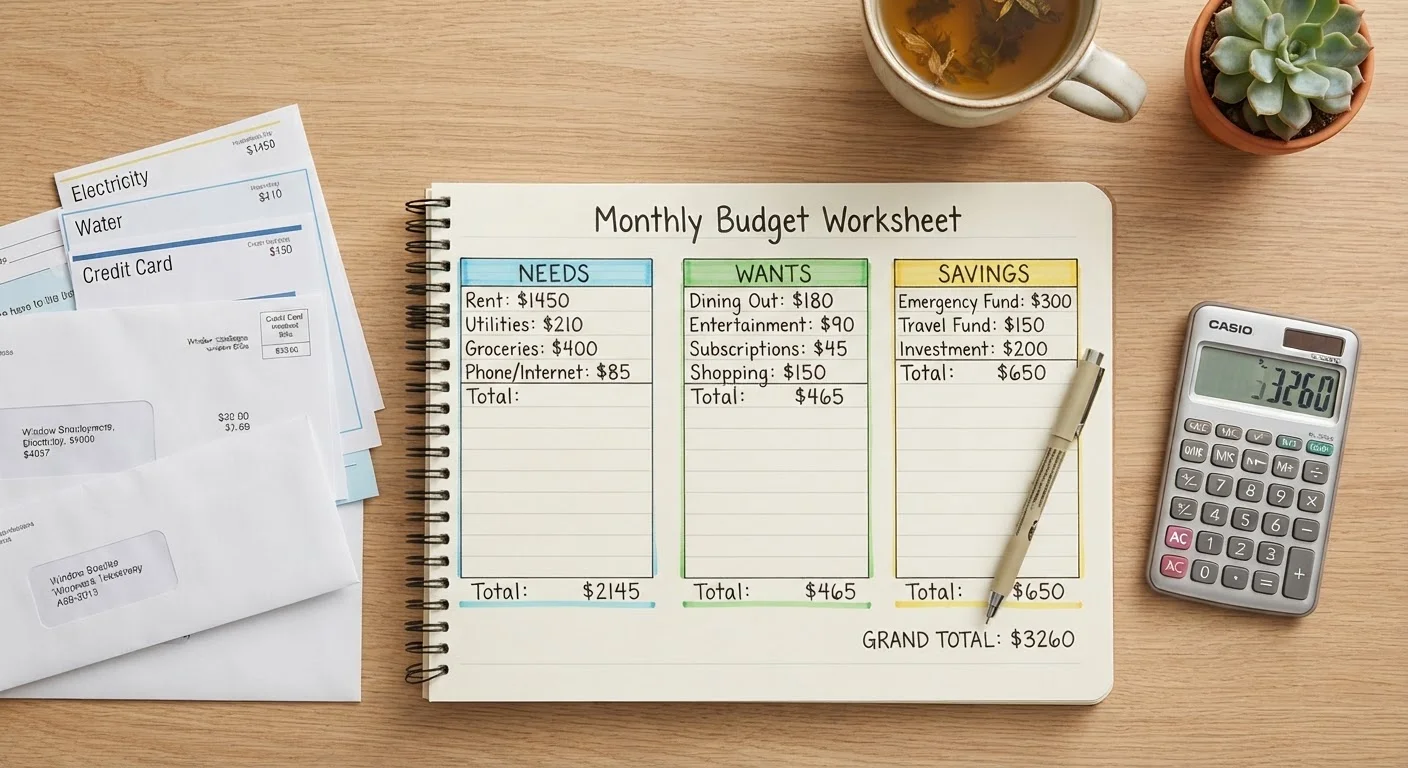
To put it into dollar terms: if your household takes home $4,000 a month after taxes, the rule suggests roughly $2,000 for needs, $1,200 for wants, and $800 for savings and debt payoff.
57%
Americans without a monthly budget
A recurring finding from NFCC financial literacy surveys suggests more than half of U.S. adults do not maintain a monthly household budget.
20%
Recommended savings and debt payoff share
The 50/30/20 rule sets 20% of after-tax income as the target for savings contributions and debt repayment beyond minimum payments.
$1 in $3
Americans with no emergency savings
Federal Reserve surveys have found that a substantial share of U.S. adults would struggle to cover an unexpected $400 expense from savings alone.
Why This Rule Is Worth Knowing
Most Americans don't have a formal budget at all. Research from the National Foundation for Credit Counseling has consistently found that a significant share of U.S. adults spend more than they earn or have no budget in place. The 50/30/20 rule lowers the barrier to entry because it asks you to sort spending into broad categories rather than assign a precise dollar amount to every line item.
That simplicity is its real advantage. You don't need a spreadsheet or an app — you just need a rough sense of where your money goes each month. Once you know your after-tax income, you can check whether each bucket is broadly in balance. If your needs are eating 65% of your income, that's a signal worth paying attention to, whether that means reducing fixed costs, seeking higher income, or revisiting your housing situation.
The rule also builds in room for enjoyment. Budgets that try to eliminate all discretionary spending tend to fail because they're not sustainable. The 30% wants bucket is intentional — it acknowledges that people need some spending flexibility to stay motivated.
“The 50/30/20 rule is less about perfection and more about proportion. Getting the ratio roughly right — even in a tough month — keeps you moving in the right direction.”
— Money & Finance Editorial Team, Personal finance writers covering budgeting and household cash flow
Adjusting the Rule to Fit Your Life
The 50/30/20 rule is a starting point, not a prescription. It was designed for a middle-income household and may not map cleanly onto every financial situation. Here are a few common adjustments worth considering:
- High-cost-of-living areas: If rent alone takes 40% of your take-home pay, hitting the 50% needs target is nearly impossible. In that case, some financial planners suggest temporarily compressing the wants bucket until income or housing costs change.
- Aggressive debt payoff: If you're carrying high-interest credit card debt, redirecting some of your wants percentage toward that debt can save you significantly in interest charges over time. For more on balancing savings and debt repayment, see how to keep savings and debt payoff in balance.
- Early retirement goals: Someone aiming to retire early might push savings to 30% or 40% and reduce discretionary spending accordingly.
- Lower incomes: When income is tight, even hitting 50% for needs may not be possible. In these cases, focus on the direction of travel — reducing the needs percentage over time — rather than hitting the exact number immediately.
For a look at how this rule stacks up against more detailed approaches, see our comparison of zero-based budgeting vs. the 50/30/20 method. You can also explore the pros and cons of budgeting every dollar if you want a more granular approach.
Getting Started With the 50/30/20 Rule
You don't need to overhaul your finances overnight. A straightforward way to begin is to pull one month of bank and credit card statements and roughly sort each transaction into needs, wants, or savings. Add up each category and calculate what percentage of your after-tax income each represents.
That snapshot tells you where you actually stand — which is almost always more useful than where you think you stand. From there, you can decide whether any category needs attention. Even small adjustments, like reducing a recurring subscription or automating a small monthly savings transfer, can shift the balance over time.
If the 50/30/20 rule feels too loose for your situation, you might prefer a spending plan built around your actual priorities. And for a broader look at other frameworks that work alongside this one, other savings frameworks worth knowing can help you compare options.
This article is for general informational and educational purposes only and does not constitute personalized financial advice. For guidance tailored to your specific situation, consider speaking with a licensed financial adviser or credit counselor.