

Key Takeaways
Working with What Your Room Actually Has
Most decorating advice assumes a sun-drenched interior. Real homes — especially apartments, north-facing rooms, and spaces buffered by neighboring buildings — often deal with something far more modest: a few hours of indirect light, or none at all from a natural source. That doesn't rule out plants. It just means choosing and placing them thoughtfully.
Low light in plant terms means a room receives indirect natural light for at least a portion of the day, or has consistent artificial light. True darkness — a closet, a sealed basement — won't support most living plants. But a hallway, a bedroom with a small north-facing window, or a living room set back from the glass? Those spaces can absolutely support greenery, and can look intentional doing it.
If you're also thinking about how lighting affects the way your room reads overall, it's worth reviewing how natural and artificial light interact with decor. Understanding your light situation is the first step to placing plants — and everything else — well.
What 'Low Light' Actually Means
In horticultural terms, low light typically means a space receives no direct sunlight but some ambient daylight — roughly equivalent to being 8–12 feet from a window. True zero-light environments cannot sustain most living plants long-term. If you're unsure of your light level, a simple light meter app can give you a rough reading to work from before you purchase.
Plants That Genuinely Perform in Low-Light Conditions
Pothos (Epipremnum aureum)
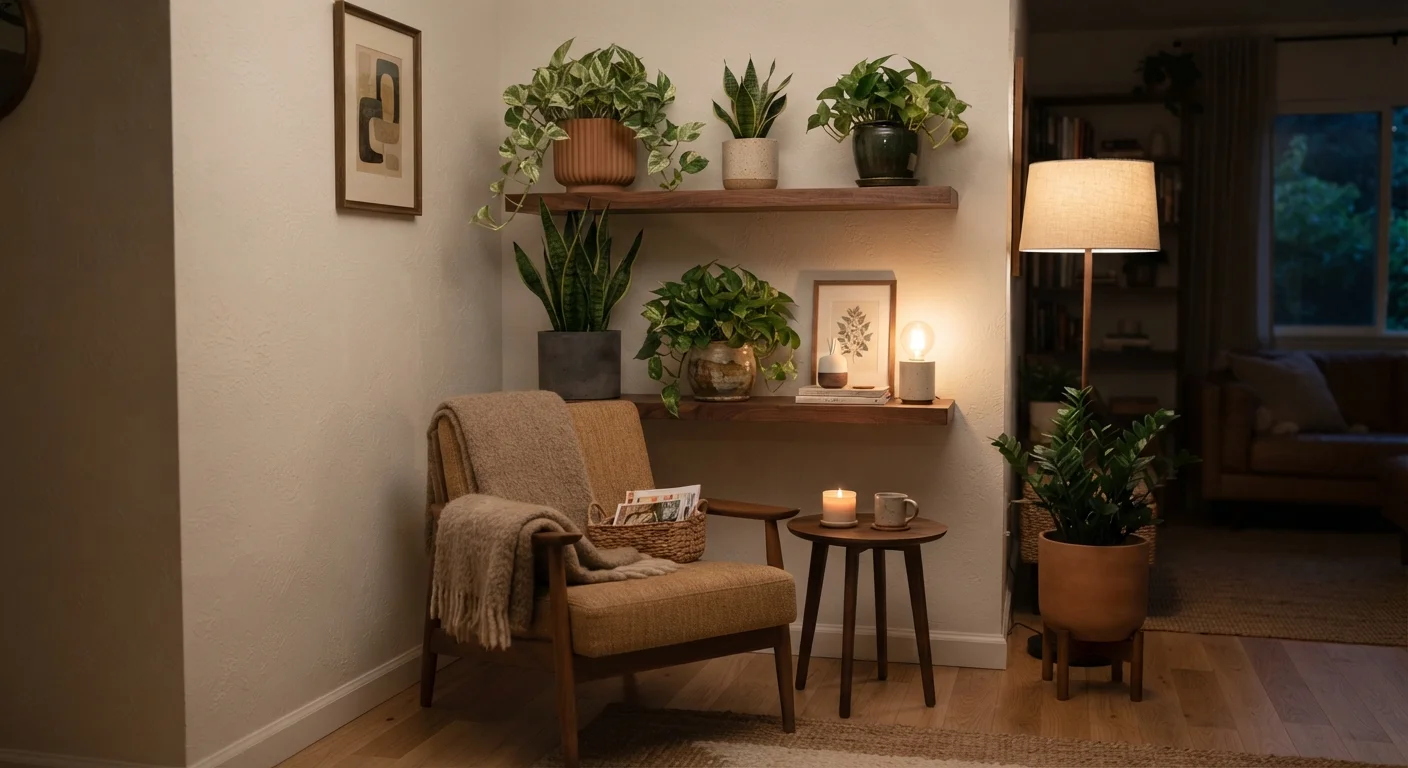
Pothos is one of the most forgiving houseplants available and earns its place in dim rooms through sheer adaptability. It tolerates low light, irregular watering, and a range of temperatures without much complaint. From a decor standpoint, its trailing vines work especially well on high shelves, in hanging planters, or cascading down a bookcase.
Variegated varieties — those with golden or silver marbling — tend to retain some of their patterning even in lower light, though deep shade will push most toward solid green. Either works well as a textural counterpoint to harder surfaces like tile or painted drywall.
Pothos thrives on neglect and fills vertical space effortlessly in dim corners.
Snake Plant (Dracaena trifasciata)
Few plants earn their decor value as reliably as the snake plant. Its upright, architectural form reads as a sculptural element in almost any room — it doesn't sprawl, doesn't shed, and holds its shape without staking. Varieties range from compact rosettes to tall, blade-like columns that can reach several feet.
Snake plants manage well in low-light conditions, though they do best with some indirect light. Their tolerance for infrequent watering makes them practical for rooms you don't spend much time in — a home office, a guest room, a dim entry hallway.
Snake plants bring sculptural height to dim rooms without demanding much care or light.
ZZ Plant (Zamioculcas zamiifolia)
The ZZ plant's glossy, dark-green leaves reflect ambient light in a way that brightens low-light corners without requiring a window nearby. It grows slowly and steadily, making it easy to size correctly for a space. Its thick rhizomes store water, so it handles inconsistent care gracefully.
From a styling perspective, the ZZ plant pairs well with minimalist or mid-century modern rooms. Its clean lines don't compete with patterned textiles or layered furniture — it complements them.
ZZ plants reflect ambient light from glossy leaves, brightening even the dimmest corners.
Peace Lily (Spathiphyllum)
The peace lily is one of the few flowering plants that genuinely blooms in low-light conditions — making it valuable in rooms where most other plants would simply hold foliage. The white spathes (the hood-like blooms) are subtle and elegant rather than showy, which suits dimmer, quieter room palettes well.
Peace lilies prefer consistent moisture and will signal when they need water by drooping slightly — they recover quickly once watered. Keep them away from drafts and heating vents for best results. Note that peace lilies are toxic to pets and children if ingested, so placement should account for household members.
Peace lilies offer rare flowering color in low-light rooms while maintaining elegant understatement.
Cast Iron Plant (Aspidistra elatior)
As its name suggests, the cast iron plant is nearly indestructible. It tolerates deep shade, temperature fluctuations, irregular watering, and low humidity — the conditions that defeat most other indoor plants. Its long, dark, strap-like leaves give it a tropical feel without requiring a tropical climate to survive.
It grows slowly, so it's well suited to spaces where you want consistent scale over time — a corner display that stays the same height year after year. Its durability makes it a sensible investment for rooms where conditions are genuinely challenging.
Cast iron plants survive conditions that defeat most houseplants, rewarding patience with lasting structure.
Chinese Evergreen (Aglaonema)
Chinese evergreens are among the most decoratively versatile low-light plants available. They come in a wide range of leaf colors — from deep green to silver-streaked, pink-flushed, and red-margined varieties — letting you pick foliage that coordinates with your existing palette. The more vivid varieties need somewhat brighter conditions to maintain their color, while the darker green forms are genuinely low-light tolerant.
They work well on side tables, credenzas, or plant stands at sitting height, where the leaf patterning is easy to appreciate. Chinese evergreens are toxic to pets if ingested, so placement matters in pet-friendly homes.
Chinese evergreens offer striking foliage color options, letting you match plant to room palette deliberately.
Consider a Grow Light for Deeper Rooms
If your space gets almost no natural light, a basic grow light on a timer can supplement what's missing without dominating the room. Many grow lights now come in warm-toned bulb options that blend naturally into ambient lighting. Running them for 10–12 hours a day can meaningfully extend your plant options beyond strict low-light species.
Placement Principles That Make the Difference
A single healthy plant in a well-chosen container, placed at the right height, will read better than a crowded shelf of struggling specimens. Use plant stands or stools to vary elevation — trailing plants like pothos gain presence when hung or elevated so their vines fall naturally, while architectural plants like snake plants anchor corners best at floor level.
Group odd numbers together for a more organic, designed look. Three small plants in pots of slightly different heights and finishes tend to feel more intentional than a row of matching containers. Matching the pot material to other textures in the room — matte ceramic with linen upholstery, terracotta with warm wood — is a reliable way to make plants feel like part of the scheme rather than afterthoughts.
For small rooms especially, vertical space is underused. A tall, slim plant like a ZZ or a wall-mounted planter lifts the eye upward, which helps the room feel taller. See how similar visual tricks work across making a small room feel larger for complementary ideas.