

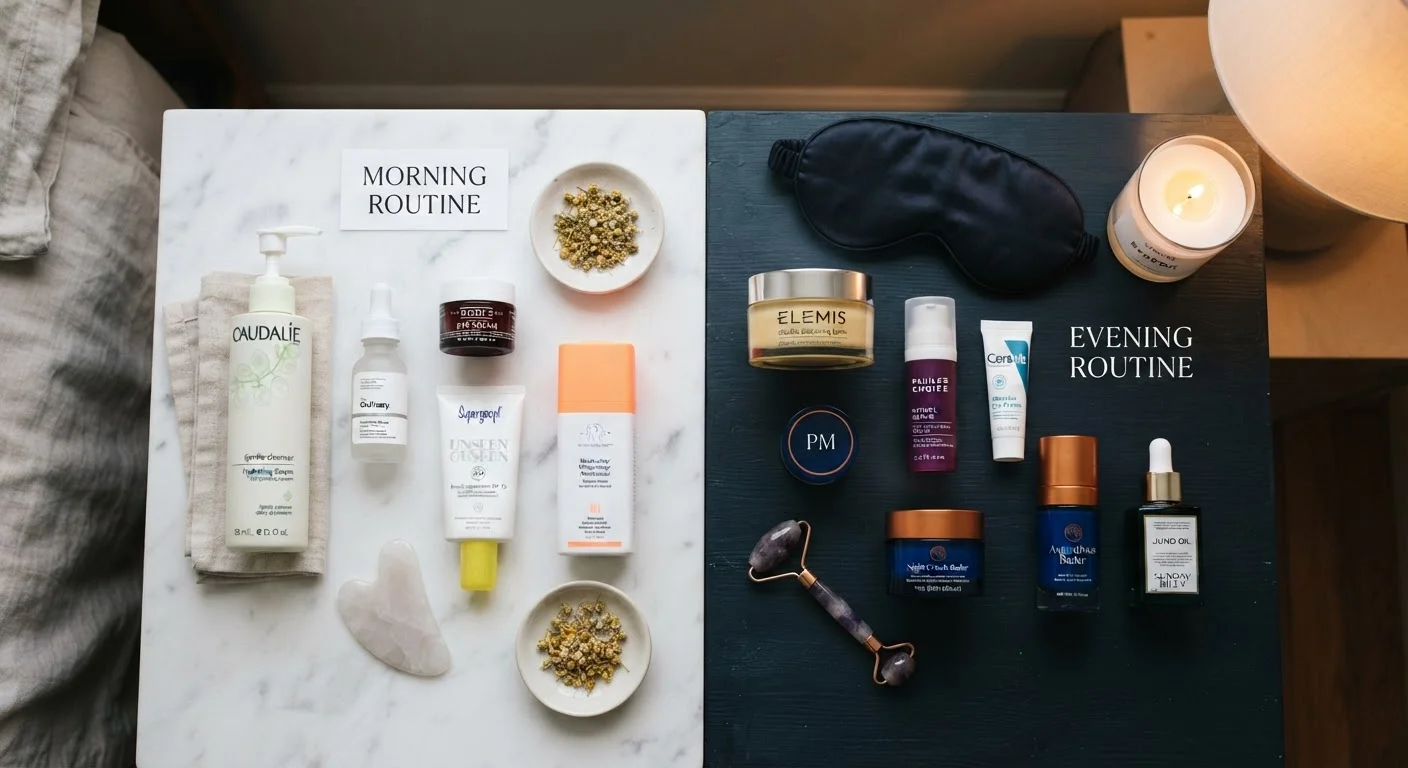
Key Takeaways
Option A
Morning Skincare Routine
The protective, prep-focused start to your day.
Best for: Anyone who wants to shield skin from UV exposure, pollution, and daily stressors before leaving the house.
Option B
Evening Skincare Routine
The restorative, repair-focused wind-down for your skin.
Best for: Anyone looking to repair, renew, and deeply nourish skin while they sleep, using active ingredients that don't play well with sunlight.
If you're brand new to skincare and building a first routine
Morning Skincare Routine
Start with a simple morning routine — cleanser, moisturizer, sunscreen — to build the habit before adding evening actives.
If you want to target fine lines, dullness, or uneven texture
Evening Skincare Routine
Nighttime is when potent actives like retinoids and exfoliating acids can work without UV interference or degradation.
If you have limited time and can only commit to one routine
Morning Skincare Routine
Sun protection is the single most impactful daily skincare habit — skipping morning SPF has real consequences for skin health.
If your skin feels dry, tight, or dull when you wake up
Evening Skincare Routine
A richer nighttime moisturizer or a facial oil can replenish the moisture your skin naturally loses overnight.
If you wear makeup daily and want it to sit better on skin
Morning Skincare Routine
Properly hydrated, protected skin creates a smoother canvas — making makeup application easier and longer-lasting.
Why AM and PM Routines Are Fundamentally Different
Skincare isn't one-size-fits-all across the clock. Your skin actually behaves differently depending on the time of day, and science backs this up. In the morning, your skin shifts into defense mode — it ramps up sebum production and prepares to face UV radiation, pollution, and environmental stressors. In the evening, it switches gears toward repair and regeneration, with cell turnover peaking overnight.
This biological rhythm is the reason a single routine used twice a day misses the mark. Morning products should protect and prep; evening products should treat and restore. Once you understand that core distinction, choosing what goes where becomes a lot more intuitive.
If you're just getting started, our beginner's guide to building a skincare routine walks you through the absolute essentials without overwhelming product lists.
| Criterion | Morning Routine | Evening Routine |
|---|---|---|
| Primary goal | Protect and prep skin | Repair and renew skin |
| Cleansing intensity | Light cleanse or water rinse | Thorough, including makeup/SPF removal |
| Key active ingredients | Vitamin C, antioxidants | Retinoids, AHAs, BHAs |
| Sunscreen | Essential — final step | Not used |
| Moisturizer weight | Lighter, fast-absorbing | Richer, more occlusive |
| Time investment | Typically 3–5 minutes | Typically 5–10 minutes |
| Skin state it addresses | Rested, starting fresh | Exposed to daily stressors, needs recovery |
The Morning Routine: Protect What You've Got
Think of your AM routine as suiting up for the day. The goal isn't aggressive treatment — it's creating a barrier between your skin and everything it's about to encounter.
- Gentle cleanser (or just water): Unless you have oily or acne-prone skin, a splash of water may be all you need in the morning. Your skin hasn't been exposed to much overnight.
- Antioxidant serum: Vitamin C is a popular morning choice because it helps neutralize free radicals from UV and pollution. It also pairs well with sunscreen for enhanced protection.
- Moisturizer: Keeps your skin barrier intact and provides a smooth base for anything you apply on top.
- Broad-spectrum SPF: This is non-negotiable. Dermatologists widely agree that daily sunscreen use is the most effective step for preventing premature skin aging and protecting skin health. Apply it as your final skin-care step, every single day.
Notice what's not on this list: retinoids, physical exfoliants, or strong acids. Those belong at night.
90%
Visible skin aging attributed to UV exposure
According to the Skin Cancer Foundation, approximately 90% of visible skin aging is caused by sun exposure — underscoring why daily SPF is so critical.
2x
Skin cell turnover rate at night vs. daytime
Research published in dermatology literature suggests skin cell renewal roughly doubles during sleep, supporting the case for nighttime actives.
1 in 5
Americans who develop skin cancer in their lifetime
The American Academy of Dermatology estimates 1 in 5 Americans will develop skin cancer, making consistent sunscreen use a key preventive habit.
The Evening Routine: Repair While You Rest
Nighttime is your skin's opportunity to absorb potent actives without sun exposure interfering or breaking them down. It's also when you're removing the day's accumulated grime, sunscreen, and makeup — so cleansing is especially important.
- Double cleanse if you wear SPF or makeup: An oil-based cleanser first, followed by a gentle water-based one, ensures you're starting with a truly clean surface.
- Exfoliating acids (2–3 times per week): Ingredients like AHAs (glycolic, lactic) or BHAs (salicylic) help slough off dead skin cells. These should only be used at night because they increase photosensitivity.
- Retinoids: Vitamin A derivatives are among the most research-supported ingredients for skin renewal, but they degrade in sunlight and can cause sensitivity. Nighttime use only — and always introduce them gradually.
- Richer moisturizer or facial oil: At night, you can go heavier. Ingredients like ceramides and peptides support the skin barrier while you sleep.
Getting the application order right matters just as much as choosing the right products. Our guide on layering skincare products in the correct order can help you avoid common sequencing mistakes.
Keep in mind your routine may also need to flex with the seasons — seasonal skincare adjustments are worth understanding as your environment changes.
A Note on Introducing New Actives
If you're adding a new ingredient — especially retinoids or exfoliating acids — introduce it slowly. Starting with once or twice a week and gradually increasing frequency gives your skin time to adjust and reduces the risk of irritation. If you experience persistent redness, peeling, or discomfort, scale back and consult a dermatologist.
Ingredients That Belong in One Routine Only
A few ingredients cause confusion because people aren't sure when to use them. Here's a quick guide:
- Retinoids — PM only
- Sunlight breaks down retinoids, reducing effectiveness. They also make skin temporarily more UV-sensitive.
- AHAs and BHAs — PM only
- Exfoliating acids increase photosensitivity. Using them at night and applying SPF the following morning is the safe approach.
- Vitamin C — AM preferred
- Works synergistically with sunscreen to boost antioxidant defense. Some formulas are stable enough for evening use, but morning is generally more beneficial.
- SPF — AM only
- Applying sunscreen at night serves no purpose and can feel unnecessarily heavy. Save it for morning.
- Hyaluronic acid and niacinamide — either time
- These gentle, broadly compatible ingredients can be used morning or evening without concern.
This article is for general informational and educational purposes only. For personalized skincare advice, especially if you have a skin condition, consult a qualified dermatologist.