
Capsule Wardrobe vs. Full Closet: Two Very Different Philosophies of Getting Dressed

Key Takeaways
Option A
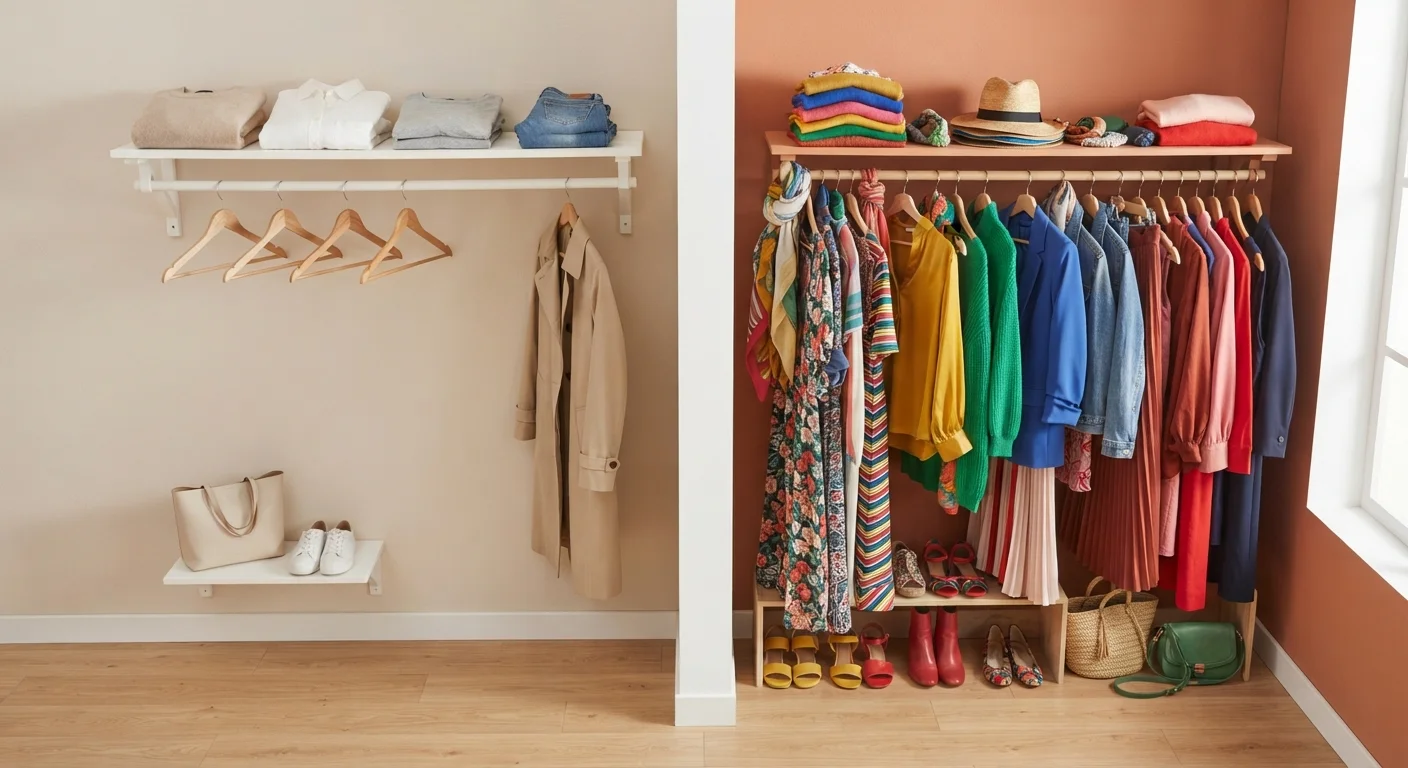
Capsule Wardrobe
The intentional, streamlined approach to dressing.
Best for: People who want a clutter-free closet, faster morning decisions, and a cohesive personal aesthetic.
Option B
Full Closet
The expressive, versatile approach to personal style.
Best for: People who enjoy variety, love experimenting with fashion, and dress for many different contexts.
If you want to simplify your morning routine and reduce decision fatigue
Capsule Wardrobe
A smaller, coordinated wardrobe means every item works with nearly everything else, making getting dressed faster and less stressful.
If you dress for a wide range of occasions — formal events, casual weekends, creative workplaces
Full Closet
Variety gives you the right outfit for every context without resorting to repetition or workarounds.
If you enjoy fashion as a form of creative self-expression
Full Closet
A fuller wardrobe lets you experiment with color, pattern, and silhouette as your mood and inspiration evolve.
If you have limited storage space or want a more sustainable approach to consumption
Capsule Wardrobe
Fewer, well-chosen pieces reduce clutter and can support more mindful purchasing habits over time.
If you're not sure which philosophy fits you yet
Full Closet
Starting with a wardrobe audit — keeping what you love and wear — often reveals your natural style instincts before committing to minimalism.
What Each Philosophy Actually Means
The term capsule wardrobe was popularized in the 1970s by British boutique owner Susie Faux, who described it as a small collection of essential, timeless pieces that could be mixed and matched across seasons. The modern interpretation typically involves somewhere between 25 and 50 items — though there's no universal rule — selected specifically because they coordinate well together and suit your actual daily life.
A full closet, by contrast, is less a philosophy than a reality for most people. It reflects the natural accumulation of clothes across moods, occasions, trends, and life stages. Rather than editing down to essentials, a full closet embraces range — seasonal pieces, statement items, clothes for work, play, and everything in between.
Neither label is a moral judgment. One isn't smarter or more stylish than the other. As our guide on dressing well on any budget points out, good style comes down to understanding fit, proportion, and color — not how many items hang in your closet.
| Criterion | Capsule Wardrobe | Full Closet |
|---|---|---|
| Number of items | Intentionally limited (25–50 typical) | Unrestricted, grows over time |
| Morning decision time | Faster — everything coordinates | Can be longer without good organization |
| Versatility across occasions | Limited; may require workarounds | High; purpose-specific pieces available |
| Creative self-expression | Constrained by design | Broad range for experimentation |
| Upkeep and organization | Easier to maintain | Requires active effort to stay functional |
| Flexibility as tastes evolve | Requires deliberate re-editing | Naturally accommodates style shifts |
| Storage space needed | Minimal | Significant — scales with volume |
The Real Trade-offs Worth Knowing
Capsule wardrobes shine when it comes to decision simplicity. When every item in your closet coordinates with several others, you spend less mental energy on getting dressed. That cognitive ease is genuinely valuable, especially on busy mornings or during high-stress periods.
But minimalism has real constraints. If your life spans multiple dress codes — a corporate office, weekend hiking, formal events, creative side projects — a tight capsule can start to feel limiting. You may end up wearing the same outfits to contexts where variety would serve you better. And if your style is still evolving, committing hard to a capsule too early can mean you end up with a curated closet that doesn't quite feel like you.
A full closet, meanwhile, gives you genuine expressive freedom. You can dress for your mood, play with trends, and shift aesthetics as your tastes change. The challenge is organization — without thoughtful structure, a large wardrobe can become chaotic, making it harder to see what you actually own. A wardrobe audit can help bring clarity to a closet that's grown beyond your ability to navigate it.
~80%
Clothes worn rarely or never
Wardrobe research commonly suggests most people regularly wear only about 20% of what they own, leaving the majority unused.
25–50
Typical capsule wardrobe size
Fashion editors and style consultants generally define a functional capsule wardrobe as falling within this item range, excluding accessories.
How you shop also matters. Whether you're drawn to capsule or full-closet thinking, the source of your clothes shapes the experience. Fast fashion and secondhand shopping each have real advantages and limitations worth understanding before building in either direction.
Finding Your Own Middle Ground
In practice, most people's wardrobes aren't purely capsule or fully maximalist — they're somewhere in between, and that's completely fine. You might keep a tight core of workwear essentials while maintaining a more expressive collection of weekend and social pieces. Or you might build a seasonal capsule each year while holding onto a handful of sentimental or statement items that don't fit the formula but genuinely bring you joy.
The most useful question isn't "capsule or full closet?" — it's "What do I actually need my wardrobe to do for me?" If it needs to simplify your mornings, lean toward curation. If it needs to support a wide social range and you love clothes as a creative outlet, give yourself permission to have more. Building a recognizable personal style doesn't require choosing one rigid system — it requires knowing what you value when you get dressed.
There's No One Right Number
Despite what some style guides suggest, there's no scientifically established ideal number of clothing items. Capsule wardrobe counts vary widely depending on climate, lifestyle, and profession. The goal is a closet that works for your real life — not one that hits an arbitrary target. Use any number as a starting point, not a rule.
Whatever direction you lean, shopping smart — evaluating each potential addition carefully before it enters your closet — applies equally to both approaches.