

Key Takeaways
Skin Undertone
Your skin undertone is the subtle, underlying hue that sits beneath your skin's surface color. Unlike your surface complexion — which can change with sun exposure, seasons, or blemishes — your undertone stays consistent throughout your life. Undertones are generally categorized as cool (pink, red, or bluish), warm (yellow, peachy, or golden), or neutral (a mix of both).
Undertone differs from skin tone (the actual lightness or darkness of your complexion). Two people can share the same skin tone but have completely different undertones, which is why shade-matching by tone alone often leads to mismatched foundation.
Why Undertone Is the Missing Piece in Shade Matching
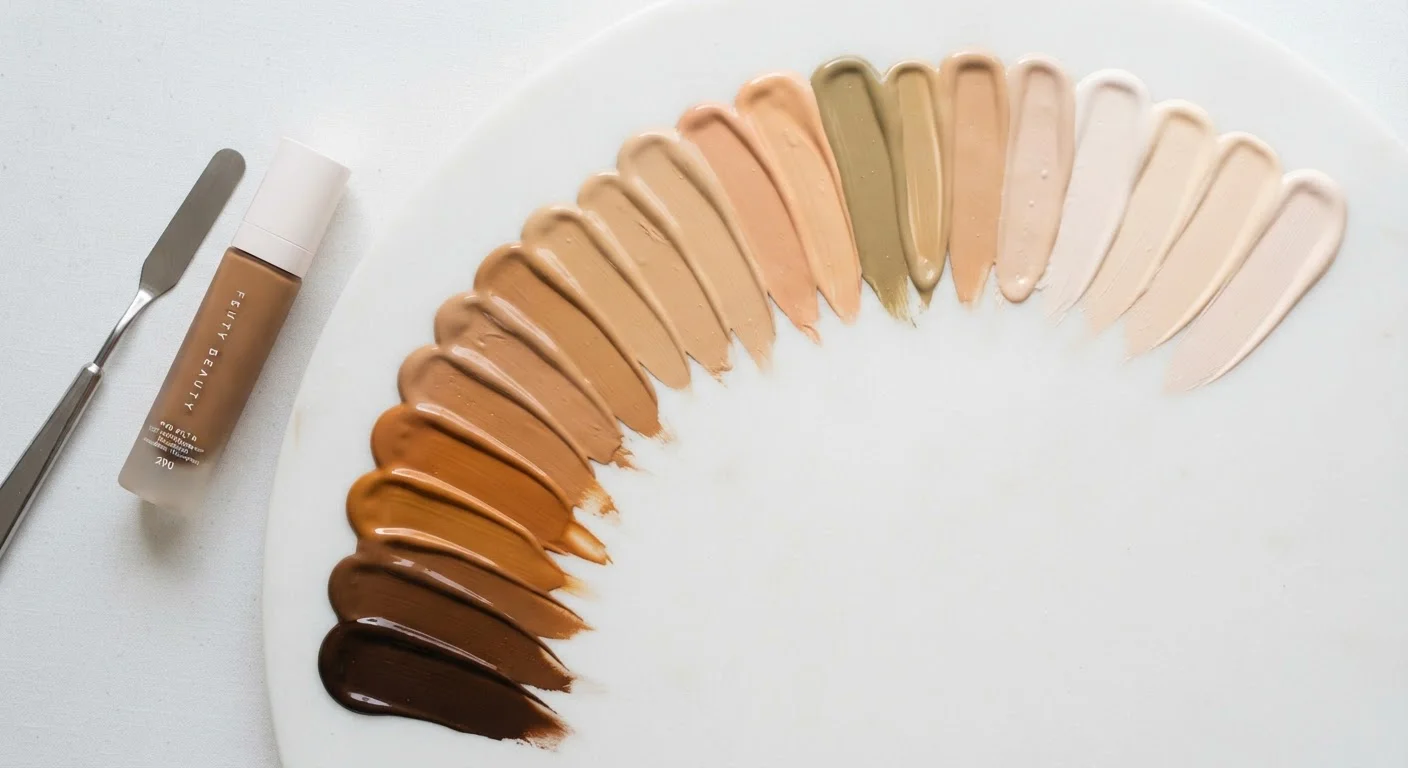
Ever tried on a foundation that looked perfect on your hand but turned an odd orange or gray on your face? The culprit is almost always undertone. Most shade-matching approaches focus on light-to-dark — finding something close to your surface complexion — but skip the undertone step entirely. That one omission is responsible for more makeup frustration than just about anything else.
Think of it this way: your skin's surface color is like the paint on a wall, but your undertone is the primer underneath. No matter how much you adjust the top coat, the primer's hue always shows through. Matching undertone is what makes a foundation look like skin rather than a mask.
Understanding this concept also opens up better decisions beyond foundation — from blush to bronzer to setting powder. Once you know your undertone, you can apply that knowledge across your entire makeup routine. For a closer look at how different blush formulas interact with skin, see how liquid, powder, and cream blush compare.
3
Primary undertone categories recognized in makeup
Cool, warm, and neutral are the standard categories used across the beauty industry to classify skin undertone for shade-matching purposes.
~60%
Foundation returns attributed to shade mismatch
Industry estimates suggest a significant majority of foundation returns and exchanges stem from undertone mismatches rather than incorrect depth or finish selection.
Cool, Warm, and Neutral: What Each Undertone Looks Like
Cool undertones have a pink, rosy, or bluish tint beneath the skin's surface. People with cool undertones often burn more easily in the sun, find that silver jewelry flatters them more than gold, and notice their veins appear blue or purple on the inner wrist.
Warm undertones carry a yellow, peachy, or golden hue. Warm-undertoned skin tends to tan rather than burn, looks more radiant in gold jewelry, and typically shows green veins at the wrist. Foundations with yellow or golden bases work best here.
Neutral undertones are a balanced blend of cool and warm. If your veins look like a mix of blue-green, both silver and gold jewelry seem equally flattering, and it's hard to pin down a single dominant hue, you're likely neutral. The good news: neutral undertones are the most forgiving when it comes to shade selection.
Simple At-Home Tests to Identify Your Undertone
You don't need a professional or a store visit to figure out your undertone. These quick checks work in natural daylight — avoid fluorescent or warm indoor lighting, which can distort color perception.
- The vein test: Look at the veins on your inner wrist. Blue or purple = cool; green = warm; a combination = neutral.
- The jewelry test: Hold silver and gold jewelry next to your bare face. Whichever metal makes your complexion look brighter and more even is a strong undertone clue.
- The white fabric test: Drape a bright white cloth near your face. If your skin looks pinker or rosier against the white, you're likely cool. If it looks more yellow or peachy, you're likely warm. If there's no strong shift, neutral is probable.
- The sun reaction test: Do you burn first, then tan — or go straight to a golden tan? Burning tendency often correlates with cooler undertones; easy tanning with warmer ones. (This is a general indicator, not a rule.)
Test in Natural Light Whenever Possible
Artificial store lighting — especially warm-toned bulbs — can make every foundation look more flattering and mask undertone conflicts. If you're testing a shade in-store, step outside or near a window before committing. Natural daylight gives you the most honest read of how a product's undertone interacts with yours.
Once you've gathered two or three consistent signals, you'll have a reliable read on your undertone category. If the signals conflict, you're probably neutral.
Applying Undertone Knowledge to Foundation and Concealer
Armed with your undertone, reading foundation labels becomes much more useful. Many foundations now specify their undertone in the shade description — words like "golden," "beige," "rose," "sand," or "porcelain" carry undertone information when you know what to look for.
For cool undertones, look for shades described as rosy, pink, or porcelain. Avoid anything labeled golden or honey, which will look muddy against cooler skin.
For warm undertones, seek out golden, tan, or peach descriptors. Foundations with pink or red bases tend to appear too saturated or red-toned.
For neutral undertones, most shades described as "beige" or "sand" work well — these are deliberately balanced formulas designed for in-between undertones.
For concealer, the same logic applies for general coverage. When you're color-correcting specifically — say, neutralizing the bluish-purple of undereye circles — a peach or salmon-toned corrector works against those cool hues before you apply your regular concealer shade. Understanding why opposite colors cancel each other out is rooted in color theory; this guide to color combinations explains the underlying logic in plain terms.
Keep in mind that your foundation shade (light to dark) may shift seasonally, but your undertone category stays fixed. Knowing the difference saves you from starting from scratch every time your skin changes. For a broader look at how and why skin itself shifts over time, this explainer on skin types is a helpful companion read.
This article is for informational and educational purposes only. It is not a substitute for personalized advice from a qualified beauty professional or dermatologist.