

Key Takeaways
Heat-Induced Hair Damage
Heat-induced hair damage refers to the structural changes that occur inside a hair strand when high temperatures from styling tools are applied. These changes can alter the hair's proteins, moisture levels, and outer protective layer. Over time, repeated heat exposure makes strands weaker, more brittle, and harder to manage.
Hair is primarily composed of keratin protein held together by hydrogen bonds, disulfide bonds, and salt linkages — all of which respond differently to sustained heat exposure above roughly 300°F (149°C).
The Structure of a Hair Strand — a Quick Tour
Before you can understand what heat does to hair, it helps to know what a strand is actually made of. Each hair has three layers: the medulla (the inner core, not always present), the cortex (the thick middle layer packed with keratin protein and pigment), and the cuticle (the outermost layer of overlapping, scale-like cells).
The cuticle acts like a protective shingle roof — when it lies flat, hair looks shiny and feels smooth. When it's lifted or cracked, moisture escapes, tangles form more easily, and the strand becomes more vulnerable to physical breakage. Heat styling directly disrupts this balance.
Understanding your hair's natural properties matters here too. If you're curious about why your hair absorbs products the way it does, our guide on hair porosity explains how the cuticle's openness affects everything from hydration to heat sensitivity.
What High Heat Actually Does Inside Each Strand
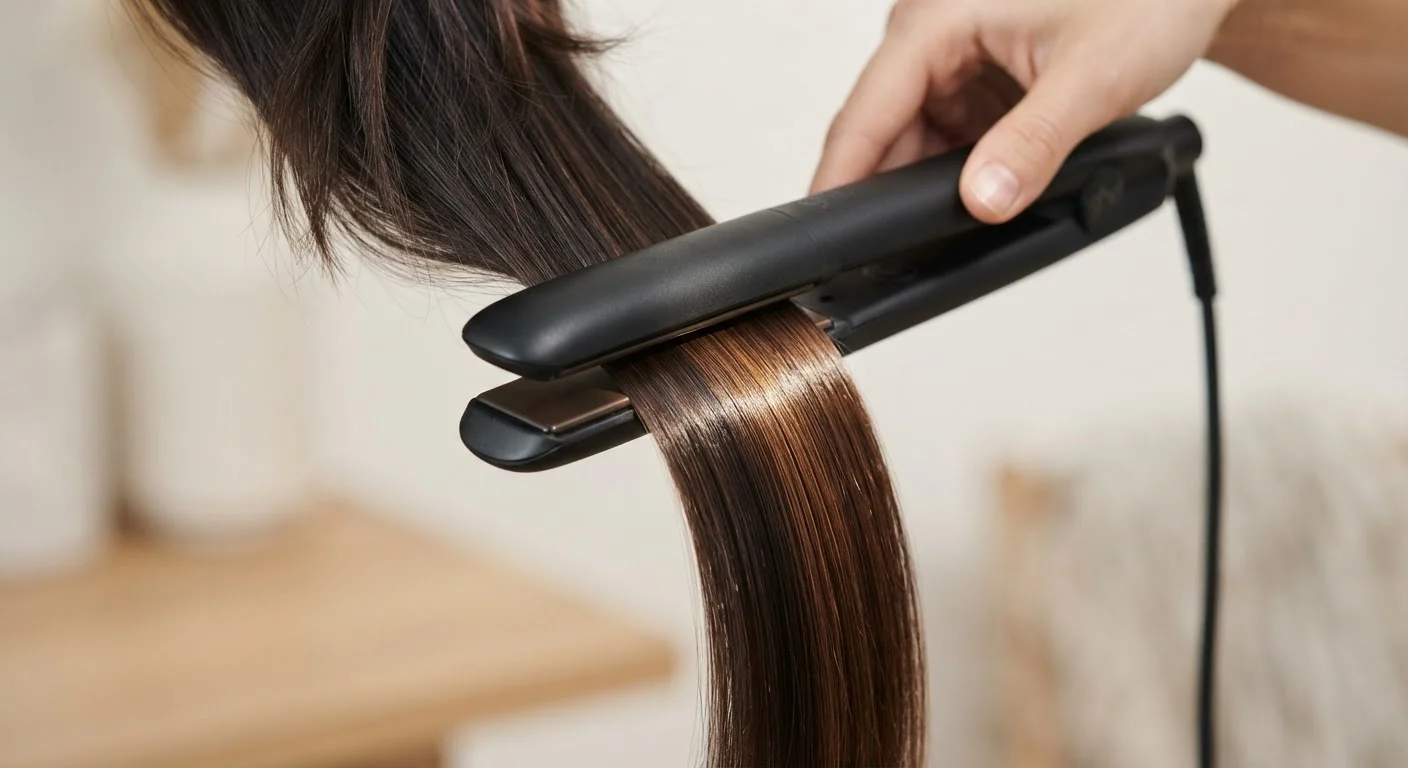
When a flat iron or curling wand makes contact with hair, it's not just smoothing or shaping the strand on the outside — it's triggering a chain of chemical and physical events throughout the entire structure.
Hydrogen bond disruption: These bonds within the cortex are what give hair its natural shape. Heat temporarily breaks them, which is how you're able to reshape a curl into a straight section or vice versa. This part is largely reversible with water or humidity — which is why a blow-dried style can revert in rain.
Protein degradation: Sustained or extremely high heat can go further, permanently breaking down keratin proteins in the cortex. This is the more serious, irreversible form of damage that leads to fragile, snapping strands.
Moisture loss: Heat rapidly drives water out of the hair shaft. Some moisture loss is temporary, but repeated dehydration sessions weaken the cuticle's ability to retain water over time.
~300°F
Temperature at which keratin protein begins to degrade
Studies on hair fiber thermal properties have identified this approximate threshold for cumulative protein damage in the cortex.
Up to 450°F
Maximum heat output of many consumer flat irons
Many widely available flat irons and curling wands are capable of reaching temperatures well above the protein degradation threshold.
15–30%
Estimated moisture loss during a single flat iron session
Research on thermal hair styling suggests significant water content can be driven from the shaft during a single styling session.
Cuticle lifting and cracking: The outer scales of the cuticle expand under heat and may not fully close afterward — especially with repeated high-heat exposure. This is what creates that rough, porous texture associated with damaged hair.
Why Some Hair Is More Vulnerable Than Others
Not all hair responds to heat the same way, and there are a few key reasons why.
- Porosity: High-porosity hair — where the cuticle is already more open — loses moisture faster under heat and can reach damaging temperatures more quickly.
- Texture and diameter: Fine strands have less protein mass to withstand heat stress compared to thicker strands, making them more susceptible at lower temperatures.
- Prior chemical processing: Hair that has been colored, bleached, or chemically relaxed already has compromised bonds, meaning it has less structural resilience before heat is even applied.
- Moisture levels at the time of styling: Applying heat to soaking-wet hair — especially with flat irons — can cause water inside the cortex to boil and create steam damage (sometimes called "bubble hair"), a particularly severe form of breakage.
Always Style Mostly-Dry Hair
Applying a flat iron or curling wand to hair that is still damp — not just towel-dried but actively wet — dramatically increases the risk of internal steam damage. Make sure hair is at least 90% dry before using any direct-contact heat tool. A cool-shot blow-dry to remove that last bit of moisture is a simple protective step.
Smarter Heat Habits That Make a Real Difference
Cutting out heat tools entirely isn't realistic for most people — and it doesn't have to be. What matters more is how and how often you use them.
Use the lowest effective temperature. Many people default to the highest setting out of habit, but fine or already-processed hair often styles perfectly at 300°F or below. Reserve higher temps for thicker, coarser textures that genuinely need them.
Apply heat protectant consistently. These products coat the cuticle before styling, distributing heat more evenly and reducing moisture evaporation. They work best applied to towel-dried or fully dry hair, depending on the product type.
Limit passes. Each additional pass of a flat iron over the same section compounds the damage. One or two well-placed passes are far less stressful on the strand than repeated clamping.
Incorporate recovery days. Spacing out heat sessions gives the cuticle time to reseal and the strand to rehydrate with conditioning. For a full picture of how to care for your hair between styling sessions, see our full-week hair maintenance guide.
This article is for general informational and educational purposes only. Individual hair types, conditions, and needs vary. Consult a licensed cosmetologist or trichologist for personalized hair care guidance.