

Key Takeaways
Option A
Fixed Expenses
The predictable, non-negotiable costs in your budget.
Best for: Anyone who wants to establish a stable baseline before allocating the rest of their income.
Option B
Variable Expenses
The flexible costs you can actively manage month to month.
Best for: Budget-conscious households looking for areas where they can cut back or reallocate spending.
If you want to know exactly how much income you need each month
Fixed Expenses
Add up your fixed costs first — rent, loan payments, insurance premiums — and you have an immediate picture of your non-negotiable financial floor.
If you want to find room to save or pay down debt faster
Variable Expenses
Variable costs like dining out, subscriptions, and entertainment are the most realistic places to trim without upending your whole lifestyle.
If you're new to budgeting and want a simple starting framework
Fixed Expenses
Mapping fixed expenses first gives your budget a stable foundation before you tackle the more unpredictable variable side of your spending.
If your income changes month to month
Variable Expenses
On lower-income months, variable costs are your primary lever — they can be scaled back in ways fixed obligations simply cannot.
What Makes an Expense 'Fixed'?
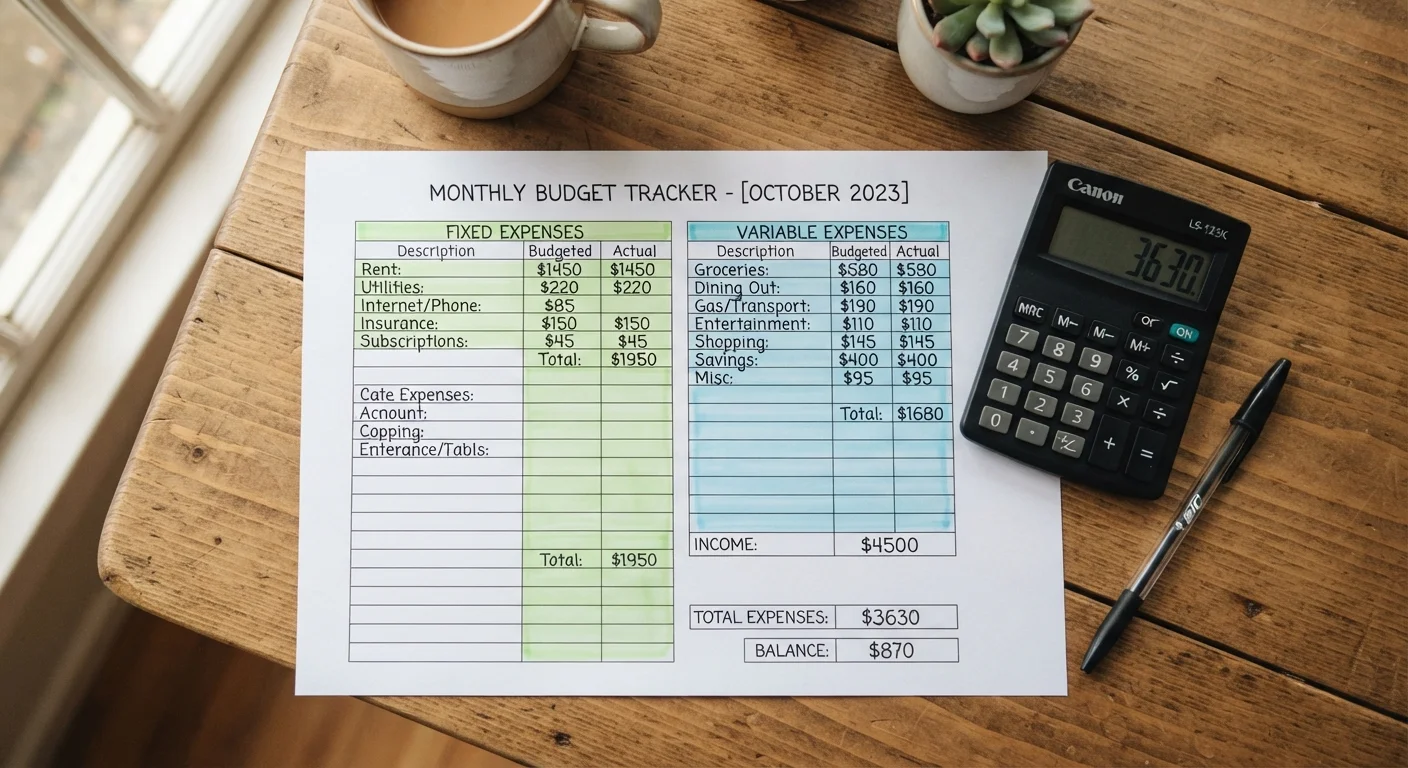
A fixed expense is one that stays the same amount every billing cycle, regardless of how you use a service or what's happening in your life. Think rent or mortgage payments, car loan installments, renter's or homeowner's insurance premiums, and minimum debt payments. These amounts are typically locked in by a contract or agreement.
Fixed expenses are the bedrock of any budget. Once you total them up, you know the minimum amount of income you must bring in just to stay current. That number is worth knowing — it removes guesswork from the bare-bones math of financial survival.
Because you generally can't change a fixed expense without renegotiating a contract or refinancing a loan, your control over this category is limited in the short run. The leverage happens earlier — when you sign a lease at a lower rent, choose a smaller car payment, or shop for a more competitive insurance rate. After that, the number is set.
See our step-by-step budgeting guide for a practical walkthrough of how to list and prioritize your fixed obligations from the start.
What Makes an Expense 'Variable'?
Variable expenses change from month to month based on your choices and circumstances. Groceries, gas, dining out, clothing, entertainment, and household supplies all fall into this category. So do some costs that feel fixed but actually shift — like a utility bill that rises in summer when the air conditioning runs constantly.
Variable costs are where most of your day-to-day spending decisions happen, which means they're also your greatest opportunity to influence your budget in real time. Cook more meals at home and your grocery and restaurant lines shift. Drive less and your gas spending drops.
That flexibility cuts both ways. Because these costs move around, they're also easier to underestimate. A $40 dinner out here, a streaming subscription there — variable spending can quietly exceed your expectations if you're not tracking it.
~33%
Average share of income spent on housing
The U.S. Bureau of Labor Statistics Consumer Expenditure Survey consistently finds housing — a largely fixed cost — consumes about one-third of average American household spending.
$300–$500
Estimated monthly food spending variation per household
Household grocery and dining budgets vary widely based on choices, according to USDA food-plan cost estimates, illustrating how variable this category truly is.
If your income varies month to month — say, you freelance or work seasonally — variable expenses become your primary adjustment dial when cash is tight. For more on navigating that challenge, see budgeting strategies for irregular income.
Head-to-Head: Fixed vs. Variable at a Glance
The table below summarizes the key differences so you can quickly apply these concepts to your own spending plan.
| Criterion | Fixed Expenses | Variable Expenses |
|---|---|---|
| Amount each month | Stays the same | Changes month to month |
| Examples | Rent, car loan, insurance | Groceries, gas, dining out |
| Level of control | Limited short-term control | High day-to-day control |
| Budgeting approach | Use exact contract amount | Estimate based on past months |
| Where leverage lives | At contract signing or refinancing | In daily and weekly choices |
| Risk of overspending | Low — amount is predetermined | Higher — easy to underestimate |
One category that often confuses people is periodic expenses — costs that are fixed in amount but don't occur every month. Car registration, annual subscriptions, and quarterly insurance premiums are examples. A simple approach: divide the annual total by 12 and set that amount aside each month so the bill doesn't blindside you.
How to Use This Distinction to Budget Better
The practical power of separating fixed from variable expenses is that it tells you where you actually have choices. Here's a straightforward approach most budgeters find useful:
- List every fixed expense first. Total them up. That's your floor — the income you need before anything else.
- Subtract your fixed total from your monthly take-home pay. What remains is your discretionary pool — the money available for variable spending, savings, and extras.
- Categorize and track your variable expenses for at least one full month. Many people are surprised by how much small, frequent purchases add up.
- Identify trim targets. You can't easily cut your rent this month, but you can decide to spend less on takeout or pause a subscription service.
This framework aligns naturally with the smart spending principles that guide many effective household money plans. If you're drawn to a more structured approach, the pros and cons of zero-based budgeting are worth understanding before you commit.
When a 'Fixed' Bill Isn't Truly Fixed
Utilities like electricity, gas, and water are often called semi-variable expenses. The service itself is ongoing, but the bill changes with usage and seasons. To budget for these, look at 12 months of past bills and use the monthly average. Some utility providers also offer budget billing programs that smooth costs into equal monthly payments — worth asking about if predictability matters to your household.
This article is for general informational and educational purposes only and does not constitute personalized financial advice. Consider consulting a qualified financial professional for guidance tailored to your specific situation.