

Key Takeaways
Option A
Engineered Hardwood
The moisture-tolerant, versatile modern option.
Best for: Homeowners installing flooring below grade, over concrete, or in rooms with moderate humidity fluctuations.
Option B
Solid Hardwood
The time-tested, refinishable classic.
Best for: Above-grade installations in dry, climate-controlled spaces where longevity and repeated refinishing matter most.
If you're finishing a basement or installing over a concrete slab
Engineered Hardwood
Its cross-layered plywood core resists the moisture vapor that concrete subfloors emit, reducing the risk of warping or cupping.
If you want a floor you can refinish repeatedly over 50–80 years
Solid Hardwood
A solid plank is typically ¾ inch thick, offering multiple sanding cycles compared to the thinner wear layer on most engineered products.
If you live in a region with dramatic seasonal humidity swings
Engineered Hardwood
Engineered construction minimizes expansion and contraction, reducing the risk of gapping or buckling common in solid wood under unstable conditions.
If you're renovating a historic home and want to match original flooring character
Solid Hardwood
Solid hardwood can be custom-milled to match original plank widths and species, and its authentic structure blends seamlessly with existing material.
If you're working with a tighter installation budget
Engineered Hardwood
Engineered planks are often less expensive per square foot than comparable solid hardwood species and may allow DIY floating installation, reducing labor costs.
What's Actually Inside Each Plank
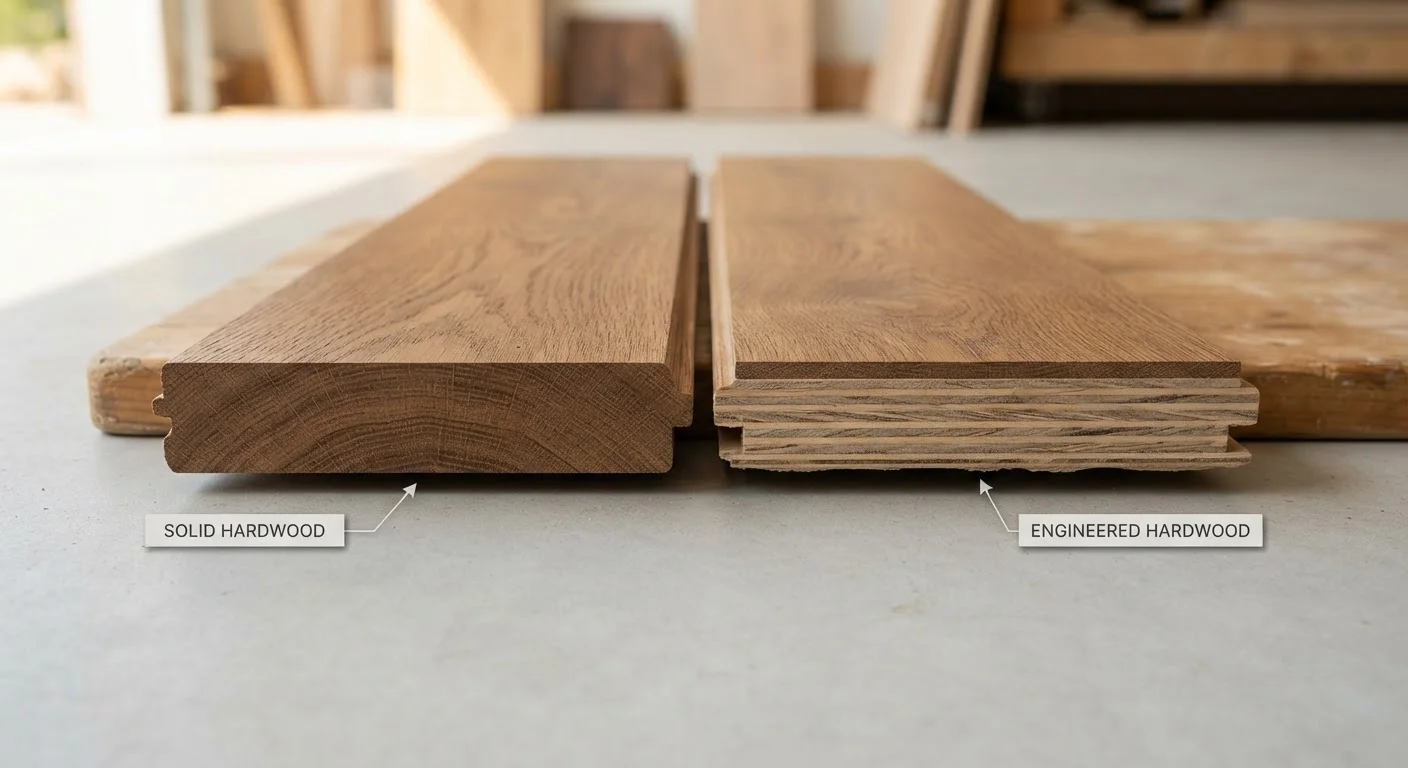
The difference between engineered and solid hardwood starts well beneath the surface you walk on. Solid hardwood is exactly what the name suggests: a single piece of milled lumber, typically ¾ inch thick, cut from one species of tree. Its uniform structure is what makes it sandable and refinishable over decades.
Engineered hardwood, by contrast, is a layered composite. A real hardwood veneer — usually between 1/16 and 1/8 of an inch thick — sits atop multiple plies of high-density plywood or fiberboard stacked in alternating grain directions. This cross-ply construction is intentional: opposing grain directions cancel out the natural tendency of wood to expand and contract along a single axis.
Neither construction is inferior — they're engineered (literally, in one case) for different performance demands. Understanding what's inside helps you predict how each floor will behave when conditions change.
| Criterion | Engineered Hardwood | Solid Hardwood |
|---|---|---|
| Core construction | Hardwood veneer over plywood plies | Single solid wood plank |
| Typical thickness | 3/8" – 9/16" | 3/4" (standard) |
| Moisture resistance | Good — dimensionally stable | Poor — swells and contracts |
| Suitable subfloors | Concrete or wood | Wood only (typically) |
| Installation methods | Float, glue, or nail | Nail or staple |
| Refinishing cycles | 0–2 (veneer-dependent) | 4–6 over lifespan |
| Grade-level suitability | Above, on, or below grade | Above grade only |
| DIY-friendliness | High (floating systems) | Moderate (requires nailer) |
Moisture, Subfloors, and Where Each Type Can Go
Moisture is the single most consequential factor when choosing between these two flooring types. Solid hardwood is highly sensitive to humidity and moisture vapor. It should only be installed above grade — meaning on ground-level or upper-floor rooms built over a wood subfloor — where moisture levels remain relatively stable. Installing it directly over concrete is not recommended by most flooring professionals because concrete naturally emits moisture vapor that solid wood absorbs unevenly, leading to warping or cupping.
Engineered hardwood, because of its plywood core, is far more dimensionally stable. It can be installed on, above, or slightly below grade, and over concrete subfloors using a moisture-barrier underlayment. This makes it the practical choice for slab-on-grade homes, renovated basements (where building codes and moisture levels permit habitable flooring), and regions with high ambient humidity.
~25%
Typical moisture expansion in solid hardwood
The USDA Forest Products Laboratory notes that wood can change in width by roughly 1% for every 4% change in moisture content, making moisture control critical for solid installations.
3mm+
Wear layer thickness needed for full refinishing
Flooring industry guidance generally holds that an engineered hardwood wear layer of at least 3mm is required to safely withstand a full sanding and refinishing process.
50–100 years
Potential lifespan of solid hardwood with refinishing
Solid hardwood floors in well-maintained homes are commonly cited by flooring professionals as capable of lasting 50 to 100 years with periodic refinishing.
Installation methods also differ. Solid hardwood is typically nail- or staple-fastened through the tongue into a wood subfloor. Engineered hardwood offers more options: glue-down, nail-down, or a floating click-lock system that rests on underlayment without fasteners. The floating method in particular appeals to confident DIYers because it requires fewer specialized tools.
Refinishing Potential and Long-Term Value
If you're thinking in decades rather than years, refinishing capacity matters. A ¾-inch solid hardwood plank can typically withstand four to six full sanding and refinishing cycles over its life, depending on how aggressively each refinish removes material. That means a well-maintained solid floor installed today could look freshly refinished well into the next generation of ownership.
Engineered hardwood's refinishing potential is directly tied to the thickness of its hardwood veneer layer. Thinner veneer products — 1/16 inch or less — can usually tolerate one light screen-and-coat but cannot withstand full sanding. Higher-quality engineered planks with a 3mm or thicker wear layer may support one or two full refinishes. Always verify the wear layer thickness before purchasing if refinishing is a priority for you.
This distinction matters when considering long-term value. Much like weighing new vs. refurbished products, the upfront cost tells only part of the story — durability and what you can do to extend the product's life over time shapes its true value.
Making the Right Call for Your Home
Before committing, walk through these practical checkpoints:
- Identify your subfloor: Concrete slab points to engineered; wood subfloor supports either option.
- Determine the grade level: Below-grade spaces should use engineered; above-grade can support solid hardwood where moisture is controlled.
- Assess your local climate: Humid coastal or Southern climates often perform better with engineered; dryer inland climates are more forgiving of solid hardwood.
- Check the wear layer: If refinishing matters to you, confirm the veneer or wear layer thickness in writing before purchase.
- Consider installation complexity: A floating engineered floor is within reach for an experienced DIYer; nail-down solid hardwood typically requires a flooring nailer and some experience to do well.
For any installation that involves significant subfloor leveling, moisture remediation, or structural concerns, consult a licensed flooring contractor. Getting a professional assessment of your subfloor's moisture content — using a moisture meter — before installation can save substantial cost in repairs later.