

Key Takeaways
Why Skincare Myths Are So Hard to Shake
Skincare advice travels fast — passed along in comment sections, shared in group chats, repeated by well-meaning friends. The problem is that many of the most widely circulated tips aren't backed by evidence, and some can quietly work against your skin over time.
The good news? Once you separate fact from fiction, building a routine that actually works becomes a lot simpler. You don't need a 12-step regimen or a cabinet full of luxury serums. You need accurate information and a few reliable habits. If you've been misled by popular money-saving logic, too, you're not alone — the same pattern of confident-sounding misinformation shows up everywhere, including your wallet. See how shopping myths quietly cost people money for a parallel reality check.
Below, we tackle the skincare myths that just won't quit — and explain what the evidence actually shows.
Myth
Steam opens your pores so you can clean them more deeply.
Fact
Pores don't have muscles and cannot open or close — steam may soften debris but does not change pore size.
Pores are fixed openings in the skin — they don't respond to temperature like a door swinging open. What steam can do is temporarily soften the material trapped inside a pore, making manual extraction slightly easier. But the idea that pores dilate with heat and shrink with cold water is a persistent anatomical myth. Pore appearance can be influenced by factors like excess sebum, collagen loss, and genetics — not temperature.
Myth
Expensive skincare products work better than affordable ones.
Fact
Efficacy depends on the active ingredients and their concentrations, not the price tag or the packaging.
A moisturizer that costs $8 can contain the same concentration of a proven humectant like hyaluronic acid as one that costs $120. Price often reflects branding, fragrance, packaging, and marketing — not ingredient quality or clinical performance. Dermatologists frequently point out that some of the most well-studied skincare ingredients, such as retinoids, niacinamide, and ceramides, are widely available at accessible price points. Focus on what's actually in the formula rather than what's on the label.
Myth
Natural and organic ingredients are always safer and gentler than synthetic ones.
Fact
"Natural" is not a regulated term in cosmetics, and many plant-based ingredients can cause irritation or allergic reactions.
Poison ivy is natural. So is lemon juice, which can cause chemical burns and photosensitivity when applied to skin. The origin of an ingredient — plant or lab — says nothing definitive about its safety profile. Many synthetic ingredients are precisely manufactured to minimize irritants found in their natural source material. Meanwhile, essential oils, botanicals, and citrus extracts are among the more common causes of contact dermatitis. Evaluate ingredients on their tested safety records, not their origin story.
Myth
If your skin is oily, you should skip moisturizer.
Fact
Oily skin still needs hydration — skipping moisturizer can actually trigger more oil production as skin compensates for dryness.
Oiliness and hydration are not the same thing. Sebum (the oil your skin produces) and water content are separate variables. When oily skin is stripped of moisture — through harsh cleansers or skipping moisturizer — the skin may respond by ramping up sebum production, potentially worsening the problem. Lightweight, non-comedogenic moisturizers (meaning formulated not to clog pores) are generally well-tolerated by oily skin types and help maintain a healthy skin barrier.
Myth
Drinking lots of water will give you glowing, hydrated skin.
Fact
General hydration supports overall health, but drinking water alone doesn't reliably resolve skin dryness or dullness.
There's a meaningful difference between your body's systemic hydration and your skin's moisture levels. Skin dryness is primarily influenced by barrier function, environmental humidity, and topical care — not simply how much water you drink. Unless you're significantly dehydrated, increasing water intake beyond normal daily needs is unlikely to produce a noticeable change in skin texture or glow. Topical moisturizers, humectants, and a healthy skin barrier are far more directly relevant to how your skin looks and feels.
Myth
You only need sunscreen on sunny days or during summer.
Fact
UV radiation is present year-round and can penetrate clouds and glass, making daily SPF use important regardless of season or weather.
UVA rays — which contribute to premature aging and skin damage — maintain a relatively consistent intensity throughout the year and can pass through clouds and window glass. UVB rays, which cause sunburn, vary more by season and latitude, but are still present in meaningful amounts even on overcast winter days. Dermatology organizations broadly recommend daily broad-spectrum SPF as a foundational skincare habit, not just a summer one. This is one of the most consistently supported recommendations in skin health research.
Building a Routine Around Facts, Not Folklore
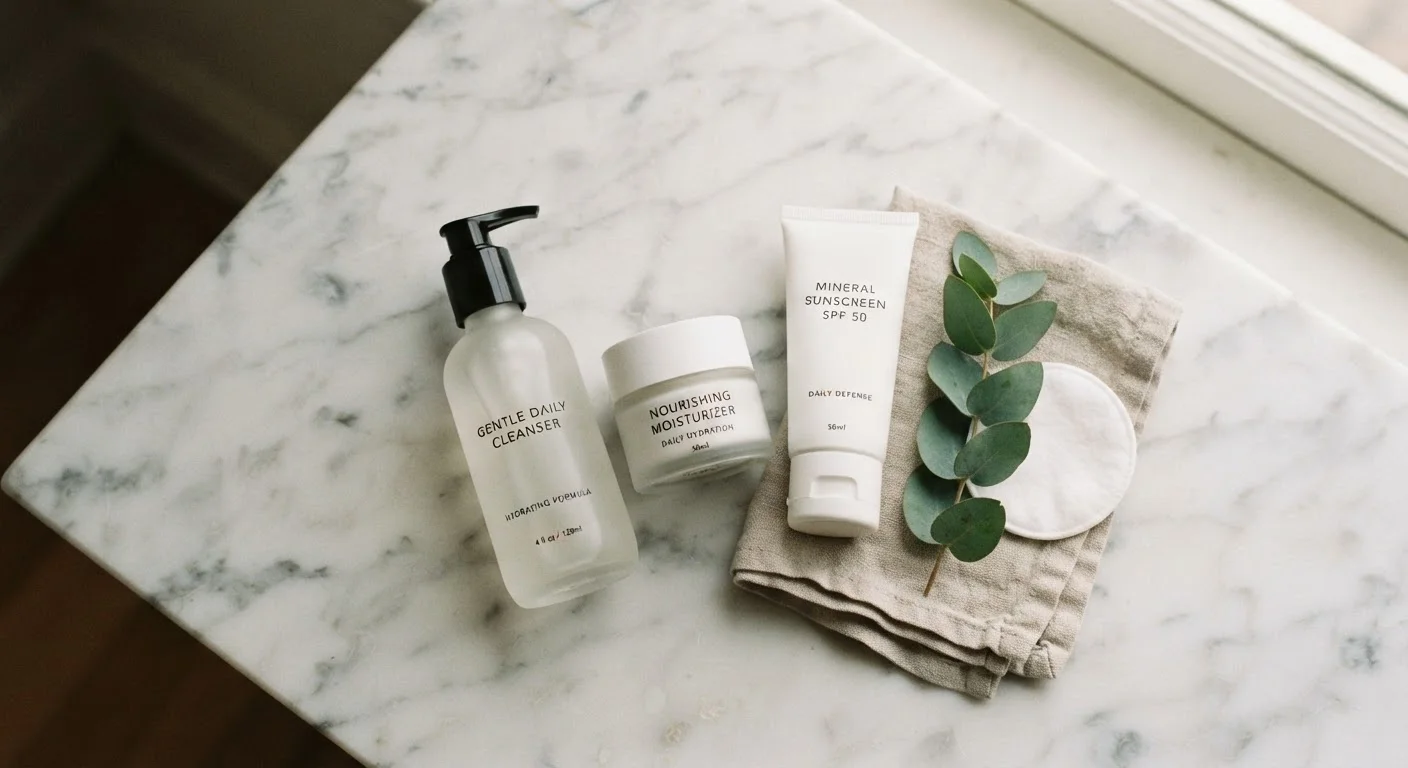
Once you've cleared out the noise, a solid skincare routine really does come down to a handful of fundamentals: a gentle cleanser that doesn't strip your barrier, a moisturizer that suits your skin type, and a broad-spectrum SPF applied every single morning. That last step matters more than almost anything else. Daily SPF use is one of the most evidence-backed habits in skincare, and it applies in winter, on cloudy days, and when you're mostly indoors near windows.
Equally important is knowing what to avoid. Over-washing, for instance, is one of the fastest ways to undermine everything else you're doing. Over-cleansing disrupts your skin barrier and can trigger a frustrating cycle of dryness, irritation, or even increased oil production.
90%
Visible skin aging attributed to UV exposure
Researchers have estimated that approximately 90% of visible skin aging — including wrinkles, dark spots, and loss of elasticity — is related to cumulative sun exposure over time.
~10%
Consumers who read ingredient lists before buying
Surveys on consumer beauty behavior consistently find that only a small minority of shoppers regularly review ingredient lists, with most relying on packaging claims and price as quality signals.
Top 3
Cause of contact dermatitis: fragrance & botanicals
Fragrance — including naturally derived essential oils — is among the leading causes of allergic contact dermatitis in skincare users, according to dermatological patch-testing data.
Similarly, if you wear mascara, common habits like pumping the wand or sleeping with it on may be causing more damage than you realize — mascara myths are worth addressing alongside your skincare routine.
The takeaway is simple: trust the basics, question the hype, and when in doubt, consult a licensed dermatologist for guidance tailored to your skin. Skincare is genuinely not one-size-fits-all, and a professional can help you cut through the noise far more effectively than any trending video.
This article is for general informational purposes only and is not a substitute for professional medical or dermatological advice. Consult a qualified healthcare provider for concerns about your skin.